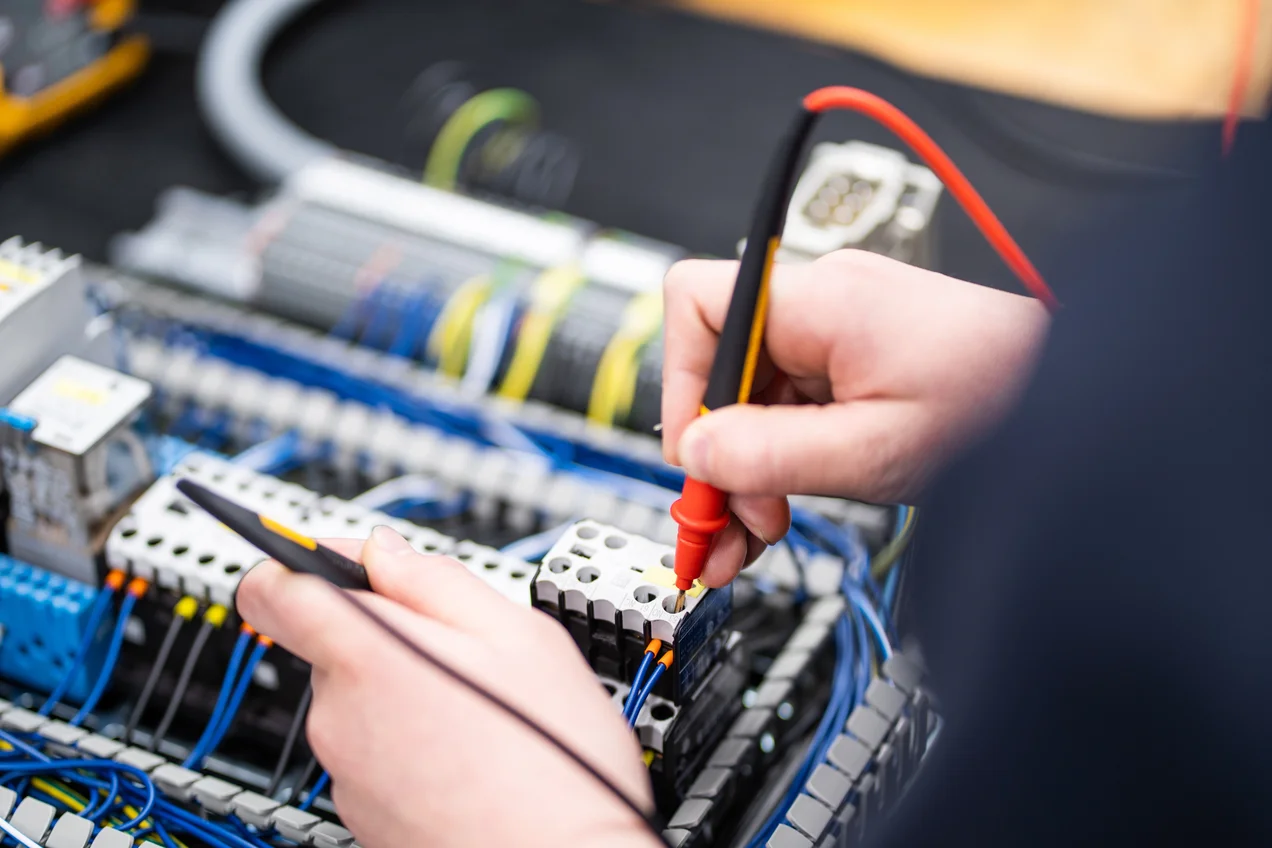

Intelligente und vernetzte Systeme prägen unseren Alltag und treiben den technologischen Fortschritt voran. Im Elektrotechnik und Informationstechnik Bachelor-Studium gestaltest Du diese Entwicklungen aktiv mit und arbeitest an innovativen Lösungen für die Technologien von morgen. Ob Smartphone, Smart Home, Smart Factory, erneuerbare Energien, 5G- und 6G-Mobilfunk, Elektromobilität oder autonomes Fahren – im Studium beschäftigst Du Dich mit zukunftsweisenden Anwendungen und lernst, technische Systeme nachhaltig, wirtschaftlich und nutzerorientiert weiterzuentwickeln. Durch die hohe Praxisnähe des Studiengangs mit Praxisprojekten und Praktika bei führenden Industrieunternehmen sammelst Du bereits während des Elektrotechnik und Informationstechnik-Studiums wertvolle Erfahrungen. Gleichzeitig erwirbst Du fundierte Kenntnisse für vielfältige Tätigkeitsfelder – von Automatisierung und IT bis hin zu Zukunftstechnologien.

Im Electrical Engineering and Information Technology Bachelor gestaltest Du innovative Technologien und arbeitest an zukunftsweisenden Lösungen für eine vernetzte Welt.
Das Electrical Engineering and Information Technology Studium dauert sieben Semester und umfasst zwei Semester Grundstudium (Grundlagen in Mathematik, Naturwissenschaften und Elektrotechnik), vier Semester mit Pflichtmodulen und wählbaren Spezialisierungsmodulen sowie ein Praxissemester in der Industrie. Praxisorientierte Labore mit modernster Mess- und Laborausstattung sind fester Bestandteil aller Studienphasen. Das Grundstudium, die Pflichtmodule und ein festgelegter Kanon an Spezialisierungsmodulen aus dem Bereich der Fahrzeugtechnik ergänzen das Pflichtfach Deutsch, um die Integration zu erleichtern, beispielsweise im Praxissemester in einem deutschen Unternehmen. Die Praxisorientierung ist ein Schlüsselelement in allen unseren Studiengängen. Wir sind davon überzeugt, dass praxisorientierter Unterricht mit einem starken Laboranteil ausländischen Studierenden einen hohen Mehrwert bieten kann. Ab dem ersten Semester studierst Du mit modernster Mess- und Gerätetechnik. Du lernst in kleinen Projektgruppen und hast die Möglichkeit zur Teilnahme an einem Stipendienprogramm in Zusammenarbeit mit einer Reihe renommierter Partnerunternehmen.
Für das Bachelor-Studium Electrical Engineering and Information Technology an der Technischen Hochschule Ulm benötigst Du eine Hochschulzugangsberechtigung. Dazu zählen zum Beispiel die Allgemeine Hochschulreife, die Fachhochschulreife oder eine fachgebundene Hochschulreife. Zudem ist Interesse an Mathematik, Naturwissenschaften und technischen Fragestellungen eine Voraussetzung. Besonders wichtig sind analytisches Denken, logisches Verständnis und die Motivation, technische Herausforderungen zu lösen. Da der Studiengang in englischer Sprache angeboten wird, musst Du ausreichende Englischkenntnisse nachweisen. Ein Vorpraktikum ist für den Studiengang nicht erforderlich.
Bei ausländischer Hochschulzugangsberechtigung benötigst Du die Anerkennung Deines Zeugnisses durch das Studienkolleg Konstanz. Wichtig ist auch ein Nachweis der Englischkenntnisse:
Zudem ist ein ausgefülltes Formular zu Deinen Deutschkenntnissen, ein Motivationsschreiben (Deine Motivation, Electrical Engineering and Information Technology an der THU zu studieren), Dein Lebenslauf und die Kopie des Reisepasses notwendig.
Auf der Seite Bewerbung für international Studierende findest Du weitere Informationen.
Mit dem Electrical Engineering and Information Technology Bachelor eröffnest Du Dir vielfältige Karrierechancen in technischen und internationalen Arbeitsfeldern in kleinen, mittleren und großen Unternhemen. Absolvent*innen arbeiten beispielsweise in der Elektronikentwicklung, der Automatisierungs- und Kommunikationstechnik, dem Vertrieb, der Softwareentwicklung oder im Bereich Energie- und Informationstechnologie. Besonders gefragt sind Fachkräfte in der Elektroindustrie, im Maschinenbau, in der Automobilbranche, Vertriebsunternehmen, Beratungsfirmen, Planungsbüros sowie in IT- und Technologieunternehmen. Nach dem Bachelorabschluss kannst Du direkt ins Berufsleben einsteigen oder ein weiterführendes Masterstudium anschließen. Nach dem Abschluss erhältst Du den akademischen Grad Bachelor of Engineering (B. Eng.). Von der Erzeugung und Verteilung elektrischer Energie über umfassende technische Unterstützung in Medizin, Haushalt und Verwaltung bis hin zu stets verfügbaren, globalen Kommunikationsverbindungen entwickelst Du als Ingenieur*in für Electrical Engineering and Information Technology die notwendigen Systeme und Komponenten für die technische Infrastruktur der modernen Gesellschaft und leistest damit einen wesentlichen Beitrag zur Gestaltung des digitalen Wandels und der Energiewende.
Bei Fragen zu Bewerbung und Zulassung:
Bei allgemeinen Fragen rund ums Studium:
Bei fachspezifischen Fragen zum Studiengang:
Yes, except for the classes to learn German.
Applicants do not need any German language skills.
This is only necessary for the organization of the German language courses that are part of the study program. So that we know how many students we will have in which German language course.
The program takes place for 7 semesters, including 1 semester internship in industry. You can write your Bachelor's thesis in cooperation with a company, if you want to.
Especially in the first two semesters we offer for the “critical” modules additional tutorials for extended exercise and questions.
Courses studied at universities abroad can be accredited within the EET program. You need to contact the dean of the program after you enrolled, to check if you can receive credit for your former course achievements. Recognition at THU is competence-based and German language can get recognized, too. However, you cannot start your studies in a higher semester at the moment, as the new degree program is currently building up these semesters.
For studying EET at Ulm University of Applied Sciences, no previous knowledge is mandatory. The program starts at the level you have after you achieve a university entrance qualification in Germany. That is why you need to get a validation of your educational credentials by the Studienkolleg Konstanz.
You can use a scholarship during this program but it must be found independently of the place of study, offers under www.funding-guide.de. We also have a scholarship program with renowned partner companies during the main study program.
Yes, as a German student you can study the English-language EET degree program. The credits for the German courses can also be recognized.
You will have excellent career prospects. Our graduates are highly sought after and are very well paid, which you will discover if you search the Internet for starting salaries for electrical engineers in Germany.
We accept:
This is not possible since we do not have a contract with Uni-assist. You would need to apply for recognition at Studienkolleg Konstanz. It is free of charge.
Yes, you would need to get it validated.
You can submit your application until July 15th. Then the application process ends. However, the coordinated succession procedure will start from approximately end of August. During this phase, applicants have the opportunity to apply for places that are still available. If you are unable to upload your school certificate by July 15th, you should submit all other documents in time and submit the certificate as part of the coordinated succession procedure.
We do have a numerus clausus. It can differ every year, depending on the grades of our applicants. But the most important thing is, that you apply and hand in your complete documents in time. Doing that, your chances are good.
You will get your letter of admission as soon as possible after we processed the applications. This will be shortly after end of application, latest by end of July.
As soon as the start date of the pre-course is fixed, it will be announced on the THU website of the EET program. Usually, the pre-course starts two weeks before the beginning of the first semester.
No, you do not have to. You can just come to the meeting point at the first day, which you will find out about on the THU website of the EET program under the topic “Information about the preliminary course”. You can also start later if you cannot make it in the first few days.
Yes, it is possible to conclude a German health insurance while being abroad. All students in Germany must have health insurance from a private or a public health insurance and you must already have health insurance with a European Health Insurance Card before you enroll. Students from outside the EU can, for example, use compulsory health insurance with one of the public health insurances.
No, a travel insurance is not sufficient for this purpose. All students in Germany must have health insurance from a private or a public insurance company.
No, you can only register once you have received your access data. Course registration at THU takes place via the SELMA portal. Registration for the courses will be explained to you in the pre-course, which will be shortly after your arrival in Ulm. Enrollment in SELMA is also explained in the introductory event for first-semester students in the first week of lectures. After this explanation, students will be contacted via the course mailing list.