
Smart and connected systems shape our everyday lives and drive technological progress. On the Bachelor’s degree programme in Electrical Engineering and Information Technology, you will play an active role in shaping these developments and work on innovative solutions for the technologies of tomorrow. Whether it’s smartphones, smart homes, smart factories, renewable energy, 5G and 6G mobile networks, electric mobility or autonomous driving – during your degree, you’ll explore forward-looking applications and learn how to develop technical systems in a sustainable, cost-effective and user-centred way. Thanks to the programme’s strong practical focus, which includes practical projects and work placements at leading industrial companies, you will gain valuable experience whilst studying Electrical Engineering and Information Technology. At the same time, you will acquire in-depth knowledge applicable to a wide range of fields – from automation and IT to future technologies.

In the Electrical Engineering and Information Technology Bachelor's degree program, you will design innovative technologies and work on pioneering solutions for a networked world.
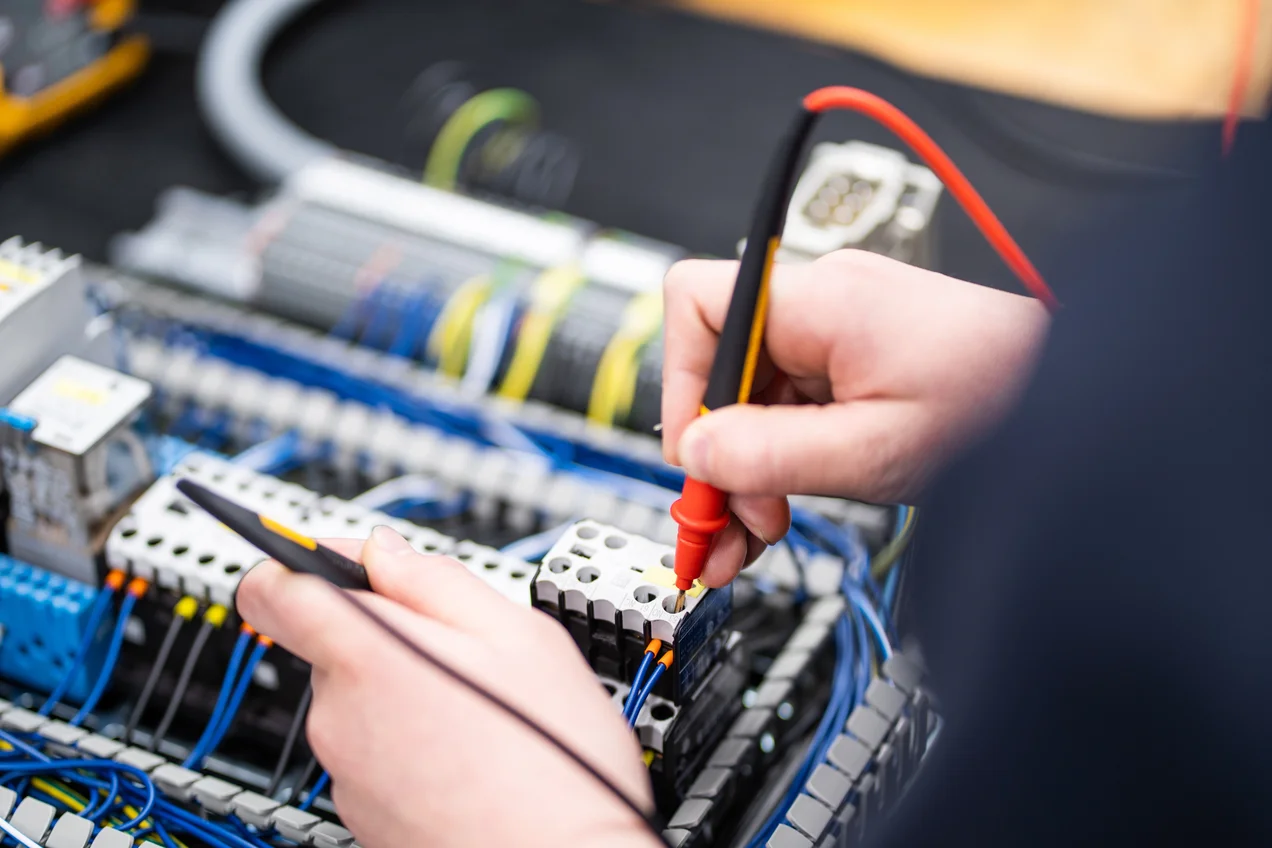
The Electrical Engineering and Information Technology course lasts seven semesters and comprises two semesters of basic studies (fundamentals in mathematics, natural sciences and electrical engineering), four semesters of compulsory modules and optional specialization modules as well as a practical semester in industry. Practice-oriented laboratories with state-of-the-art measuring and laboratory equipment are an integral part of all study phases. The foundation course, the compulsory modules and a defined canon of specialization modules from the field of automotive engineering supplement the compulsory subject German in order to facilitate integration, for example during the practical semester in a German company. Practical orientation is a key element in all our degree courses. We are convinced that practice-oriented teaching with a strong laboratory component can offer foreign students great added value. From the first semester onwards, you will study with state-of-the-art measurement and equipment technology. You will learn in small project groups and have the opportunity to participate in a scholarship program in cooperation with a number of renowned partner companies.
To enroll in the Bachelor’s program in Electrical Engineering and Information Technology at Ulm University of Applied Sciences, you need a high school diploma or equivalent that qualifies you for university admission. This includes, for example, the Allgemeine Hochschulreife, the Fachhochschulreife, or a subject-specific high school diploma. In addition, an interest in mathematics, the natural sciences, and technical problems is a prerequisite. Analytical thinking, logical understanding, and the motivation to solve technical challenges are particularly important. Since the program is taught in English, you must demonstrate sufficient English proficiency. A pre-study internship is not required for this program.
If you hold a foreign high school diploma, you must have your diploma recognized by the Studienkolleg Konstanz. Proof of English proficiency is also required:
In addition, you must submit a completed form regarding your German language proficiency, a statement of purpose (explaining your motivation to study Electrical Engineering and Information Technology at THU), your resume, and a copy of your passport.
You can find further information on the Application for International Students page.
The Electrical Engineering and Information Technology Bachelor's degree opens up a wide range of career opportunities in technical and international fields of work in small, medium-sized and large companies. Graduates work, for example, in electronics development, automation and communication technology, sales, software development or in the field of energy and information technology. Specialists are particularly in demand in the electrical industry, mechanical engineering, the automotive industry, sales companies, consulting firms, planning offices and IT and technology companies. After completing your Bachelor's degree, you can enter professional life directly or continue with a Master's degree. Upon graduation, you will receive the academic degree Bachelor of Engineering (B. Eng.). From the generation and distribution of electrical energy to comprehensive technical support in medicine, the household and administration, through to constantly available, global communication connections, as an Electrical Engineering and Information Technology engineer you will develop the necessary systems and components for the technical infrastructure of modern society and thus make a significant contribution to shaping digital change and the energy transition.
Courses studied at universities abroad can be accredited within the EET program. You need to contact the dean of the program after you enrolled, to check if you can receive credit for your former course achievements. Recognition at THU is competence-based and German language can get recognized, too. However, you cannot start your studies in a higher semester at the moment, as the new degree program is currently building up these semesters.
For studying EET at Ulm University of Applied Sciences, no previous knowledge is mandatory. The program starts at the level you have after you achieve a university entrance qualification in Germany. That is why you need to get a validation of your educational credentials by the Studienkolleg Konstanz.
We accept:
You can submit your application until July 15th. Then the application process ends. However, the coordinated succession procedure will start from approximately end of August. During this phase, applicants have the opportunity to apply for places that are still available. If you are unable to upload your school certificate by July 15th, you should submit all other documents in time and submit the certificate as part of the coordinated succession procedure.
Yes, it is possible to conclude a German health insurance while being abroad. All students in Germany must have health insurance from a private or a public health insurance and you must already have health insurance with a European Health Insurance Card before you enroll. Students from outside the EU can, for example, use compulsory health insurance with one of the public health insurances.
No, you can only register once you have received your access data. Course registration at THU takes place via the SELMA portal. Registration for the courses will be explained to you in the pre-course, which will be shortly after your arrival in Ulm. Enrollment in SELMA is also explained in the introductory event for first-semester students in the first week of lectures. After this explanation, students will be contacted via the course mailing list.