



Embedded wireless systems play a central role in the networking of future production and logistics facilities, which must meet the demands of highly customised products within the context of highly flexible (large-scale) production (‘Industry 4.0’). The networking of these facilities must be able to adapt autonomously to rapidly changing topologies, whilst also supporting real-time applications on mobile nodes in the harsh environment of radio wave propagation found in industrial production facilities. Mesh radio systems, in which radio front-ends utilising multi-antenna technology are employed whilst maintaining low power consumption, are particularly well-suited to such requirements, as well as for the general network connectivity of a wide variety of devices within the context of the ‘Internet of Things’.
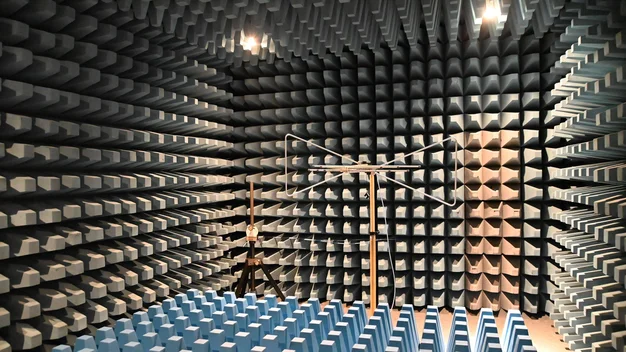
The research conducted by the Wireless Communication Systems Research Group at Ulm University of Technology focuses on algorithms and concepts for autonomous radio management and the provision of Quality of Service (QoS) sufficient for the applications. Key areas of focus include routing algorithms as well as load balancing and congestion control methods, all operating at Layer 2 of the wireless system. In addition, the research group is interested in the further development of low-power RF front-ends with multi-antenna technology for embedded wireless systems, utilizing MIMO (Multiple-Input-Multiple-Output) techniques to increase capacity and stabilize wireless connections.
Project Leader: Prof. Dr. Roland Münzner
Project Duration: March 1, 2024–February 28, 2026
Funding Agency: Federal Government – BMWK
Program Name: ZIM
Project Description:
The goal of the funding project is to develop a Fail-Safe Wireless Interface (FSWI) as a wireless data interface that meets the highest requirements in automation technology in terms of availability and cycle time and can thus be used as a so-called “black channel” in safety control systems. Currently, applications that require such high availability and such short cycle times are necessarily dependent on wired transmission methods. A cost-effective implementation of the FSWI must rely on license-free radio bands and commercially available radio modules, and this will only be possible by pooling the expertise of the project partners. Ulm University of Applied Sciences is responsible for technology selection (analysis of the radio channel and potential radio standards), defines the FSWI architecture in collaboration with the project partner, develops a system simulator for analyzing the FSWI’s performance, and conducts the corresponding simulations. Furthermore, the University of Ulm is developing a protocol analyzer for the FSWI and using it to perform measurements and protocol analyses, including as part of a field test.
Project Leader: Prof. Dr. Roland Münzner
Project Duration: ongoing
Project Description:
Preliminary development and development support for various aspects of wireless communication systems, e.g., system architecture, antenna technology, RF performance of analog front-ends, or radio certification.
Project manager: Prof. Dr. Roland Münzner
Project duration: 01/2012 - 12/2013
Project description:
The main aim of the CHAMELEON project is to develop a cost-effective, fast-to-deploy, low-power and flexible video surveillance system that automatically combines images from multiple cameras with overlapping regions to create a natural seamless panoramic view of the monitored area. CHAMELEON will be a flexible CCTV system allowing for fast and cost-effective deployment. In cases where a wired solution would be feasible, CHAMELEON will interface with the Internet network using the Ethernet communication protocol. In scenarios like remote surveillance, CHAMELEON will use a low-power and secure 5GHz Wireless LAN IEEE 802.11a connection to transmit real-time video signals to the monitoring station. CHAMELEON will implement two layers of security protocols - Data encryption after encoding and authentication at the network layer. CHAMELEON will use a very low power and light-weight video compression algorithm with low bit rates. This will make it possible for the system to be battery operated for a longer time, making it ideal for Temporary Monitoring. CHAMELEON is ideal for Temporary Monitoring since it can be connected to a wireless link, can be battery operated, fast-to-deploy and is able to quickly and automatically configure a network. CHAMELEON will improve the quality of CCTV video display by combining images from multiple cameras with overlapping regions to create a natural seamless panoramic view of the monitored area. CHAMELEON can be used to feed existing Intelligent Video Surveillance systems with wider-view (panoramic) video, therefore increasing their efficiency and detection rate.
Derr, Frowin; Janssen, Jan Philipp; Graf, Simon; Buck, Markus; Wolff, Tobias:
AStudy on LCMV Filtering for Crosstalk Cancellation in a Distributed Microphone Environment,
in: Tagungsband DAGA 2019 - 45. Jahrestagung für Akustik 18-21. March 2019, Rostock, Dt. Gesellschaft für Akustik (ed.), 2019, pages 1378-1381.
ISBN: 978-3-939296-14-0
C. Hepner: An IEEE 802.11 Based Wireless Mesh Disaster Recovery System with Lifetime Enhancement - System Design, Hardware Requirements and Performance Evaluation, Dissertation (Friedrich-Alexander-Universität Erlangen-Nürnberg), 2018
C. Hepner, R. Münzner, R. Weigel: Lifetime enhancement of Disaster Recovery Systems based on IEEE 802.11s Wireless Mesh Networks using a sleep-wake algorithm with minimum number of neighbors, IEEE 13th International Conference on Wireless and Mobile Computing (WiMob), pp. 218 - 226, 2017
C. Hepner, S. Moll, R. Münzner: Influence of Processing Delays on the VoIP Performance for IEEE 802.11s Multihop Wireless Mesh Networks - Comparison of ns-3 Network Simulations with Hardware Measurements, 9th EAI International Conference on Simulation Tools and Techniques (SIMUTools), Prague, Czech Republic, 2016
C. Hepner, R. Münzner, A. Witt: In depth analysis of the ns-3 physical layer abstraction for WLAN systems and evaluation of its influences on network simulation results,2nd Baden-Württemberg Center of Applied Research Symposium on Information and Communication Systems (SInCom 2015), pp. 46-51, Konstanz, 2015
C. Hepner, R. Münzner: Lifetime enhancement of disaster recovery systems based on IEEE 802.11s wireless mesh networks, IEEE 11th International Conference on Wireless and Mobile Computing (WiMob), pp. 91 - 99, 2015
C. Hepner, R. Münzner: IEEE 802.11 Wireless Mesh Networks - Flexible network structures for a wide range of applications, Research Report for Electrical Engineering in Baden-Württemberg WS 2015/16, pp. 23-25, 2015
S. Moll, M. Welk, M. Düll, R. Münzner: High-Level Synthesis of an OFDM Radio Communication System for a Software Defined Radio Platform Designed for Use in Education, Proceedings of the 54th Workshop of the Multi-Project Chip Group Baden-Württemberg, pp.77-83, 2015
C. Hepner, A. Witt, R. Münzner: A new ns-3 WLAN error rate model - Definition, validation of the ns-3 implementation and comparison to physical layer measurements with AWGN channel, Workshop on ns-3 WNS3, Castelldefels (Barcelona), Spain, 2015
C. Hepner, R. Münzner, A. Witt: Validation of the ns-3 802.11s model and proposed changes compliant to IEEE 802.11-2012, Workshop on ns-3 (WNS3), Castelldefels (Barcelona), Spain, 2015