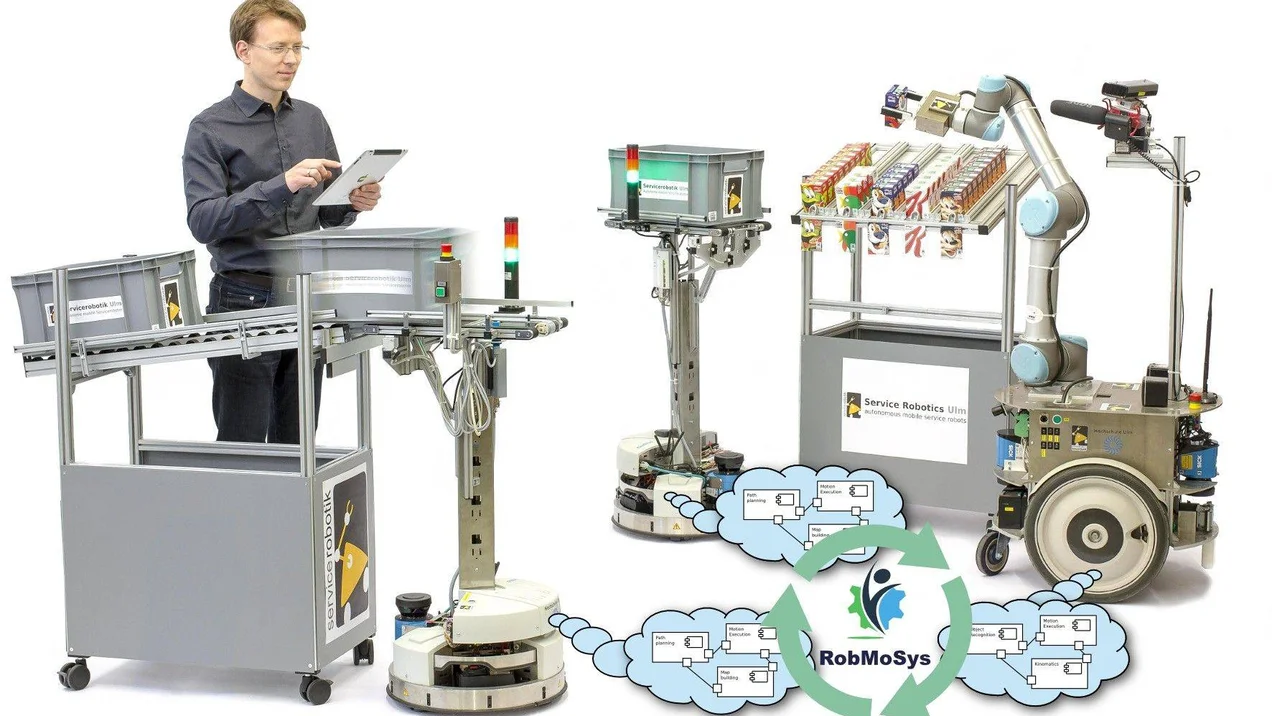

Service robots provide services for or alongside humans in industrial and commercial applications, as well as in domestic settings. Service robots enhance flexibility and adaptability, giving rise to new categories of socio-technical systems. Increasing attention is being paid to the integration of service robot technology with fields such as intralogistics, agriculture and industrial production.
The Service Robotics research group focuses on methods, algorithms and model-driven software tools for the flexible and work-sharing realization of service robotics systems suitable for everyday use. The focus is always on the beneficial embedding of service robots in larger application contexts (e.g. Industry 4.0, intralogistics, agriculture). The approaches are evaluated in real-world scenarios.
Project manager: Prof. Dr. Christian Schlegel
Project duration: 01.03.2017 - 30.06.2022
Funded by: State of BW - MWK / EFRE
Program name: ZAFH
Project partners: Reutlingen University, Ulm University of Applied Sciences (Prof. Christian Schlegel, Prof. Norbert Bartneck), University of UlmProject description: Norbert Bartneck), University of Ulm
Project description:
In the joint project "Intralogistics", the project partners Reutlingen University, Ulm University of Applied Sciences and the University of Ulm have joined forces to find practical solutions, particularly for small and medium-sized enterprises, for the gradual automation of previously manual activities in intralogistics. This supports and enhances human capabilities. In the long term, the robot should become a safe and efficient assistant to humans. Areas of application for such automated solutions include unloading or loading trucks or sea containers, picking goods or supplying workstations in production environments. "By combining the respective strengths of humans and robots, we gain sustainable technology solutions with the necessary flexibility and performance," said Minister Theresia Bauer at the presentation of the funding decision for the ZAFH in Reutliungen in April. The aim is to quickly implement such solutions and processes in companies.
Ulm University of Applied Sciences focuses on picking processes, recognition and learning processes, software systems engineering and service robotics. The various pillars of ZAFH Intralogistics were successfully combined into complex scenarios for the interim evaluation. It was shown how sustainable technology solutions with the necessary flexibility and performance can be achieved by combining the respective strengths of humans and robots (YouTube link).
Following a positive interim evaluation, ZAFH Intralogistics will be funded for a further two years. In the second phase, the capabilities of service robots, the digitalization of intralogistics processes (i.e. modelling, execution, adaptation and monitoring of corresponding workflows) and scenario evaluation will be made available and accessible to end users by means of role-specific tools.
Project manager: Prof. Dr. Christian Schlegel
Project duration: 01.03.2017 - 30.11.2021
Funded by: Federal Government - BMWi
Program name: BMWi PAiCE
Project description:
Ulm University of Applied Sciences (HSU) is a partner in the overall project "SeRoNet - Platform for the development of service robot solutions based on the division of labour". The research focus of HSU is on methods for model-driven software development. Industry 4.0 technologies such as OPC-UA play a special role.
Today, service robots (SR) are generally highly customized systems with precise adaptation to specific environments, objects to be handled, processes to be executed and required user interactions. Although the application potential of SRs has been assessed favorably for years, market development and the establishment of an equipment industry remain below expectations. In many applications, existing automation potential cannot be exploited as only single-digit sales are achieved for each specific solution. SR suppliers are therefore dependent on quick, simple and cost-effective adaptations through the efficient replacement of individual subsystems in order to be able to offer economical solutions even for small quantities. In particular, the enormous costs associated with specific software development have been proven many times over, which in many cases cannot be afforded by small and medium-sized supplier structures, neither with the available resources nor with the necessary expert knowledge.
The aim of the SeRoNet joint project is to develop a growth-oriented platform that supports dynamic value creation networks for the efficient development of customer-specific solutions across the key development phases of a service robot system (SR). The platform is intended to bring suppliers and operators/users of an SR solution together and ensure the SR development process from a system "first time right" in terms of cost-effectiveness and implementation quality. The classic linear value chain is replaced by a value network in which manufacturers, system integrators and end users cooperate dynamically as players in the development and operation of service and assistance robot systems in solution-specific sub-networks of varying composition. The SeRoNet platform supports these networks by providing access to ontology-based domain knowledge and a directory service for standardized (OPC UA) services and mediating knowledge-based individual actors to sub-networks based on the division of labour. In the final expansion stage, independent operation of the platform is planned.
Project manager: Prof. Dr. Christian Schlegel
Project duration: 01.01.2017 - 31.12.2020
Funded by: EU - Horizon 2020 / FP8
Program name: EU H2020
Project description:
Model-driven engineering techniques are well suited to manage system-of-system integration, as has been proven in many engineering domains. Robotics can benefit from these advantages. RobMoSys proposes an integrative approach with respect to existing tech- nologies for further use and improvement. It aims at establishing a composition-oriented approach that manages, maintains and assures system-level properties on model-level,
while preserving modularity and independence of existing robotics frameworks and code. RobMosys will turn community involvement into active support for an open and sustainable European robotics software ecosystem of professional quality and scope. Two Open Calls for broad involvement will provide important concretizations for many of the common robot functionalities.
Project leader: Prof. Dr. Christian Schlegel
Project duration: 01.01.2017 - 31.12.2020
Funded by: State of BW
Program name: Promotionskolleg
Project description:
The doctoral college serves to develop innovative concepts for cognitive machines and the emerging era of cognitive computing. These form the methodological and technological basis for the realization of complex infrastructures in which humans and artificial systems interact and cooperate with each other, thus enabling the creation of novel socio-technical systems. They also allow the realization of intelligent service robotics and companion systems, enable resource-efficient logistics and production control and are of crucial importance for the implementation of Industry 4.0 processes.
The research program is structured into 12 doctoral projects, half of which are based at Ulm University and half at THU. In their entirety, they aim to closely link the four fundamental pillars of cognitive computing - (i) perception, (ii) planning and reasoning, (iii) learning and (iv) interaction.
The doctoral program serves to develop innovative concepts for cognitive machines and the emerging era of cognitive computing. These form the methodological and technological basis for the realization of complex infrastructures in which humans and artificial systems interact and cooperate with each other, thus enabling the creation of novel socio-technical systems. They also allow the realization of intelligent service robotics and companion systems, enable resource-efficient logistics and production control and are of crucial importance for the implementation of Industry 4.0 processes.
Project manager: Prof. Dr. Christian Schlegel
Project duration: 01.06.2016 - 31.05.2019
Funded by: Federal Government - BMBF
Programme name: BMBF KMUinnovativ IKT
Project description:
Fast reorganization of a production facility and ist production flows enables the auotmated and efficient production of individualized products up to a lot size of one single instance in large-scale. Flexible service robots replacing hard wired transportation belts are one of the enablers of the Industry 4.0 idea. LogiRob develops a distributed approach for autonomous robots forming a fleet capable of performing transportation tasks within industrial production systems. The robotics fleet is working in a human robot shared environment, collaborating with human workers in an intuitive and predictable way. The system is able to adapt to changes in the production flow by changing the software configuration only. The quality-of-service (QoS) the robotics fleet provides will be made measurable and visible to the operators.
Project manager: Prof. Dr. Christian Schlegel
Project duration: 01.07.2013 - 29.02.2016
Project description:
Accurate navigation and localization information is already seen to be providing great added value for emerging mobile services. The commercial importance of location-based services (LBS) can already be seen, and is forecast to grow substantially over the coming years. The wide coverage and low cost of GPS systems have been critical to this. However, where GPS systems are unavailable (e.g. indoors or urban canyons) or provide insufficient accuracy, the potential for LBS remains relatively untapped. FIONA aims to address some of these issues by developing a modular, accessible framework to support the core functions of localization and navigation in indoor and outdoor areas as well as facilitate the development of applications and services to be built upon it.
Project leader: Prof. Dr. Christian Schlegel
Project duration: 01.03.2013 - 29.02.2016
Project description:
The University of Applied Sciences Ulm (HSU) is project partner within the BMBF collaborative research project iserveU. HSU is extensively involved in the design and development of the modular service-oriented software architecture as well as the according model-driven software development toolchain.
Project leader: Prof. Dr. Christian Schlegel
Project duration: 01.05.2015 - 31.10.2016
Project description:
The MARS experiment aims at the development of small and stream-lined mobile agricultural robot units to fuel a paradigm shift in farming practices. The concept addresses looming challenges of today's large and constantly growing tractor-implement combinations with mainly three aspects. First: to optimize plant specific precision farming, leading to reduced input of seeds, fertilizer and pesticides and to increased yields. Second: to reduce the massive soil compaction as well as energy consumption of heavy machinery. Third: to meet the increasing demand for flexible to use, highly automated and simple to operate systems, anticipating challenges arising from climate change as well as shortage of skilled labor.
The robots will cooperate as a group, similar to swarm principles. MARS will focus on the seeding process for corn performed by two robots as an example. The key strategy of this approach is on the one hand the radical reduction of weight and size compared to conventional farming equipment, which also allows for a fundamental simplification of safety tasks. On the other hand it is the essential simplification compared to known agricultural robot prototypes, especially by minimized use of on-board sensors. This will be realized by transferring control algorithms, process optimizing and supervising intelligence to cloud services and utilizing precise GPS-Real Time Kinematic technology. All these measures are intended to lead to a significant cost reduction of the overall system.
Blender, Timo; Schlegel, Christian:
Dynamic Allocation of Service Robot Resources to an Order Picking Task Considering Functional and Non-Functional Properties,
in: IEEE/ACM 4th International Workshop on Robotics Software Engineering (RoSE), IEEE, IEEE Xplore, 2022, pages 25-32.
DOI: 10.1145/3526071.3527518
ISBN: 978-1-4503-9317-1
Nagrath, Vineet; Blender, Timo; Shaik, Nayabrasul; Schlegel, Christian:
Industry 4.0 Asset Administration Shell (AAS): Interoperable Skill-Based Service Robots,
in: arXiv, 2022, pages 5.
DOI: 10.48550/ARXIV.2208.01273
Nagrath, Vineet; Schlegel, Christian:
SmartDG: Modeling System-Level Requirements for Component-Based Robotic Software Systems,
in: Arai, K. (eds) Advances in Information and Communication. FICC 2022. Lecture Notes in Networks and Systems, vol. 438, Springer, Cham, 2022, pages 741-759.
DOI: doi.org/10.1007/978-3-030-98012-2_52
ISBN: 978-3-030-98011-5
Nagrath, Vineet; Schlegel, Christian:
Model-Driven Run-Time Dependency Graphs for Component-Based Robotic Software,
in: Fifth IEEE International Conference on Robotic Computing (IRC), IEEE, IEEE Xplore, 2022, pages 137-142.
DOI: 10.1109/IRC52146.2021.00033
ISBN: 978-1-6654-3416-4
Nagrath, Vineet; Schlegel, Christian:
Towards Model Based Electronic Institutions and Contract Regulated Services in a Component-Based Robotic Software Ecosystem,
in: Arai, K. (eds) Advances in Information and Communication. FICC 2022. Lecture Notes in Networks and Systems, vol. 438, Springer, Cham, 2022, pages 760-772.
DOI: doi.org/10.1007/978-3-030-98012-2_53
ISBN: 978-3-030-98011-5
Nagrath, Vineeth; Schlegel, Christian:
Run-Time Dependency Graph Models for Independently Developed Robotic Software Components,
in: Arai, K. (eds) Intelligent Computing. SAI 2022. Lecture Notes in Networks and Systems, vol. 507, Springer, 2022, pages 892-909.
DOI: 10.1007/978-3-031-10464-0_62
ISBN: 978-3-031-10463-3
Nagrath, Vineet; Schlegel, Christian:
SmartTS: A Component-Based and Model-Driven Approach to Software Testing in a Robotic Software Ecosystem,
in: International Journal of Advanced Computer Science and Applications (IJACSA), Volume 12, Issue 7, 2021, The Science and Information (SAI) Organization, The Science and Information (SAI) Organization, 2021, pages 11-22.
DOI: 10.14569/IJACSA.2021.0120702
ISSN: 2156-5570
Schlegel, Christian; Lotz, Alex; Lutz, Matthias; Stampfer, Dennis:
Composition, Separation of Roles and Model-Driven Approaches as Enabler of a Robotics Software Ecosystem,
in: Software Engineering for Robotics, Cavalcanti A., Dongol B., Hierons R., Timmis J., Woodcock J., Springer, Cham., 2021, pages 53-108.
DOI: 10.1007/978-3-030-66494-7_3
ISBN (Print): 978-3-030-66493-0, ISBN (online): 978-3-030-66494-7
Schlegel, Christian; Stampfer, Dennis; Lotz, Alex; Lutz, Matthias:
Robot Programming,
in: Mechatronics and Robotics: New Trends and Challenges, Marina Indri, Roberto Oboe (eds.), CRC Press, Taylor and Francis Group, 2020, pages 161 - 194
DOI: doi.org/10.1201/9780429347474, ISBN: 9780429347474
Blender, Timo; Schlegel, Christian:
Implementing Resource Adequate Service Robot Behavior by Systematic Management of Non-Functional Properties: An Intralogistics Use Case,
in: 25th IEEE Int. Conf. on Emerging Technologies and Factory Automation (ETFA), IEEE (ed.), IEEE, 2020, pages 659-666.
DOI: 10.1109/ETFA46521.2020.9211986
Shaik, Nayabrasul; Lutz, Matthias; Schlegel, Christian:
2D Localization in Large Areas Using Inexpensive RGBD Camera Augmented With Visual Tags,
in: 25th Int. Conf. on Emerging Technologies and Factory Automation (ETFA), 2020, pages 613-619.
DOI: 10.1109/ETFA46521.2020.9211882, ISBN: 978-1-7281-8956-7 (eISBN) / 978-1-7281-8957-4 (PoD)
Nagrath, Vineet; Hariz, Mossaab; El Yacoubi, Mounim A.:
Adaptive Retraining of Visual Recognition-Model in Human Activity Recognition by Collaborative Humanoid Robots,
in: Proc. of the SAI Intelligent Systems Conference (IntelliSys 2020), Springer, 2020, pages 124-143.
DOI: doi.org/10.1007/978-3-030-55187-2_12
Rollenhagen, Matthias; Lutz, Matthias; Shaik, Nayab; Andrews, Kevin; Steinau, Sebastian; Reichert, Manfred; Schlegel, Christian:
Towards Flexible Process Automation - An Approach for Flexible Service Robot Adaptation and Allocation,
in: Proceedings of the 3rd International Conference on Industrial Automation, Robotics and Control Engineering (IARCE), ACM, New York, NY, USA, 2019, pages 7.
ISBN: 978-1-4503-6529-1
Lotz, A., Hamann, A., Lange, R., Heinzemann, C., Staschulat, J., Kesel, V., Stampfer, D., Lutz, M., and Schlegel, C. Combining Robotics Component-Based Model-Driven Development with a Model-Based Performance Analysis. In IEEE International Conference on Simulation, Modeling, and Programming for Autonomous Robots (SIMPAR), 2016, San Francisco, CA, USA.
Timo Blender, Thiemo Buchner, Benjamin Fernandez, Benno Pichlmaier and Christian Schlegel," Managing a Mobile Agricultural Robot Swarm for a Seeding Task," In Proc. Industrial Electronics Society, IECON 2016 - 42nd Annual Conference of the IEEE, Florence, Italy, October 24-27, 2016.
Matthias Lutz, Christian Verbeek and Christian Schlegel. "Towards a Robot Fleet for Intra-Logistic Tasks: Combining Free Robot Navigation with Multi-Robot Coordination at Bottlenecks". In Proc. of the 21st IEEE International Conference on Emerging Technologies and Factory Automation (ETFA), Berlin, September 6-9, 2016. Electronic ISBN: 978-1-5090-1314-2, DOI: 10.1109/ETFA.2016.7733602
Dennis Stampfer, Alex Lotz, Matthias Lutz and Christian Schlegel. "The SmartMDSD Toolchain: An Integrated MDSD Workflow and Integrated Development Environment (IDE) for Robotics Software". Special Issue on Domain-Specific Languages and Models in Robotics, Journal of Software Engineering for Robotics (JOSER), 7(1), 3-19 ISSN: 2035-3928, July 2016.
Alex Lotz, Arne Hamann, Ingo Lütkebohle, Dennis Stampfer, Matthias Lutz, Christian Schlegel. Modeling Non-Functional Application Domain Constraints for Component-Based Robotics Software Systems. In 6th International Workshop on Domain-Specific Languages and models for ROBotic systems (DSLRob-15), Hamburg, October, 2015.
Timo Blender and Christian Schlegel. Motion Control for Omni-Drive Servicerobots Under Kinematic Dynamic and Shape Constraints. In Proc. of the 20th IEEE International Conference on Emerging Technologies and Factory Automation (ETFA), Luxembourg, September 8-11, 2015.
Christian Schlegel, Alex Lotz, Matthias Lutz, Dennis Stampfer, Juan F. Inglés-Romero, and Cristina Vicente-Chicote. "Model-driven software systems engineering in robotics: Covering the complete life-cycle of a robot", in Journal IT - Information Technology: Methods and Applications of Informatics and Information Technology, Volume 57, Issue 2, Pages 85-98, ISSN (Online) 2196-7032, ISSN (Print) 1611-2776, DOI: 10.1515/itit-2014-1069, DE GRUYTER, March 2015.
Matthias Lutz, Dennis Stampfer, Alex Lotz, Christian Schlegel. Service Robot Control Architectures for Flexible and Robust Real-World Task Execution: Best Practices and Patterns. Workshop Roboter-Kontrollarchitekturen, Informatik 2014, Springer LNI der GI, ISBN 978-3-88579-626-8, Stuttgart, September 2014.
Siegfried Hochdorfer, Heiko Neumann and Christian Schlegel. Landmark Rating and Selection for SLAM in Dynamic Environments. In Proc. International Conference on Intelligent Autonomous Systems (IAS13), July 15-18, 2014, Padova, Italy.
Alex Lotz, Juan F. Ingles-Romero, Dennis Stampfer, Matthias Lutz, Cristina Vicente-Chicote and Christian Schlegel. "Towards a Stepwise Variability Management Process for Complex Systems - A Robotics Perspective", in International Journal of Information System Modeling and Design (IJISMD 2014), DOI: 10.4018/ijismd.2014070103, 5(3):55-74, 2014.
Dennis Stampfer, Christian Schlegel. "Dynamic State Charts: composition and coordination of complex robot behavior and reuse of action plots", in Journal of Intelligent Service Robotics, 7(2), pp. 53-65, Springer Berlin Heidelberg, ISSN 1861-2776, 2014.
Christian Schlegel, Alex Lotz, Matthias Lutz, Dennis Stampfer, Juan F. Inglés-Romero, Cristina Vicente-Chicote. Model-Driven Software Systems Engineering in Robotics: Covering the Complete Life-Cycle of a Robot. Workshop Robot Control Architectures, Computer Science 2013, Springer LNI of the GI, Koblenz, September 2013
Alex Lotz, Juan F. Inglés-Romero, Cristina Vicente-Chicote, Christian Schlegel. Managing run-time variability in robotics software by modeling functional and non-functional behavior. In Selmin Nurcan, Henderik A. Proper, Pnina Soffer, John Krogstie, Rainer Schmidt, Terry Halpin, and Ilia Bider, editors. BPMDS and EMMSAD, volume 147 of Lecture Notes in BIP, pages 441-455. Springer, 2013. ISBN 978-3-642-38483-7
Matthias Lutz, Dennis Stampfer, Christian Schlegel. Probabilistic object recognition and pose estimation by fusing multiple algorithms. In Proc. IEEE Int. Conf. on Robotics and Automation (ICRA), Karlsruhe, Germany, May, 2013.
Dennis Stampfer, Christian Schlegel. Dynamic state charts: Composition and coordination of complex robot behavior and reuse of action plots. In Proc. IEEE Int. Conf. on Technologies for Practical Robot Applications (TePRA). Woburn, MA, USA, April 2013. ISBN 978-1-4673-6224-5.
Juan F. Inglés-Romero, Alex Lotz, Cristina Vicente-Chicote, Christian Schlegel. Dealing with Run-Time Variability in Service-Robotics: Towards a DSL for Non-Functional Properties. 3rd International Workshop on Domain-Specific Languages and models for ROBotic systems (DSLRob-12), Proceedings of SIMPAR 2012 Workshop, Emanuele Menegatti (Ed.), Tsukuba, Japan, November 2012, ISBN 978-88-95872-01-0
Dennis Stampfer, Matthias Lutz, Christian Schlegel. Informed Active Perception with an Eye-in-hand Camera for Multi Modal Object Recognition. Proc. IEEE IROS 2012 Workshop on Active Semantic Perception (ASP'12), ISBN 978-972-8822-26-2, Vilamoura, Algarve (Portugal), 2012.
Video attachment
Alex Lotz, Andreas Steck, Christian Schlegel. Analyzing Solution Quality of Anytime Bag of Words Object Classification for a Service Robot. Proc. IEEE Int. Conf. on Technologies for Practical Robot Applications (TePRA), Pages 1-6, Woburn, Massachusetts, USA, ISBN 978-1-4673-0854-0, 2012.
Matthias Lutz, Dennis Stampfer, Siegfried Hochdorfer, Christian Schlegel. Probabilistic Fusion of Multiple Algorithms for Object Recognition at Information Level. Proc. IEEE Int. Conf. on Technologies for Practical Robot Applications (TePRA), Pages 139-144, Woburn, Massachusetts, USA, ISBN 978-1-4673-0854-0, 2012.
Dennis Stampfer, Matthias Lutz, Christian Schlegel. Information Driven Sensor Placement for Robust Active Object Recognition based on Multiple Views. Proc. IEEE Int. Conf. on Technologies for Practical Robot Applications (TePRA), Pages 133-138, Woburn, Massachusetts, USA, ISBN 978-1-4673-0854-0, 2012.
Christian Schlegel, Andreas Steck, Alex Lotz.Robotic Software Systems: From Code-Driven to Model-Driven Software Development. In Ashish Dutta, editor, Robotic Systems - Applications, Control and Programming. Pages 473-502, InTech, ISBN 978-953-307-941-7, 2012.
Christian Schlegel, Andreas Steck, Alex Lotz.Model-Driven Software Development in Robotics: Communication Patterns as Key for a Robotics Component Model. In Daisuke Chugo and Sho Yokota, editors, Introduction to Modern Robotics. Pages 119-150. iConcept Press, 978-0980733068 (Hard Cover) / 978-1463789428 (Paperback), 2012
Dennis Stampfer, Christian Schlegel. Modeling and Reuse of Complex Behaviors as Building Blocks with Dynamic State Charts using the Example of Service Robotics. In Conference Embedded Software Engineering (ESE), Pages 511-515, Sindelfingen, December 5-9, ISBN 978-3-8343-2405-4, 2011.
Andreas Steck, Alex Lotz, Christian Schlegel. Model-driven engineering and run-time model-usage in service robotics. In Proc. of the Tenth ACM Int. Conference on Generative Programming and Component Engineering (GPCE), Portland, Oregon, USA, October, 2011.
Andreas Steck, Christian Schlegel. Managing execution variants in task coordination by exploiting design-time models at run-time. In Proc. IEEE/RSJ Int. Conf. on Robotics and Intelligent Systems (IROS), San Francisco, USA, September, 2011.
Alex Lotz, Andreas Steck, Christian Schlegel. Runtime Monitoring of Robotics Software Components: Increasing Robustness of Service Robotic Systems. In Proc. 15th Int. Conf. on Advanced Robotics, Tallinn, Estonia, 2011.
Matthias Lutz, Siegfried Hochdorfer, Christian Schlegel. Global Localization using Multiple Hypothesis Tracking: A real-world Approach. Proc. IEEE Int. Conf. on Technologies for Practical Robot Applications (TePRA), Pages 127-132, Woburn, Massachusetts, USA, ISBN 978-1-61284-480-0, 2011
Andreas Steck, Christian Schlegel. Resource Awareness and Quality of Service in Service Robotics through Model-Driven Software Development. Embedded Software Engineering Kongress (ESE), Pages 607-610, December 7-9, Sindelfingen, ISBN 978-3-8343-2404-7, 2010
Christian Schlegel, Andreas Steck, Davide Brugali, Alois Knoll. Design Abstraction and Processes in Robotics: From Code-Driven to Model-Driven Engineering. In 2nd International Conference on Simulation, Modeling, and Programming for Autonomous Robots (SIMPAR), Pages 324-335, Darmstadt, Springer LNAI 6472, ISBN-10 3-642-17318-7, 2010
Andreas Steck, Christian Schlegel. SmartTCL: An Execution Language for Conditional Reactive Task Execution in a Three Layer Architecture for Service Robots. In Proc. of SIMPAR 2010 Workshops (International Workshop on Dynamic languages for RObotic and Sensors systems (DYROS)), 2nd Intl. Conf. on Simulation, Modeling, and Programming for Autonomous Robots, Pages 274-277, Darmstadt, ISBN 978-3-00-032863-3, 2010.
Matthias Lutz, Andreas Steck, Christian Schlegel. Person Following through Cluttered Environments using Probabilistic Methods and Fast Local Obstacle Avoidance. The 3rd Israeli Conference on Robotics (ICR 2010), November 10-11, 2010, Herzlia, Israel
Andreas Steck, Christian Schlegel. Towards Quality of Service and Resource Aware Robotic Systems through Model-Driven Software Development. In 1st International Workshop on Domain-Specific Languages and models for ROBotic Systems (DSLRob'10), 2010 IEEE/RSJ International Conference on Intelligent Robots and Systems (IROS 2010), October 18-22, 2010, Taipei, Taiwan
Siegfried Hochdorfer, Christian Schlegel. 6 DoF SLAM using a ToF Camera: The challenge of a continuously growing number of landmarks. The 2010 IEEE/RSJ International Conference on Intelligent Robots and Systems (IROS 2010), October 18-22, 2010, Taipei, Taiwan
Siegfried Hochdorfer, Christian Schlegel. Landmark Rating and Selection: Considering the Observability Regions. The 11th Int. Conf. on Intelligent Autonomous Systems (IAS-11), Ottawa, Canada, IOS Press, ISBN 978-1-60750-612-6, 2010
Manuel Wopfner, Jonas Brich, Siegfried Hochdorfer, Christian Schlegel. Mobile Manipulation in Service Robotics: Scene and Object Recognition with Manipulator-Mounted Laser Ranger. ISR / ROBOTIK June 7-9, 2010, Munich
Siegfried Hochdorfer, Matthias Lutz, Christian Schlegel. Bearing-Only SLAM in everyday environments using Omnidirectional Vision. IEEE ICRA 2010 Workshop on Omnidirectional Vision, Anchorage, AK, 2010.
Andreas Steck, Dennis Stampfer, Christian Schlegel. Software Engineering in Service Robotics - The Path to Model-Driven Software Design. Embedded Software Engineering Congress (ESE), Sindelfingen, 2009
Andreas Steck, Dennis Stampfer, Christian Schlegel. Model-driven software development for robotic systems. Expert discussion Autonomous Mobile Systems (AMS), Karlsruhe, 2009
Siegfried Hochdorfer, Matthias Lutz, Christian Schlegel. Lifelong Localization of a Mobile Service-robot in Everyday Indoor Environment Using Omnidirectional Vision. Proc. IEEE Int. Conf. on Technologies for Practical Robot Applications (TePRA), Woburn, Massachusetts, USA, 2009
Siegfried Hochdorfer, Christian Schlegel. Landmark rating and selection according to localization coverage: Addressing the challenge of lifelong operation of SLAM in service robots. Proc. IEEE/RSJ Int. Conf. on Intelligent Robots and Systems (IROS), St. Louis, Missouri, USA, 2009
Siegfried Hochdorfer, Christian Schlegel. Towards a robust Visual SLAM Approach: Addressing the Challenge of life-long Operation. Proc. 14th International Conf. on Advanced Robotics (ICAR), Munich, 2009
Christian Schlegel, Thomas Haßler, Alex Lotz, Andreas Steck. Robotic Software Systems: From Code-Driven to Model-Driven Designs. Proc. 14th Int. Conf. on Advanced Robotics (ICAR), Munich, 2009
Christian Schlegel. Service robotics 1: Service requires local knowledge. In Forschungswerk, pages 40-43, ISBN 978-3-9810998-2-9, Ulm University of Applied Sciences, 2009
Christian Schlegel. Service robotics 2: The problem of software complexity can be solved, In Forschungswerk, pages 44-47, ISBN 978-3-9810998-2-9, Ulm University of Applied Sciences, 2009