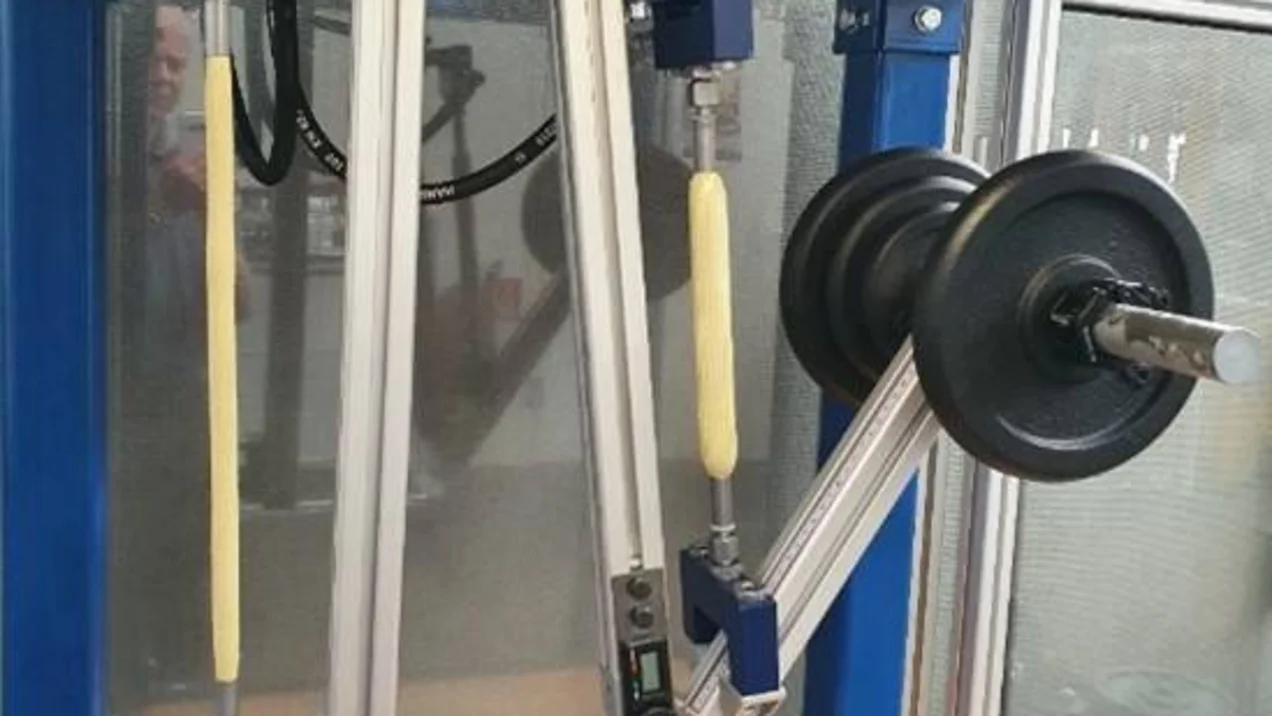
Hydraulic components and systems have established themselves as effective high-performance drives in many stationary applications and vehicles, thanks to their exceptional power and performance density, their precise control and regulation capabilities, and their outstanding robustness, all combined with low capital costs.
Applied research and further development of hydraulic components, hydraulic drive systems, and new applications are the focus of the projects at the Hydraulics Competence Center at Ulm University of Applied Sciences. In addition to hydraulic training systems (mobile hydraulics, shift-type hydraulics), the laboratory equipment for teaching, research, and development includes a valve test bench donated by TRIES Hydraulik-Elemente Ehingen, a testing facility for fluids and oil condition sensors, and other test benches for hydraulic drive and control technology in the mechanical engineering laboratory.
Project Leader: Prof. Dr. Mathias Niebergall
Project Duration: Oct. 1, 2022 – ongoing
Funding Source: Corporate Foundation
Hydraulic components are key elements in high-performance drive systems for German machinery and commercial vehicles, which are in high demand worldwide. At the THU Hydraulics Competence Center, the focus is on education and research into hydraulic drive systems and their components. The bionic example of the human cardiovascular system served as inspiration for the following project: an innovative hydraulic drive system designed to directly assist humans.
ProjectDescription
Development of Hydraulic Muscle and Exoskeleton Drive Systems to Assist Humans
Exoskeleton drives can, on the one hand, significantly increase human physical performance and, on the other hand, reduce physical strain to a level appropriate to the individual’s capabilities in many different application areas. Exoskeleton drive systems are the innovative key to assisting humans in everyday activities, during heavy physical labor, and in medical rehabilitation.
Fluid-based exoskeleton drive systems, particularly those with hydraulic muscles, already offer functionally attractive solutions due to their exceptional performance, compactness, and low mass. In contrast to rigid electromechanical solutions or even conventional fluid-powered cylinders, the flexible, compliant structure of hydraulic muscles—composed of elastomeric tubing and high-strength fabric—results in highly adaptable, comfortable exoskeleton structures. The inherently simple design of hydraulic muscles results in remarkable operational robustness and, ultimately, economically attractive solutions.
The project’s goals are to develop high-performance hydraulic muscles as the basis for exoskeleton drive systems designed to assist humans. The design and development of hydraulic muscles and exoskeleton propulsion systems are accompanied by experimental testing as well as the development of associated mathematical and physical models to serve as the basis for future model-based control and regulation systems (cyber-physical systems).
Project manager: Prof. Dr. Mathias Niebergall
Project duration: 01.10.2018 - 31.01.2021
Funded by: Federal Government - BMWi
Program name: ZIM
Project description:
For decades, hydraulic drive technology has been characterized by increasing power and pressure requirements with reduced installation space. In order to meet future requirements, a control module with a compact, highly integrated valve technology structure is being developed as part of this project, which enables safe hydraulic power control of a drive above 500 bar. The control module is to consist of a modular hydromechanical structure with adapted actuator technology, pilot and main control with separate control edges and tailored on-board electronics (OBE).
The project objective is a market-oriented control module that meets the highest performance requirements and offers safe and efficient functional networking of several hydraulic consumers by means of intelligent control / regulation. This creates the control technology basis for energy-efficient operation of hydraulic power drives.
Mathias Niebergall, Jonas Pfister, Roman Strobel, Jonathan Scheible: HYDRAULIC ARTIFICIAL MUSCLES FOR EXOSKELETON ACTUATION SOLUTIONS, 15th International Fluid Power Conference, Aachen, Germany, 2026
Niebergall Mathias, Strobel Roman: DEVELOPMENT OF A HYDRAULIC ARTIFICIAL MUSCLE WITH HIGH FORCE DENSITY, 14th International Fluid Power Conference, Dresden, Germany, 2024
Niebergall Mathias, Ziegler Hannes: COMPACT FLUID POWER CONTROL UNIT WITH INDEPENDENT METERING, 14th International Fluid Power Conference, Dresden, Germany, 2024
Bauer Gerhard, Niebergall Mathias: Oil Hydraulics, Springer Vieweg Verlag, 12th edition, 2020
DOI: doi.org/10.1007/978-3-658-27027-8