

Would you like to combine your technical expertise with medical knowledge to develop solutions for the healthcare sector? The Bachelor’s degree programme in Medical Informatics offers you a sound grounding in computer science, tailored to applications in modern medicine. You will learn to manage health data efficiently, develop medical software, use artificial intelligence to analyse patient findings, and manage IT projects as part of a team. The Bachelor’s degree in Medical Informatics also provides knowledge of data protection and data security when handling patient data. A unique feature of the programme is the opportunity to choose your own specialisation, for example in the field of AI or medical technology.
Launch your career in Medical Informatics and help shape the future of healthcare.
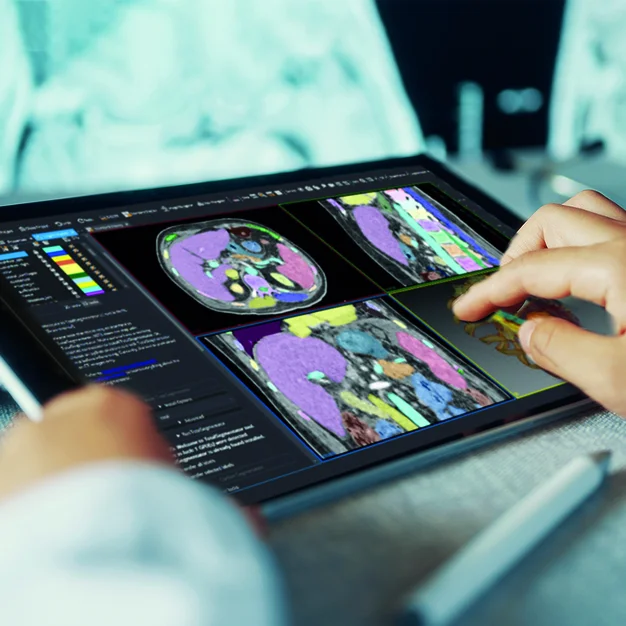
The Medical Informatics degree program combines medicine, informatics and data analysis and prepares you for exciting career paths at the interface of healthcare and IT.
The Medical Informatics course lasts seven semesters. You will receive a comprehensive computer science education in which you will be introduced to programming languages, data management, algorithms, computer networks, etc. from the ground up - always with a view to the requirements of medicine. Of course, modern technologies such as machine learning and artificial intelligence (e.g. for imaging diagnostics or patient-specific therapy determination) are just as much a part of this as the special requirements for software development, data protection and data security when handling patient data.
The range of courses is supplemented by interdisciplinary skills such as technical English, project management, scientific work and seminar papers, which strengthen your communication, organizational and methodological skills.
The practical semester offers you the opportunity to apply your theoretical knowledge directly in a real working environment and gain practical experience that will prepare you optimally for your Bachelor's thesis, career entry or further specialization.
Depending on your interests, you can choose one of the following specializations:
The Medical Informatics Bachelor's degree program does not require an NC, which means that no specific grade point average is necessary. The course is particularly suitable for you if you are interested in technology, medicine and computer science and enjoy solving complex problems. Enthusiasm for technological and medical contexts is just as important as basic knowledge of mathematics and natural sciences. You will also benefit from your ability to work in a team and good communication skills during your studies. If you are also prepared to deal with ethical issues in the healthcare sector, you have the ideal prerequisites for studying Medical Informatics.
For example, you can work in IT management in the healthcare sector or develop medical software and apps. Jobs in research and development in medical informatics and medical technology also offer you exciting prospects. In addition, areas such as data analysis and AI-supported applications in the healthcare sector open up attractive employment opportunities. If you are more interested in consulting and project management, you will find suitable careers in healthcare facilities as well as in IT and medical technology companies. The path to further Master's degree courses is also open to you. This will allow you to deepen your knowledge or specialize in areas such as bioinformatics or health economics.