

Would you like to study environmental engineering and play an active role in tackling climate change, resource scarcity and environmental pollution? The Bachelor’s degree in Environmental Engineering combines engineering with sustainability. You will learn how to use resources in a climate-friendly way and establish circular economies. In doing so, you will engage intensively with topics such as environmental protection, energy and material efficiency, and hazardous substance management.
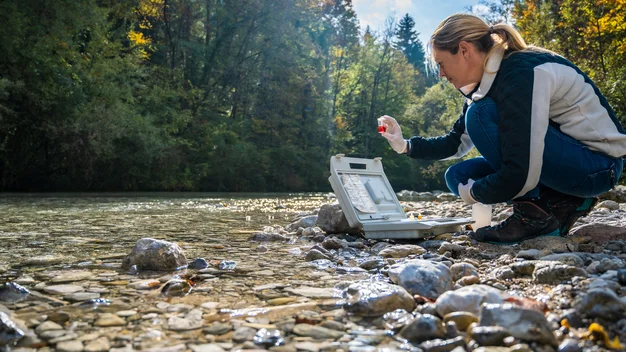
The Environmental Engineering Bachelor combines sound theoretical foundations with practical projects and applications in a modern research environment.
The Environmental Engineering program at THU lasts seven semesters. It focuses on technologies for keeping water, air, and soil clean, as well as climate protection. In this program, you’ll learn
In the first two semesters, you’ll acquire fundamental knowledge in mathematics, physics, and chemistry, which is necessary for understanding environmental engineering processes. Courses such as “Engineering Mechanics” and “Computer Science” lay the foundation for analyzing and solving technical problems.
The specialization phase (3rd–4th semesters) introduces you to specific topics in environmental engineering, including thermodynamics, water treatment, and waste management. Practical lab exercises and project work help you apply theoretical concepts to real-world environmental engineering problems.
Apractical semester in the 5th semester at a company or research institution allows you to apply your theoretical knowledge in practice and gain valuable professional experience. You’ll work on real-world projects that often have a direct connection to current environmental issues.
In the final phase of the program, you will deepen your knowledge through required-elective modules. By choosing specializations, you can tailor the program to your own interests and goals and refine your professional profile.
The following specializations are available:
The bachelor’s thesis marks the completion of the degree program and offers the opportunity to delve deeply into a specific topic in environmental engineering.
In order to be admitted to the Bachelor's degree course, you need a general higher education entrance qualification, a subject-specific higher education entrance qualification or an entrance qualification for universities of applied sciences. The Environmental Engineering course is NC-free, which means that no specific grade point average is required. A pronounced environmental awareness and an interest in developing innovative solutions to ecological challenges are key prerequisites for this course. You also have a passion for technology and innovation and would like to put your knowledge of mathematics, biology, ecology, chemistry and physics to practical use. Complex challenges are tackled with solution-oriented thinking, perseverance and enjoyment of teamwork. Self-motivation and the openness to expand your English skills for international perspectives round off your profile.
After completing the Environmental Engineering Bachelor of Engineering (B. Eng.), there is a wide range of career fields and opportunities to start a career. After successfully completing your degree, you can also complete further training to become a hazardous goods officer, energy consultant or radiation protection specialist. THU also offers suitable Master's programs and the opportunity to do a doctorate. Professionally, you will work in areas such as water and wastewater technology, waste and recycling management, air pollution control and emission protection, energy and resource efficiency, soil protection and remediation, environmental and quality management, research and development as well as consulting, project management and in authorities and regulatory bodies.