



The focus is on innovative approaches to integrating forward-looking digital technologies into industrial processes and applications, with a view to improving efficiency and quality, conserving resources and protecting the environment, whilst opening up new business opportunities. The aim is never to replace people, but rather to support them more effectively than before and reduce their workload.
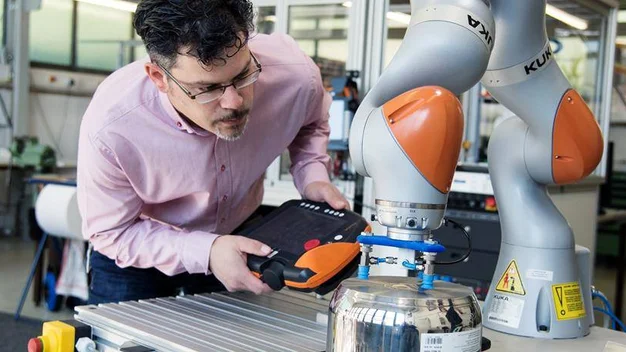
Research at Ulm University of Technology focuses on the development of lean application processes and technologies for assembly, manufacturing, and logistics—for example, using robotics, flexible automation, and decentralized conveyor systems— the planning and control of production systems and value-added networks, as well as standards and IT architectures such as digital twins and the Asset Administration Shell (AAS).
The THU focuses in particular on small and medium-sized enterprises (SMEs) and their needs and opportunities. A key aspect of this is the accelerated translation of creative ideas and scientific findings into practical applications. This is a crucial factor for fostering innovation and ensuring technological sovereignty.
Project manager: Prof. Dr. Klaus Schlickenrieder
Project duration: 01.03.2024 - 29.02.2028
Funded by: private
Project description:
Shearography in optoelectronic tire testing is an established method for feature recognition. However, the current gray image analysis cannot detect all findings and artifacts. A time-consuming and error-prone manual inspection process is currently required. There is therefore an urgent need to automate the process of feature detection and classification using intelligent algorithms.
Project manager: Prof. Dr. Sebastian Geier
Project duration: 01.10.2024 - 31.03.2026
Funded by: Federal Government - BMBF
Program name: DATIpilot
Project description:
Small and medium-sized manufacturing companies (SMEs) are to be enabled by the "LCA4All" project to determine the environmental footprint of their products within extensive supply chains and to find reduction potentials. The core idea of the LCA4All project is to transfer the state of research on lifecycle assessment (LCA) into practice and to develop innovative LCA software for the needs-based implementation of LCA in SME supply chains and to test it in companies. In addition, a guideline for the pragmatic implementation of the LCA will be developed and validated in companies as transfer partners.
Project leader: Prof. Dr. Christian Schlegel
Project duration: 01.01.2017 - 31.12.2020
Funded by: State of BW
Program name: Promotionskolleg
Project partners: Ulm University of Applied Sciences (Prof. Schlegel, Prof. Baumgärtel, Prof. Bartneck, Prof. Völker), University of Ulm
Project description:
The doctoral college serves to develop innovative concepts for cognitive machines and the emerging era of cognitive computing. These form the methodological-technological basis for the realization of complex infrastructures in which humans and artificial systems interact and cooperate with each other, thus enabling the creation of novel socio-technical systems. They also allow the realization of intelligent service robotics and companion systems, enable resource-efficient logistics and production control and are of crucial importance for the implementation of Industry 4.0 processes.
The research program is structured into doctoral projects, which in their entirety aim to closely link the four fundamental pillars of cognitive computing - (i) perception, (ii) planning & reasoning, (iii) learning and (iv) interaction. To this end, the doctoral projects place individual weightings on the four pillars on the one hand and individual focuses in relation to the areas of application on the other. The focus and prioritization of the research work is adjusted in the interplay between the further development of the methods (push) and the needs from the fields of application (pull).
Two doctoral projects have been successfully completed so far, two more are in the final phase (as of 12/24).
Further information: Website of the KPK at the University of Ulm
Project manager: Prof. Christian Schlegel
Project duration:01.03.2017 - 30.06.2022
Funded by: State of BW - MWK / EFRE
Program name: ZAFH
Project partners: Reutlingen University, Ulm University of Applied Sciences (Prof. Christian Schlegel, Prof. Norbert Bartneck), University of Ulm (Prof. Christian Schlegel, Prof. Norbert Bartneck). Norbert Bartneck), University of Ulm
Project description:
In the joint project "Intralogistics", the project partners Reutlingen University, Ulm University of Applied Sciences and the University of Ulm have joined forces to find practical solutions, particularly for small and medium-sized enterprises, for the gradual automation of previously manual activities in intralogistics. This supports and enhances human capabilities. In the long term, the robot should become a safe and efficient assistant to humans. Areas of application for such automated solutions include unloading or loading trucks or sea containers, picking goods or supplying workstations in production environments. "By combining the respective strengths of humans and robots, we gain sustainable technology solutions with the necessary flexibility and performance," said Minister Theresia Bauer at the presentation of the funding decision for the ZAFH in Reutliungen in April. The aim is to quickly implement such solutions and processes in companies.
Ulm University of Applied Sciences focuses on picking processes, recognition and learning processes, software systems engineering and service robotics. The various pillars of ZAFH Intralogistics were successfully combined into complex scenarios for the interim evaluation. This demonstrated how sustainable technology solutions with the necessary flexibility and performance can be achieved by combining the respective strengths of humans and robots (YouTube link).
Following a positive interim evaluation, ZAFH Intralogistics will be funded for a further two years. In the second phase, the capabilities of the service robots, the digitalization of intralogistics processes (i.e. modelling, execution, adaptation and monitoring of corresponding workflows) and scenario evaluation will be made available and accessible to end users by means of role-specific tools.
Further information: ZAFH Intralogistics and Service Robotics Ulm
Project manager: Prof. Dr. Christian Schlegel
Project duration: 01.03.2017 - 30.11.2021
Funded by: Federal Government - BMWi
Program name: BMWi PAiCE
Project description:
SeRoNet, the [Se]rvice [Ro]boter [Net]work aims to significantly simplify the design, development and use of service robots in a wide range of areas from logistics, care and healthcare to assembly support in manufacturing companies. Users, system integrators and component manufacturers of service robot solutions will be able to work together efficiently via an online platform and jointly manage solutions from requirements analysis to deployment.
Further information: SeRoNet - A platform for the collaborative development of service robot solutions
Project manager: Prof. Jens Kiefer
Project duration: 01.11.2015 - 31.12.2021
Funded by: State - MWK / EFRE
Program name: ZAFH
Project partners: Ulm University of Applied Sciences, Ravensburg-Weingarten University of Applied Sciences, Reutlingen University of Applied Sciences, Albstadt-Sigmaringen University of Applied Sciences, University of Stuttgart
Project description:
A product goes through various stages from the idea to the time it is taken off the market. In research and practice, these phases are called the product life cycle. The aim of the Center for Applied Research (ZAFH) "Digital Product Life Cycle (DIP)" is to investigate how these stages can be fully digitally mapped and automatically executed. This project was set up as a research network at the universities of Ulm, Ravensburg-Weingarten, Reutlingen, Albstadt-Sigmaringen and the University of Stuttgart. It is supported by the state of Baden-Württemberg with funding of up to 1.5 million euros, half of which comes from the European Regional Development Fund (ERDF). The ZAFH is coordinated by Ravensburg-Weingarten University of Applied Sciences.
This means that all relevant product, process and resource-related aspects from the product planning, product development, production planning, production and use phases, plus the life cycle-related cost and energy balances, are integrated into an overall digital model. This is to be realized through innovative knowledge representation and knowledge processing using graph-based design languages. The aim is to accelerate innovation and achieve greater time and cost efficiency.
Ulm University of Applied Sciences is responsible for research in the field of production planning. The research focus is on the concept phase. In order to carry out the early planning process more efficiently and quickly, a model and rule-based configuration system is to be developed that also includes quality management and life cycle management requirements. A holistic approach will be pursued. The industrial implementation will initially be demonstrated using three use cases - a car front flap, a quadrocopter and a Segway - as examples.
An accompanying industry group, consisting of twelve companies from the region, will continuously evaluate the results and ensure direct application relevance. In addition, it is planned to teach the methodology of the knowledge-based digital product life cycle at the participating universities through joint teaching and training courses.
Further information: Digital product life cycle research project
Project leader: Prof. Dr. Christian Schlegel
Project duration: 01.01.2017 - 31.12.2020
Funded by: EU - Horizon 2020 / FP8
Program name: EU H2020
Project description:
Model-driven engineering techniques are well suited to manage system-of-system integration, as has been proven in many engineering domains. Robotics can benefit from these advantages. RobMoSys proposes an integrative approach with respect to existing tech- nologies for further use and improvement. It aims at establishing a composition-oriented approach that manages, maintains and assures system-level properties on model-level,
while preserving modularity and independence of existing robotics frameworks and code. RobMosys will turn community involvement into active support for an open and sustainable European robotics software ecosystem of professional quality and scope. Two Open Calls for broad involvement will provide important concretizations for many of the common robot functionalities.
Further information: RobMoSys - Composable Models and Software for Robotics Systems
Project manager: Prof. Sven Völker
Project duration: October 2016 - March 2019
Project description:
The broad concept of "Industry 4.0" is still difficult to grasp for both students and long-standing practitioners. A haptic simulation game was developed to convey the possible applications, potentials and limits of digitalization in intralogistics. The simulation game depicts assembly and intralogistics for variant-rich series production with a batch size of one.
The game has a turn-based structure: The starting point (game round 1) is an assembly line set up according to the classic principles of "lean production" and a material supply according to the pull principle. First, the limits of lean production are demonstrated by pushing the assembly line and supply logistics to their limits (game round 2). Then, in each subsequent round, digital technologies are introduced one after the other (digital work instructions, e-Kanban, intelligent load carriers, electronic process monitoring, quality control using image recognition) and finally the assembly line is broken down into matrix production. In this way, the effects of the individual Industry 4.0 concepts and technologies are illustrated. Practitioners can use the simulation game as a source of inspiration for discussing the potential applications of digitalization in their own company.
The "Industry 4.0 from the suitcase" simulation game was developed in cooperation with the Intralogistics Network in Baden-Württemberg e.V. and was named one of the "100 Places for Industry 4.0 in Baden-Württemberg".
Further information: Web page on the simulation game at the Intralogistics Network
Project manager: Prof. Sven Völker
Project duration: October 2014 - September 2017
Project description:
The concept of Industry 4.0 requires extensive flexibilization of production and logistics. In production logistics, hierarchically controlled continuous conveyors are traditionally used to handle large transport volumes, which do not meet the flexibility requirements of Industry 4.0. Modular, decentrally controlled continuous conveyor systems offer a solution to this problem. The scientific foundations for such conveyor systems have already been laid, but applied research is still required for widespread industrial application.
An important phase in the life cycle of production and logistics systems is their commissioning. It used to be time-consuming and cost-intensive for conventional systems, but can now be significantly accelerated using methods and tools from the digital factory. Virtual commissioning" is a modern buzzword in this context. It consists of setting up a simulation of the system, which is already modularly separated into hardware and control components. The control system is implemented on this simulation. During commissioning, the control system is transferred from the simulation to the real system, ideally by simply "replugging" the connections from the emulated to the real physical world. Comparable principles do not yet exist for modern, decentrally controlled, modular conveyor systems such as the FlexFörderer.
Project manager: Prof. Hartwig Baumgärtel
Project duration: August 2009 - February 2012
Project description:
In the DTM project, a provider-independent process and information standard was developed for the handling of dynamic truck meetings in the area of full truckload transport.
In contrast to fixed-route, fixed-schedule transport, full truckload transport must be planned dynamically and at short notice, as the carriers have new transport orders to other customers every day. For carriers, the benefit of such a standard lies in the ability to use their resources more efficiently and thus cope with the growing demand for transportation despite a shortage of drivers. Truck drivers have the advantage that they can be home more often at the end of their driving time.
The DTM project was funded by the Federal Ministry of Economics and Technology as part of the Industrial Collective Research (IGF) program under the number 16162 N with €231 thousand, of which €123 thousand was managed at Ulm University of Applied Sciences. The final project report was published as a research report by the Karlsruhe Institute of Technology (KIT), Institute of Materials Handling and Logistics Systems. Presentations on the results of the project were given at several conferences and workshops.
Further information: Final report of the DTM project
Baumgärtel, Hartwig; Lober, Andreas; Ollinger, Lisa; Völker, Sven:
Digital Twin-supported Warehouse 5.0 - A practical path towards smart warehousing,
in: Warehousing 5.0: Managing the transition from techno-focused to human-value-centric intralogistics, Glock, Christoph; Grosse, Eric (eds.), Independent, 2024, pages 303-320.
ISBN: 979-8873704354
Härdtlein, Christian; Karg, Christian; Schmelzle, Martin; Ollinger, Lisa; Daub, Rüdiger:
Energy-orientated path planning for mobile robots using the SMA swarm intelligence algorithm,
in: 57th CIRP Conference on Manufacturing Systems 2024 (CMS 2024), Volume 130, CIRP, International Academy for Production Engineering, Elsevier, 2024, pages 873-878.
DOI: 10.1016/j.procir.2024.10.178
ISSN: 2212-8271
Lober, Andreas; Lehmann, Joel; Weber, Jakob; Reichwald, Julian; Ollinger, Lisa; Völker, Sven; Baumgärtel, Hartwig:
Agent-based redesign and reinterpretation of OPC UA design strategies for flexible capability-based production,
in: at - Automatisierungstechnik Volume 72, Issue 3, De Gruyter, 2024, Pages 233-259.
DOI: doi.org/10.1515/auto-2023-0171
ISSN: 2196-677X
Baumgärtel, Hartwig; Lober, Andreas; Som, Johannes; Völker, Sven; Ollinger, Lisa:
Design of a WMS with OPC UA-based Control of an Automated Rack Storage as Study Project in Computer Science and Proof-of-Concept for Skill-Based Engineering.
IALF 13th Conference on Learning Factories. Reutlingen, May 2023
Kiefer, Jens; Ollinger, Lisa; Precht, Melina; Beer, Kai:
Potentials, Limits and Challenges of using Data Science Methods to Improve Quality Processes in Manufacturing Industry,
in: Proceedings of the 17th Multi Conference on Computer Science and Information Systems - MCCSIS 2023, 2023, pages 269-276.
ISBN: 978-989-8704-50-4
Kiefer, Jens; Rauch, Tara; Zeller, Valesca:
Action Management - Status, Requirements And Implementation Strategies For SMEs,
in: Herberger, D.; Hübner, M. (Eds.): Proceedings of the Conference on Production Systems and Logistics - CPSL 2023-2. Publish-Ing., 2023, pages 496-505.
DOI: 10.15488/15292
ISSN: 2701-6277
Lehmann, Joel; Lober, Andreas; Häußermann, Tim; Rache, Alessa; Baumgärtel, Hartwig; Reichwald, Julian:
Domain-agnostic Intelligent Digital Twins: Merging of Application-near Knowledge Representations with the Proactive Internet of Digital Twins (IoDT).
Lecture Notes in Informatics (LNI) - Proceedings, Volume P-337 (NFORMATIK 2023 - Designing Futures: Zukünfte gestalten), pp. 1725-1738. Gesellschaft für Informatik e.V., Berlin, 2023
Lober, Andreas; Lehmann, Joel; Reichwald, Julian; Ollinger, Lisa; Baumgärtel, Hartwig:
Flexible Skill-based Production Systems through novel OPC UA Design Approaches.
IFAC-PapersOnLine Vol. 56 Issue 2, pp. 3654-3659, Elsevier, 2023
Lehmann, Joel; Lober, Andreas; Häußermann, Tim; Rache, Alessa; Ollinger, Lisa; Baumgärtel, Hartwig and Reichwald, Julian:
The Anatomy of the Internet of Digital Twins: A Symbiosis of Agent and Digital Twin Paradigms Enhancing Resilience (not only) in Manufacturing Environments.
In: Grieves, M; Vickers, J.: MDPI Machines, Special Issue on Advances in Digital Twins for Manufacturing, ISSN 2075-1702, 2023
Lober, Andreas; Ollinger, Lisa; Völker, Sven; Baumgärtel, Hartwig:
Towards Logistics 4.0: A Skill-based OPC UA Communication between WMS and the PLC of an Automated Storage and Retrieval System.
International Conf. on Industrial Logistics, Zagreb, 2023
Matthes, Marvin; Guhr, Oliver; Munkelt, Torsten; Krockert, Martin; Völker, Sven:
Machine learning of machine sequences for the simulation-based testing of production planning and control processes,
in: Simulation in Produktion und Logistik 2023, Bergmann, Sören; Feldkamp, Niclas; Souren, Rainer; Straßburger, Steffen, Universitätsverlag Ilmenau, 2023, pages 167-176.
DOI: 10.22032/dbt.57476
ISBN: 978-3-86360-276-5
Baumgärtel, Hartwig:
The role of Semantics and Semantic Web Technologies for Digital Twins in Industry 4.0 systems,
In: Keynote Workshop Management for Industry 4.0, IEEE/IFIP Network Operations and Management Symposium (NOMS), April 2022, Budapest
Lehmann, Joel; Lober, Andreas; Rache, Alessa; Baumgärtel, Hartwig and Reichwald, Julian:
Collaboration of Semantically Enriched Digital Twins based on a Marketplace Approach,
In: Proceedings of the 19th International Conference on Wireless Networks and Mobile Systems - WINSYS, ISBN 978-989-758-592-0, p. 35-45
Lober, Andreas; Lehmann, Joel; Häußermann, Tim; Reichwald, Julian; Baumgärtel, Hartwig:
Improving the Engineering Process of Control Systems Based on Digital Twin Specifications,
In: The 4th IEEE International Conference on Emerging Trends in Electrical, Electronic and Communications Engineering (IEEE ELECOM), November 2022
Rieder, Mathias; Bartneck, Norbert:
Demonstrator for a Collaborative Human-Robot Picking System,
in: Intelligent Human Systems Integration (IHSI 2022): Integrating People and Intelligent Systems. Vol. 22, 2022, Tareq Ahram, Waldemar Karwowski, Pepetto Di Bucchianico, Redha Taiar, Luca Casarotto and Pietro Costa (eds), AHFE Open Access, 2022, pages 8.
DOI: 10.54941/ahfe100971
ISBN: 978-1-7923-8988-7
Shihata, Lamia; Ghaly, Adam; Kiefer, Jens:
Potentials of Energy Efficiency Improvement in Manufacturing Plants,
in: Procedia CIRP, Vol. 107, 2022, Proceedings of the 55th CIRP Conference on Manufacturing Systems, Science Direct, Elsevier, 2022, pages 729-733.
DOI: 10.1016/j.procir.2022.05.053
ISSN: 2212-8271
Rieder, Mathias; Bonini, Marco; Verbeet, Richard; Urru, Augusto; Bartneck, Norbert; Echelmeyer Wolfgang:
Evaluation of Human-Robot Order Picking Systems Considering the Evolution of Object Detection,
in: Proceedings of the IEEE International Conference on Industrial Engineering and Engineering Management (IEEEM), 2021, pages 8.
Verbeet, Richard; Rieder, Mathias; Bartneck, Norbert:
Coping with Changing Articles in Automated Picking Systems by Adaptive Object Detection and Human-Robot Cooperation,
in: Social Science Research Network (SSRN), SSRN / Elsevier, 2021, pages 18.
DOI: 10.2139/ssrn.3821401
Völker, Sven; Verbeet, Richard:
Simulationsbasierte Konfiguration der Stationen von Matrix-Produktionssystemen,
in: Simulation in Produktion und Logistik 2021, Franke, Jörg; Schuderer, Peter, Cuvillier Verlag, Göttingen 2021, 2021, pages 285-294.
ISBN: 978-3-73697-479-1
Krockert, Martin; Matthes, Marvin; Munkelt, Torsten; Völker, Sven:
Generation of realistic test data for the simulation of productions,
in: Simulation in Produktion und Logistik 2021, Franke, Jörg; Schuderer, Peter, Cuvillier Verlag, Göttingen 2021, 2021, pages 565-574.
ISBN: 978-3-73697-479-1
Baumgärtel, Hartwig; Moder, Patrick; Ramzy, Nour; Ehm, Hans:"Service-based Semiconductor Manufacturing using the Digital Reference Ontology for Global Service Discovery", IECON 2020 - 46th Annual Conference of the IEEE Industrial Electronics Society, Singapore, October 2020
Lober, Andreas; Baumgärtel, Hartwig:"Semantic service discovery in heterogeneous cyber-physical systems", Proceedings of the Hamburg International Conference of Logistics (HICL), Hamburg, October 2020
Sipsas, Konstantinos; Zalonis, Andreas; Broechler, Raimund; Baumgärtel, Hartwig; Ehm, Hans:"A platform application for exploiting the Digital Reference Ontology", IEEE Conference on Industrial Cyber-Physical Systems (ICPS), Tampere (online), June 2020
Baumgärtel, H., R. Verbeet:"Service and Agent based System Architectures for Industrie 4.0", IEEE/IFIP Network Operations and Management Symposium (NOMS) 2020, Workshop on Management for Industry 4.0; Budapest, May 2020
Verbeet, R., H. Baumgärtel:"Implementierung von autonomen Industrie 4.0-Systemen mit BDI-Agenten", in Bauernhansl, T., M. ten Hompel, B. Vogel-Heuser: "Handbuch der Industrie 4.0", 3rd edition, Springer, 2020
Baumgärtel, H., R. Verbeet:"Service- und Agenten-basierte Ansätze für Industrie 4.0-Systeme"; in Bauernhansl, T., M. ten Hompel, B. Vogel-Heuser: "Handbuch der Industrie 4.0", 3rd edition, Springer, 2020, link
Moder, P., H. Ehm, H. Baumgärtel, N. Ramzy:"Semantic Web - Befähiger der Industrie 4.0", in Bauernhansl, T., M. ten Hompel, B. Vogel-Heuser: "Handbuch der Industrie 4.0", 3rd edition, Springer, 2020
Kiefer, Jens; Precht, Melina: Usage of process mining in the "offer to production process" of a contract manufacturer for cast components,
in: International Conference on Big Data Analytics, Data Mining and Computational Intelligence - BIGDACI 2019, Porto, Portugal, 2019, 2020, pages 103-110.
ISBN: 978-989-8533-92-0
Rieder, Mathias; Verbeet, Richard: Evaluation and Control of a Collaborative Automated Picking System,
in: EcoProduction: Environmental Issues in Logistics and Manufacturing, Golinska-Dawson, Paulina; Tsai, Kune-Muh; Kosacka-Olejnik, Monika (ed.), Springer, 2020, pages 41-59.
DOI: 10.1007/978-3-030-61947-3_3, ISBN: 978-3-030-61946-6
Rieder, Mathias; Verbeet, Richard: Realization and Validation of a Collaborative Automated Picking System,
in: Data Science and Innovation in Supply Chain Management (Proceedings of the Hamburg International Conference of Logistics (HICL), 29), Kersten, Wolfgang; Blecker, Thorsten; Ringle, Christian M. (eds.), epubli, 2020, pages 521-558.
DOI: 10.15480/882.3131, ISBN: 978-3-753123-46-2
Verbeet, Richard; Rieder, Mathias; Kies, Martin:
Realization of a Cooperative Human-Robot-Picking by a Learning Multi-Robot-System Using BDI-Agents,
in: Social Science Research Network (SSRN), SSRN (ed.), Elsevier, 2020, pages 8.
DOI: 10.2139/ssrn.3502934
Otte, Ralf: "Artificial Intelligence for Dummies", Wiley-VCH, Weinheim, May 2019, ISBN-13: 978-3527714940
Gutenschwager, K.; Völker, S.: Development of a building block kit for the simulation of mobile warehouse robots. In: Putz, M.; Schlegel, A. (Eds.): Simulation in Produktion und Logistik 2019. Chemnitz, 18-20.9.2019. Verlag Wissenschaftliche Scripten, pp. 265-274.
Baumgärtel, H.: "Impact of Industry 4.0 on the Trade and Connectivity Sector", Main Talk, e2i Business Dinner, Employment and Empoyability Institute Singapore, Singapore, August 22nd, 2019, link
Fay, A., F. Gelhoff, M. Seitz, B. Vogel-Heuser, H. Baumgärtel, C. Diedrich, A. Lüder, T. Schöler, G. Sutschet, R. Verbeet: "Agenten zur Realisierung von Industrie 4.0", VDI-Statusbericht des VDI/VDE Gesellschaft für Mess- und Automatisierungstechnik Fachausschuss 5.15; VDI; 2019; link
Breckle, Theresa; Kiesel, Markus; Kiefer, Jens; Beisheim, Nicolai: "The evolving digital factory - new chances for a consistent information flow", 12th CIRP Conference on Intelligent Computation in Manufacturing Engineering, July 18-20, 2018, Gulf of Naples, Italy, link
Stetter, Ralf; Kiefer, Jens; Witczak, Marcin; Till, Markus: Integrated Optimization based on Balanced Scorecard and Graph-based Design Languages,
in: Proceedings of the Conference on Competitive Manufacturing, COMA 2019, 2019, pages 539-544. ISBN: 978-0-7972-1779-9
Schlüter, Christoph; Breckle,Theresa; Kiefer, Jens; Stetter, Ralf: "Layout Design for Industrial Production Systems using Graph-based Design Languages", Proceedings of the Conference on Competitive Manufacturing (COMA'19), pp 545-551, 2019
Rieder, Mathias:Roboter in der Kommissionierung - Konzept zur effizienten Integration und Erweiterung von Roboter-Picksystemen,
in: 28th German Material Flow Congress 2019, VDI Wissensforum GmbH (ed.), DVI Verlag GmbH, 2019, pages 169-180. ISBN: 978-3-18-092340-6
Rieder, Mathias; Verbeet, Richard:Lernende Roboter in der Kommissionierung,
in: Digital Transformation in a Smart Product World, Härting, Ralf-Christian (ed.), BoD - Books on Demand, 2019, pages 41-53. ISBN: 978-3-7504-1229-3
Rieder, Mathias; Verbeet, Richard: Robot-Human-Learning for Robotic Picking Processes,
in: Proceedings of the Hamburg International Conference of Logistics (HICL), 2019, epubli GmbH, 2019, pages 87-114. DOI: 10.15480/882.246, ISBN: 978-3-7502-4947-9
Schneider, R.; Grant, R. J.; Schlosser, J. M.; Rimkus, W.; Radlmayr, K.; Grabner, F.; Maier, Ch.: An Investigation of the Deep Drawing Behavior of Automotive Aluminum Alloys at Very Low Temperatures,
in: Metallurgical and Materials Transactions A, Springer US, 2019, pages 1-11. DOI: 10.1007/s11661-019-05584-4
Baumgärtel, H., H. Ehm, S. Laaouane, J. Gerhardt, A. Kasprzik: "Collaboration in Supply Chains for Development of CPS enabled by Semantic Web Technologies", 14th International Conference on Modeling and Analysis of Semiconductor Manufacturing (MASM) at Winter Simulation Conference 2018, Gothenburg, December 2018, pp. 3627-3638, ISBN 978-1-5386-6572-5, IEEE, 2018
Gutenschwager, K.; Wilhelm, B.; Völker, S.: Speeding up simulation-based optimization of supply networks by means of a multi-population genetic algorithm and reuse of partial solutions. In: Rabe, M.; Juan, A. A.; Mustafee, N; Skoogh, A.; Jain, S.; Johansson, B. (Eds.): Proceedings of the 2018 Winter Simulation Conference, Gothenburg, December 9-12, 2018, pp. 3036-3047.
Wünsch, Fabian; Ramsaier, Manuel; Breckle, Theresa; Stetter, Ralf; Till, Markus; Rudolph, Stephan: "Executable cost-sensitive product development of a self-balancing two-wheel scooter with graph-based design languages", Proceedings of: DESIGN 2018 - 15th International Design Conference, pp 1769-1780, Dubrovnik, Croatia, 2018
Kiefer, Jens; Breckle, Theresa; Stetter, Ralf; Manns, Martin: "Digital assembly planning using graph-based design languages", Proceedings of 51th CIRP Conference on Manufacturing Systems - CMS, Stockholm, Sweden. - Procedia CIRP, Volume 72, pp 802-807, 2018.
Breckle, T.; Kiefer, J.; Kiesel, M.; Manns, M.: "Konzeptplanung von Montagesystemen mit graphenbasierten Entwurfssprachen", Proceedings of the ASIM Conference on "Simulation technischer Systeme - Grundlagen und Methoden in Modellbildung und Simulation", Ulm, Germany, ISBN 978-3-901608-50-6 , 2017
Völker, S.; Gutenschwager, K.; Schmidt, P.-M.: Use of variance reduction techniques in current simulation tools. In: Wenzel, S.; Peter, T. (Eds.): Simulation in Produktion und Logistik 2017. Kassel, 20-22.9.2017. kassel university press, pp. 179-188.
Munkelt, T.; Behne, S.; Wacker, M.; Völker, S.: A model factory in augmented reality as an eye-catcher at exhibitions and fairs. In: Simulation Notes Europe, Volume 27, Number 1, March 2017, pp. 1-8.
Völker, S.; Fischer, Jörg W.: Licht ins Dunkle - Wie sich Industrie 4.0 und Digitalisierungsszenarien mit Lifecycle Mapping gestalten lassen. In: ZWF Journal for Economic Factory Operation 1-2/2016, pp. 69-72.
Bartneck, Norbert: "Service Robotik für die Kommissionierung", in: Warehousing 4.0. Technische Lösungen und Managementkonzepte für die Lagerlogistik der Zukunft, B+G Wissenschaftsverlag 2016, ISBN 978-3-944325-07-1
Kiefer, J.; Allegretti, S.; Breckle, T.: Quality- and Lifecycle-oriented Production Engineering in Automotive Industry, Proceedings of the 10th CIRP Conference on Intelligent Computation in Manufacturing Engineering - CIRP ICME '16, Gulf of Naples, Italy, 2016
Baumgärtel, Hartwig: "Back to the future? Industrie 4.0 und die Digitalisierung der WIrtschaft", Workshop Industrie 4.0, Logistik-Cluster Schwaben, June 2016, link
Völker, S.; Fischer, Jörg W.: A contribution to the life cycle management of simulation models in the digital factory. In: Rabe, M.; Clausen, U. (eds.): Simulation in Production and Logistics 2015; Proceedings of the 16th ASIM Conference on Simulation in Production and Logistics. Dortmund, 23-25.9.2015. Fraunhofer Verlag, pp. 417-426.
Hertig, Thorsten; Höhmann, Philipp; Otte, Ralf: "Hypercomplex Algebras and their applications to the mathematical formulation of Quantum Theory"; arXiv: 1406.1014v1 [quant-ph]; 2014
Feldmann, Norbert, Dietrich, Jürg; Otte, Ralf: "Data Mining - ein neues Verfahren zur Erneuerungsplanung in Gasnetzen", Energie | Wasser - Praxis, Düsseldorf, ISSN: 1436-6134, Vol.63, No.6, 2012
Baumgärtel, H., Kunze, O., Rosemeier, S., Neitmann,A.. Dynamic Truck Meeting - a blueprint for coordination of different autonomous IT systems in a dynamic, complex and stochastic environment . In 6th International Symposium on Logistics (ISSL), Hamburg, June 2012
Kunze, O.; Baumgärtel, H.; Neitmann, A.; Rosemeier, S.. Dynamic Truck Meeting (DTM) - A process and interface standard for the realization of dynamic meeting traffic with the help of dispatching and telematics systems. Volume I - Process Standard, Edition KIT Scientific Report 7613 Karlsruhe Institute of Technology (KIT), Karlsruhe, March 2012. ISBN 978-3-86644-850-6.
Baumgärtel, H.; Kunze, O.; Rosemeier, S.; Neitmann, A.. Dynamic Truck Meeting (DTM) - A process and interface standard for the realization of dynamic meeting traffic with the help of dispatching and telematics systems. Volume II - Interface Standard, Edition KIT Scientific Report 7614 Karlsruhe Institute of Technology (KIT), Karlsruhe, March 2012. ISBN 978-3-86644-851-3
Becker, H.; Otte, R.; Bachmann, O.; Ressel, C. : "Reduzierung von Ausschussraten durch gezielten Einsatz von Data Mining", Gießerei - Zeitschrift für Technik, Innovation und Management, 98, 4; 52-55; GIESSEREI, Düsseldorf, 2011
Bachmann, Oliver; Stein, Torsten; Otte, Ralf: "Process data are worth their weight in gold"; Quality & Reliability, Year 55, 2010