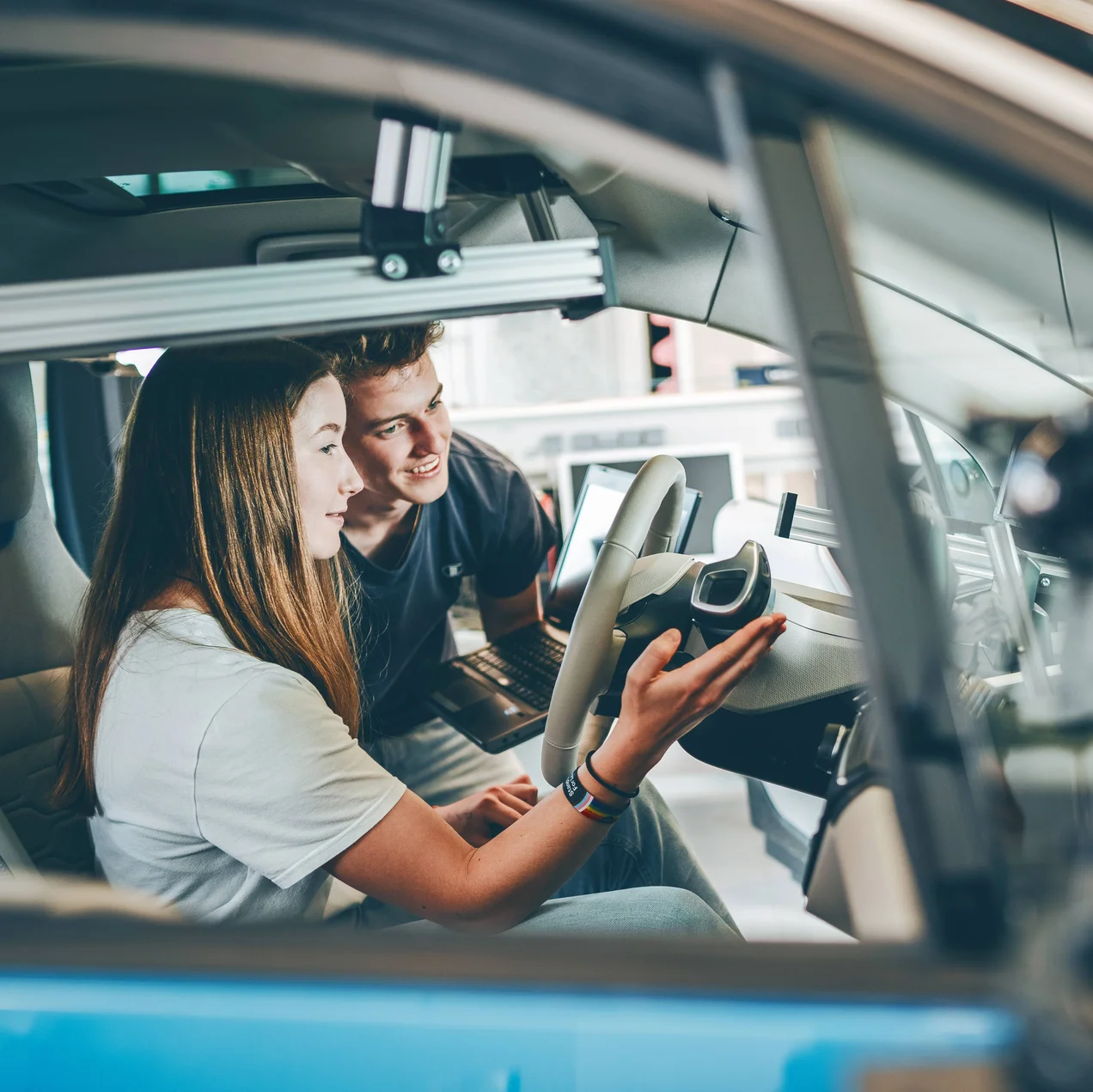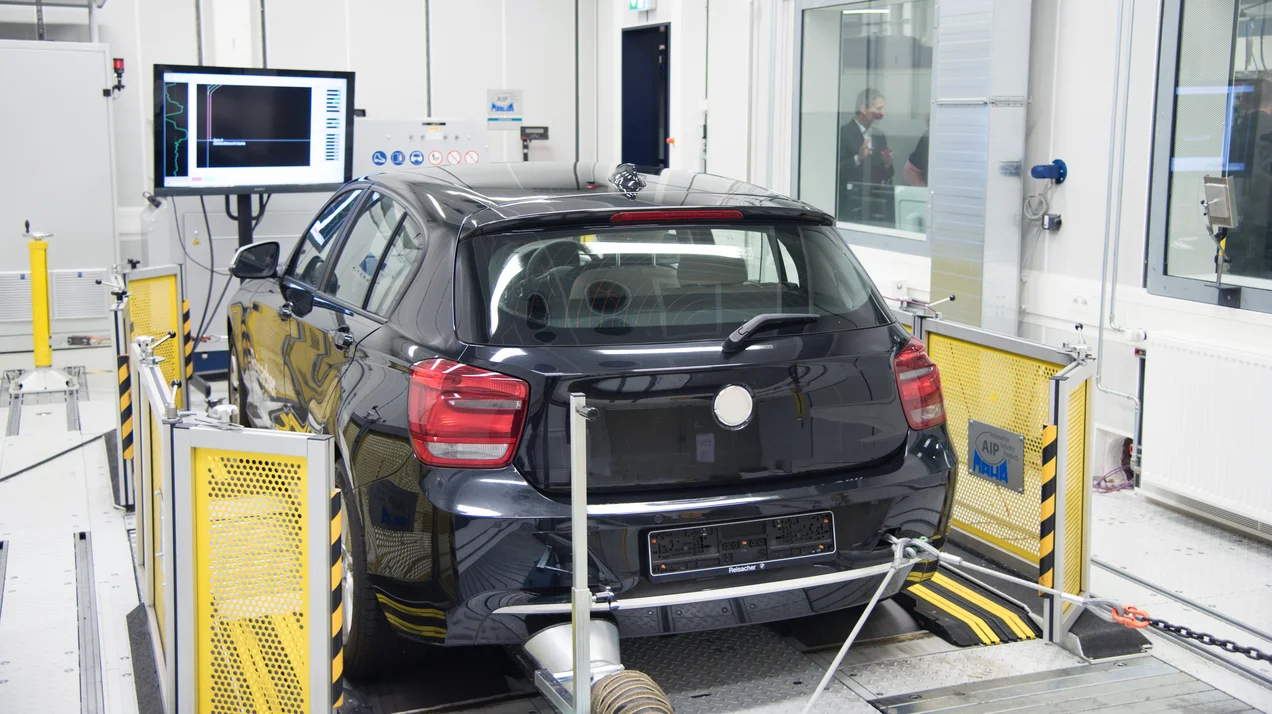

The Automotive Centre is equipped with a roller dynamometer with a 2-axle drive (2 × 150 kW), a dynamic engine test bench (370 kW) and an electrical source-sink (100 kW) for testing battery, hybrid and electric powertrains.
Real-world driving situations can be automatically simulated on both test benches, and the data obtained can be analysed using data mining. Multidomain simulations are also employed.
The research focuses on passenger cars, light commercial vehicles and e-bikes, with an emphasis on powertrain optimisation, efficient energy conversion and predictive energy management.
The centerpiece of the engine test bench is an asynchronous electric motor that functions as a brake. It delivers a maximum power output of 370 kW and a maximum torque of 900 Nm at a rated speed of 4,000 rpm. The maximum speed is 8,000 rpm. Since the maximum torque is available even at the lowest speeds, hybrid powertrains can also be tested on the test bench. In addition to stationary testing of engine operating points, dynamic engine operation is also possible. For example, certification-relevant driving cycles can be run on the engine test bench. Conditioning systems for coolant, engine oil, and fuel enable controllable and reproducible measurements. The test bench automation system allows for the planning of complex measurement sequences.
An indexing system for time-resolved pressure measurement in the cylinders allows a wide range of thermodynamic investigations. For example, combustion process analyses provide an insight into engine combustion, which is crucial for the efficiency and pollutant emissions of combustion engines.
The performance data of the engine brake allows the engine test bench to be used for almost all passenger car engines up to light commercial vehicle engines. In addition to its use in teaching, the engine test bench is also available for joint research and cooperation projects with industry.
The extensive measurement technology and the Morphee automation system enable complex test sequences to be carried out. Both stationary and dynamic engine operation are possible, which opens up a wide range of applications for working on a wide variety of issues.
The roller dynamometer at Ulm University of Applied Sciences is suitable for simulating dynamic test cycles with passenger cars and light commercial vehicles with an axle load of up to two tons. In combination with the methods of real-world driving data recording practiced at Ulm University of Applied Sciences, any route can be reproducibly simulated on the roller dynamometer. When testing vehicles with conventional internal combustion engines and hybrid powertrains, the available fuel consumption and exhaust gas measurement technology can be used to determine fuel consumption and pollutant emissions for any driving situation. Vehicles with hybrid or all-electric drives can be tested on the dynamometer to assess their range, with the goal of increasing range through a predictive operating strategy. With an electrical source and sink rated at 100 kW, electric vehicles can be operated independently of their battery, which allows tests to be conducted without being constrained by charging times.
Project manager: Prof. Dr.-Ing. Thomas Mayer
Project duration: 01.04.2023 - 31.03.2025
Funding provider: State - WM
Program name: Invest BW: Innovation and technology project
Project description:
The H2P project aims to research the use of ammonia as a combustion engine fuel and develop an ammonia combustion engine for mobile applications. As an alternative storage form of hydrogen, ammonia does not release any climate-damaging CO2 during combustion and burns with low emissions. However, ammonia is much more reluctant to ignite and also burns more slowly than conventional petrol and diesel fuel. In ammonia combustion engines that have already been implemented to date, this problem is usually solved by adding conventional fuels as an ignition aid, but this means that operation is no longer completely CO2-neutral.
The H2P project is investigating alternative measures to improve ammonia combustion that do not require the addition of another fuel and thus enable genuine CO2-neutral operation.
As part of a research cooperation between Ulm University of Applied Sciences and the company AIP GmbH & Co. KG from Haldenwang/Allgäu, new concepts for transferring real driving to chassis dynamometers are being investigated.
The driving robot James and a mobile exhaust measurement system (PEMS) are being used.
Heilmann, Oliver; Bocho, Britta; Frieß, Alexander; Cortès, Sven; Schrade, Ulrich; Casal Kulzer, André; Schlick, Michael:
Driving Profiles of Light Commercial Vehicles of Craftsmen and the Potential of Battery Electric Vehicles When Charging on Company Premises,
in: World Electric Vehicle Journal, 15(5), 211, MDPI, 2024, pages 17.
DOI: doi.org/10.3390/wevj15050211
ISSN: 2032-6653
Schmitz, Thomas:
Chassis concept of the individually steerable five-link suspension: a novel approach to maximize the road wheel angle to improve vehicle agility,
in: Automotive and Engine Technology, Vol. 9, art. no. 5, Springer Nature, 2024, pages 1-11.
DOI: doi.org/10.1007/s41104-024-00142-6
ISSN: 2365-5135
Schmitz, Thomas; Küppers, Theo:
Weight Reduction Strategies for Chassis Systems,
in: VDI-Berichte 2438, VDI, VDI-Verlag, 2024, pages 193-206.
ISBN: 978-3-18-092438-0
ISSN: 0083-5560
Cortès, Sven; Albers, Albert; Dettmann, Christian; Boche, Philipp:
Studie zur Bewertung des Einflusses einer alternativen Regelart in Bezug auf die Abbildung von Realfahrten auf Rollenprüfben,
in: Beiträge zum 5. Aalener Kolloquium antriebstechnische Anwendungen, Gretzschel, Moritz, Shaker, 2023, Seiten 60-78.
ISBN: 978-3-8440-8974-5, ISSN: 0945-0874
Schmitz, Thomas; Carlitz, Andreas:
Chassis concept of an individually steerable spatial steering axle with a large steering angle,
in: VDI-Berichte 2425, VDI, VDI-Verlag, 2023, pages 55-71.
DOI: doi.org/10.51202/9783181024256
ISBN: 978-3-18-092425-0, ISSN: 0083-5560
Schrade, Ulrich; Heilmann, Oliver:
Which braking systems must be installed in trucks in order to optimally relieve the wear-prone service brake, which contributes to particulate matter emissions?
in: VDI Report 2414, VDI Wissensforum GmbH, VDI-Verlag GmbH, Düsseldorf, 2023, pages 245-267.
DOI: doi.org/10.51202/9783181024140
ISBN: 978-3-18-092414-4, ISSN: 0083-5560
Cortès, Sven; Albers, Albert; Dettmann, Christian; Boche, Philipp:
Roller dynamometers - A development environment for the calibration and validation of vehicle powertrains in the context of RDE legislation?,
in: Dritev 2022, Volume 2401, VDI Wissensforum GmbH, VDI Verlag Düsseldorf, 2022, Pages 347-364.
DOI: 10.51202/9783181024010-347
ISBN: 978-3-18-092401-4
Cortès, Sven; Dettmann, Christian; Heinzelmann, Linus; Haidar, Omar:
Maneuver-based validation of a longitudinal dynamics simulation using generically generated real load curves,
in: Proceedings Langbeiträge ASIM SST 2022, 26th Symposium Simulationstechnik, TU Wien, ARGESIM Report 20, TU Verlag, Vienna, 2022, pages 119-127.
DOI: 10.11128/arep.20.a2001
ISBN: 978-3-901608-97-1
Cortès, Sven; Dettmann, Christian; Heib, Julian; Millberg, Felix:
Robustness analysis of a longitudinal dynamics simulation based on different quality criteria,
in: Proceedings Langbeiträge ASIM SST 2022, 26th Symposium Simulationstechnik, TU Wien, ARGESIM Report 20, TU Verlag, Vienna, 2022, pages 129-137.
DOI: 10.11128/arep.20.a2002
ISBN: 978-3-901608-97-1
Cortès, Sven; Dettmann, Christian; Mayer, Thomas; Junginger, Niklas; Lorenz, Artur et al.:
Entwicklung einer closed-loop Fahrzeugbremsregelung auf einem Rollenprüfstand,
in: Open Access Repositorium der Universität Ulm und THU., 2022, Seiten 17.
DOI: 10.18725/OPARU-44886
Cortès, Sven; Mayer, Thomas; Schlick, Michael; Aydin, Mustafa; Haidar, Omar:
Impact of variable driving conditions and additional consumers on the driving range and energy consumption of light commercial electric vehicles,
in: EVS35 Electric Vehicle Symposium Oslo 2022, 2022, pages 12.
DOI: 10.26226/m.628e4d5240b9604ad9d7a065
Mayer, Hannes; Tomaschko, Silvia; Mayer, Thomas; Lange, Günther:
New Method for Evaluating and Optimizing Transient Piston Friction and Cooling Using a High-Power Laser in Motored Operation,
in: SAE International Journal of Engines 16(4), SAE International, 2022, pages 14.
DOI: doi.org/10.4271/03-16-04-0025
ISSN: 1946-3936