

The Bachelor’s degree in Energy Economics at Ulm University of Applied Sciences equips you for one of the most important challenges of the future: making the energy transition affordable, secure and sustainable. You’ll learn through practical, hands-on experience from experts in research and industry, combining subjects such as management, energy economics, sustainable technologies and digitalisation. Through optional modules, projects, work placements and the option of a semester abroad, you can tailor your studies precisely to your interests. The Energy Economics programme prepares you for careers in a forward-looking and socially relevant professional field.

In the Bachelor’s program in Energy Economics, you’ll deepen your knowledge of sustainable management and sustainable energy technologies, energy economics, and digitalization. You’ll engage in hands-on learning and prepare specifically for the career opportunities arising from the energy transition.
The Energy Economics program lasts seven semesters and provides practical, interdisciplinary knowledge of sustainable energy technologies, energy economics, and management, ideally preparing you for specialist and leadership roles in the energy sector.
A pioneer since 2012: With a focus on management and corporate leadership, energy economics, sustainable energy technologies, and energy information management, THU offers a degree program that is unique in Germany and ideally prepares students for careers in the energy sector in specialist and leadership roles. Introduced in 2012 as Germany’s first bachelor’s degree program in Energy Economics and continuously updated, the program imparts all the skills necessary for the affordable, environmentally friendly, and safe implementation of the energy transition.
Perfectly tailored to the demands of the energy industry: The program takes an interdisciplinary approach, integrating content from the fields of energy economics, business and management, sustainable energy technologies, energy information management, and quantitative methods in energy economics. The individual specializations include the following course modules:
Customized Study Program Based on Your Interests: A wide range of electives, along with diverse projects and internships, allows you to tailor your studies to your specific interests. Depending on your preferences, you can choose electives focusing on business and management, sustainable energy technologies, or energy information management. In addition, an optional semester abroad at one of over 60 partner universities worldwide provides access to intercultural competence and new ideas and insights for implementing the energy transition—all without extending the standard duration of study. Building on the Bachelor’s degree in Energy Economics, THU offers two related Master’s programs: “Energy Research and Digital Transition” and “Electrical Energy Systems and Electromobility.”
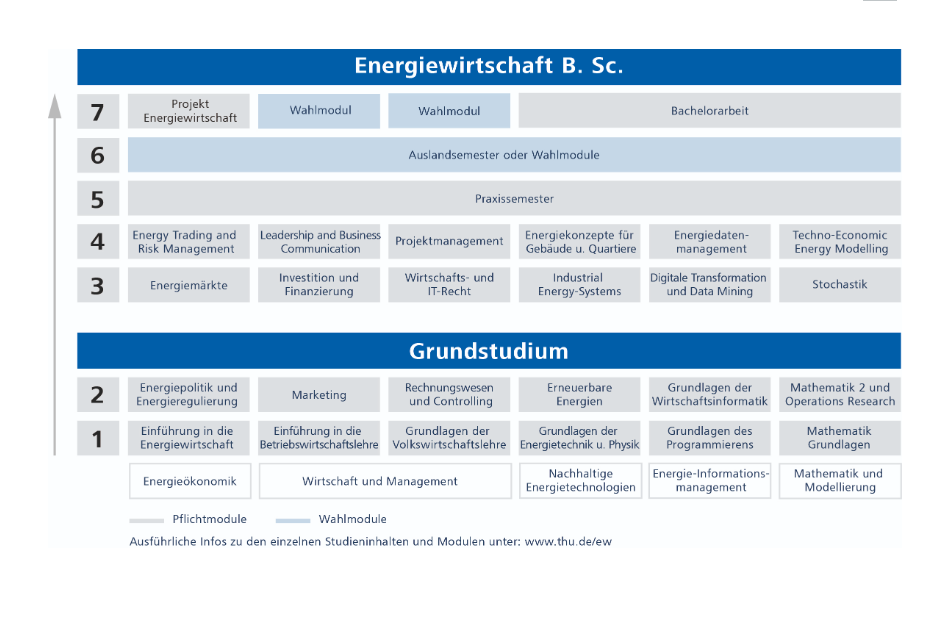
The Energy Management degree course can be studied without an NC, which means that no specific grade point average is required. The course requires a general higher education entrance qualification, a subject-specific higher education entrance qualification or an entrance qualification for universities of applied sciences. It is important that you have a strong interest in management and sustainable energy supply and are a team player who solves tasks with logical understanding and analytical thinking. Planning skills also play a key role in achieving projects and goals in a structured manner. The energy management course lasts seven semesters.
The Bachelor's degree in Energy Management opens up a wide range of career opportunities in a future-oriented industry. For example, you will work for energy suppliers, electricity grid operators or industrial companies and actively shape topics such as renewable energies, sustainability, energy trading or environmental management.
You will also take responsibility for projects and develop innovative energy concepts in energy and management consulting. If you are interested in research and development, you will analyze energy markets or prepare techno-economic assessments. In addition, international organizations, NGOs and public authorities offer exciting prospects in the areas of energy regulation, sustainability and public relations.