
The Institute for Business Organisation and Logistics (IBL) is responsible for teaching, research and consultancy across the value chain, from procurement through production to distribution. Its focus covers the entire spectrum, from strategy development through planning to implementation.
Topics range from procurement strategies and supply chain concepts, integrated production systems, activity-based costing and factory planning to order-picking and warehouse systems, telematics and RFID. In all these areas, particular emphasis is placed on the integration of IT systems, processes and organisation, with the aim of achieving end-to-end, lean business processes.
Faculty of Production Engineering & Production Management
In the field of business organization, the focus is on the internal aspects of the value chain. This includes the design of workplaces, the analysis of processes and the planning of production areas - with the help of the digital factory, among other things. The aim is to develop production systems that are optimized in terms of process reliability, ergonomics and costs. Production management deals with the operation and control of these systems. Important methods are
The field of logistics and supply chain management covers the planning, control and further development of logistics systems along the entire value chain. In physical logistics, the focus is on technical systems and their operational control, for example warehouse and conveyor systems, identification technologies (barcode, RFID), picking systems (pick-by-voice, pick-by-light, pick-by-vision), object localization (RTLS) and fleet telematics.
IT systems and tools for planning and optimizing logistics processes are also considered. With the transition to supply chain management, strategic issues take center stage. Companies are developing value creation strategies and coordinating these with suppliers and customers. Logistics is thus becoming a key competitive factor.
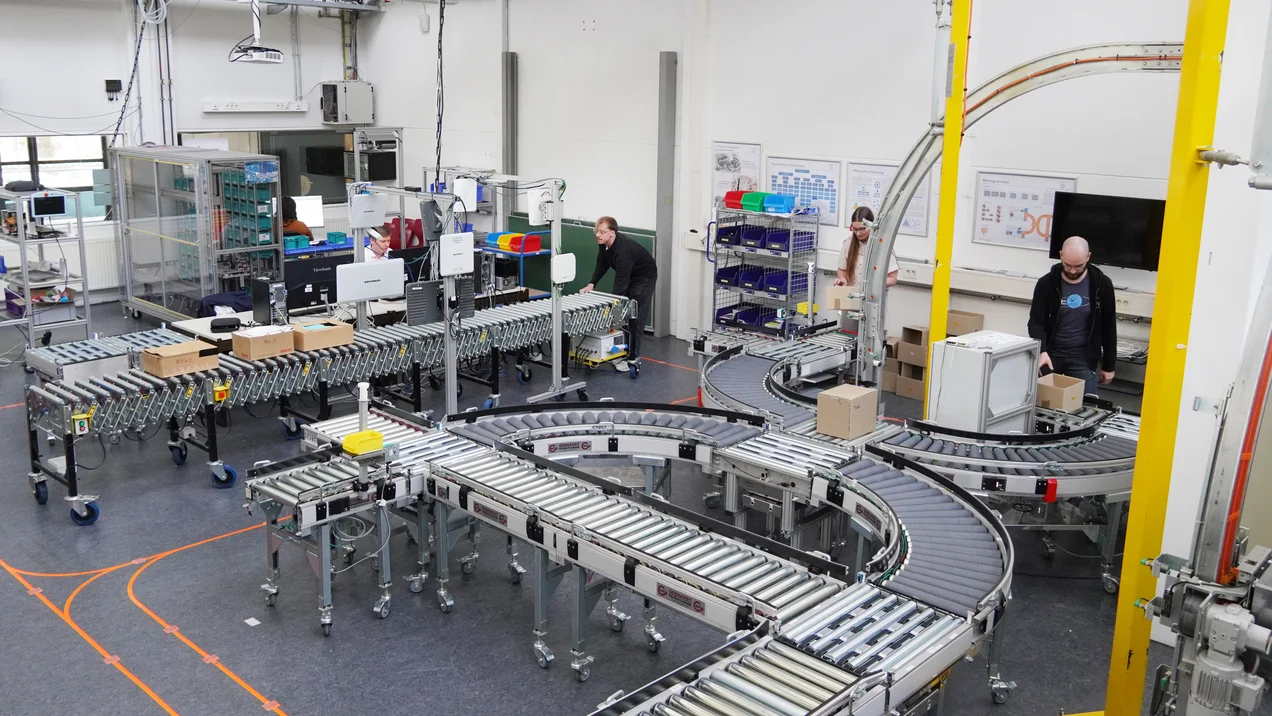
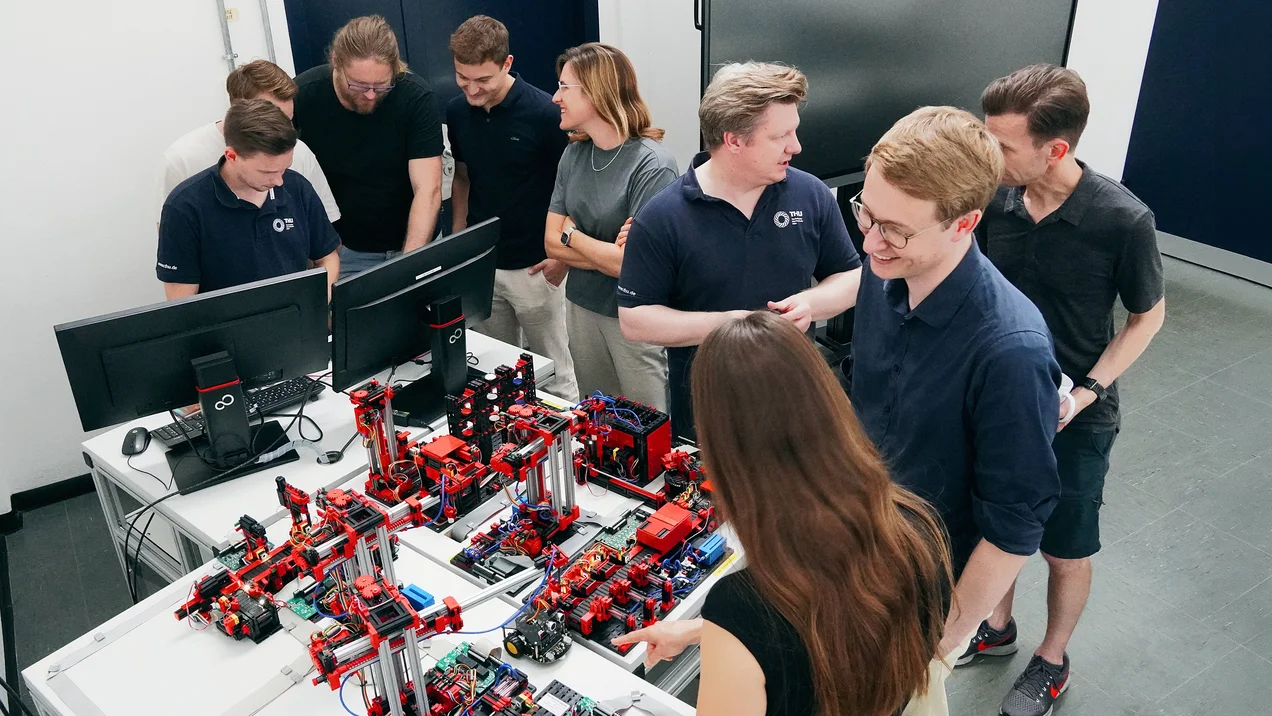
The institute operates a physical logistics laboratory and a computer laboratory for teaching and application. Business games are used to make the complexity of operational processes tangible. The learning environment covers topics such as Intralogistics 4.0, lean production, production support and supply chain management. Software solutions for planning, controlling and monitoring logistics systems and processes are also used. The logistics laboratory is currently being developed into a learning factory. The aim is to create a learning environment that makes it possible to experience the dynamics, flexibility and changeability of modern production systems in a practical way.
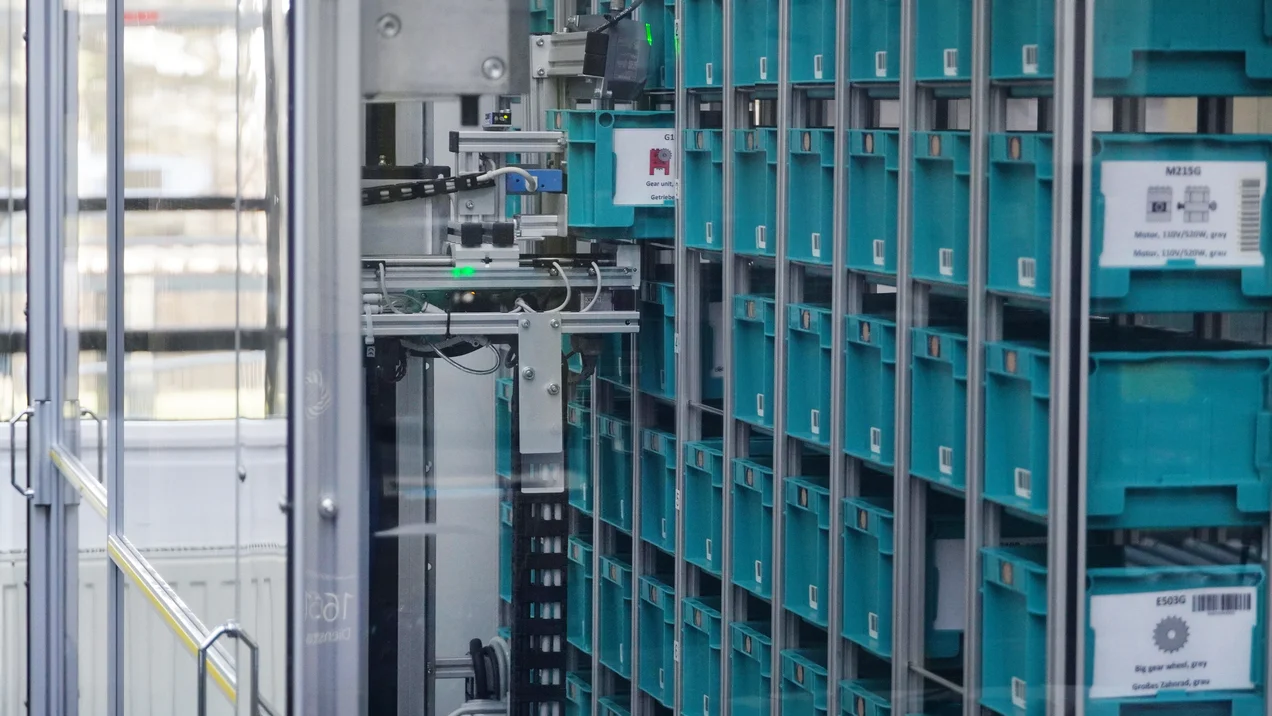
Automated smallparts warehouse (AKL)
The AKL can be operated using a modern warehouse management system. In this course, students learn how to use an automated small parts warehouse, e.g. goods-to-person picking and the effects of various warehouse strategies such as ABC zoning or chaotic storage.
Design of an RFID system for bulk detection
Students learn about the parameters and their interactions of a UHF RFID system using a realistic scenario from the textile industry. An antenna gate is used to detect textiles in a load carrier (cardboard box) in bulk.
Identification technologies
Students learn about barcode technology and its various forms during the course.
Paperless picking
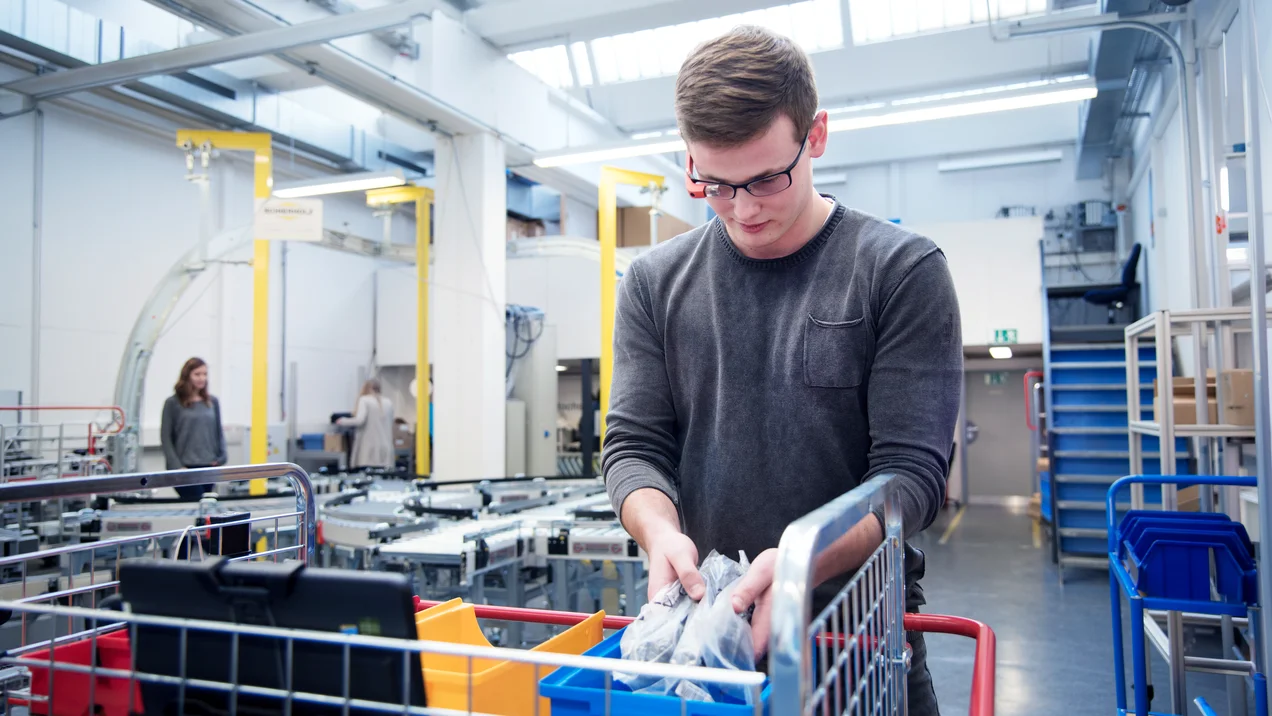
In this experiment, students learn about various technologies for paperless picking (pick-by-light, pick-by-voice, pick-by-vision) and compare them with picking with a receipt.
Flexible, decentrally controlled conveyor technology
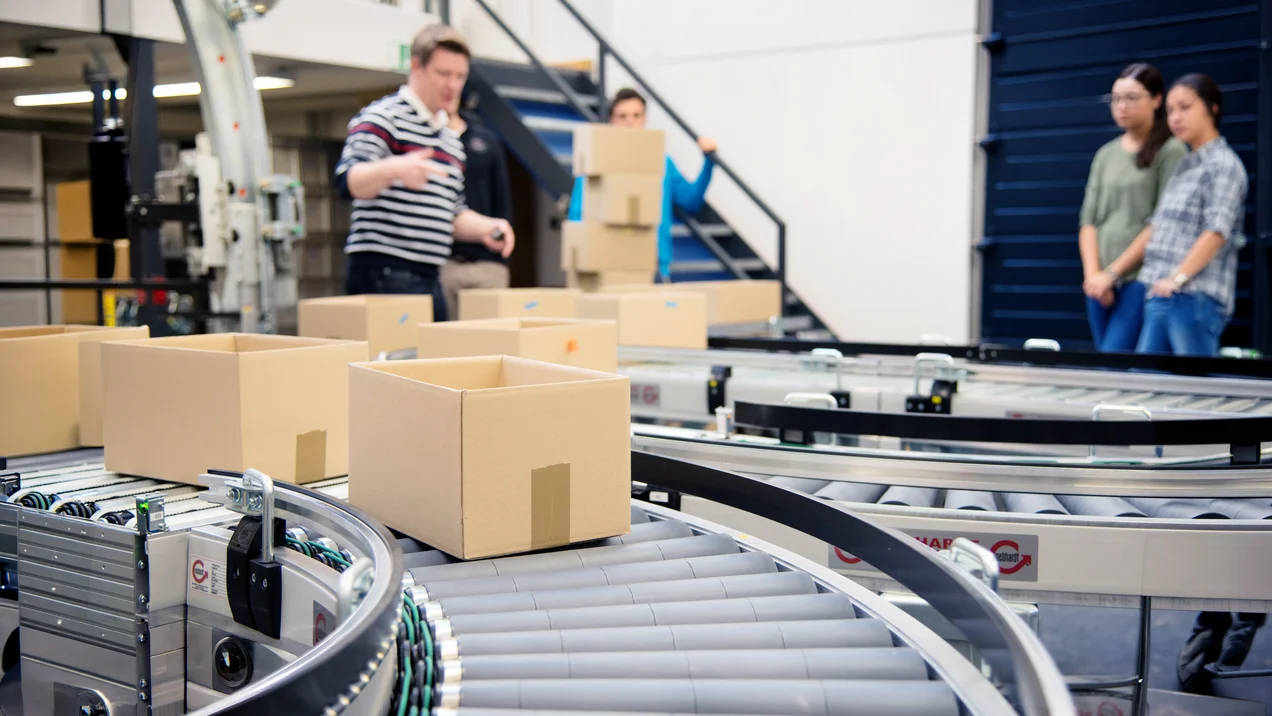
Configuration, commissioning and flexible modification of a flexible, decentrally controlled roller conveyor system are the activities of the students.
Fleet telematics - live control of order processes
Fleet telematics systems for road freight transport. Process support and vehicle monitoring for dispatchers and drivers. The students take on these functions and change roles.
Planning of production and logistics networks with 4flow vista
Design and analysis of production and logistics networks with the network planning software 4flow vista is the task of the students in the exercises.
SAP case studies
Students work independently on case studies in SAP S4/Hana on materials management, production planning and control and sales and distribution. They are supported by members of the institute through consultations.
Aspin simulation game: Setup optimization using the SMED method with video analyses
Setup processes and therefore setup times are optimized for the production of gyroscopes in different variants. The basis for the optimization is the SMED method (Single Minute Exchange of Die), supported by video analyses with the SOLME AviX system.
Simulation game Wüstenflitzer
The efficiency of assembly processes is influenced by the work plans and parts lists provided, among other things. Students actively experience this through multi-stage adaptations of an assembly process with different parts lists and construction plans.
Production Line simulation game
With this software-supported simulation gamewhich uses the principle of game-based learning students learn how to design a production system in terms of sequencing, balancing the production of product variants and setting up a smooth material flow.
Simulation game MIT Beer Game
With the famous simulation game on a four-stage supply chain, which was developed at MIT, students experience the bullwhip effect at first hand and then discuss possible solutions for the organizational and communicative improvement of supply chains.
Friday Night at the ER simulation game
Teams of 4 students are involved in this simulation game are challenged to manage a busy hospital for 24 hours. Good teams learn the way from silo thinking to systems thinking.
The main target group of our learning factory are students of industrial engineering and production management. Other target groups are students of electrical engineering, mechanical engineering and computer science. Skills are taught in stages according to Bloom's taxonomy with the levels of knowledge, understanding, application, analysis, synthesis and evaluation.
Before the students use the learning factory, they receive a number of lectures on the subject of industrial production(knowledge). After this preparation, the students take on the role of workers in the learning factory and operate the system, i.e. they manufacture products according to instructions that they receive dynamically via digital work assistance systems. In doing so, they link the theoretical concepts with the elements of the learning factory(understanding) and apply their knowledge(application). The use of the learning factory to acquire basic skills is particularly important for prospective industrial engineers. At the next competence level, analysis, the learning factory also becomes interesting for other disciplines.
Here, students analyze in detail the functioning of individual technical devices and components, e.g. an automated guided vehicle (AGV), an automated small parts warehouse (AKL), a modular, decentrally controlled conveyor system (FlexFörderer) and various AutoID technologies. In addition, worker assistance systems and application software systems are also scrutinized. While industrial engineering students aim to develop a general understanding of these components and their interactions, electrical engineering and mechanical engineering students focus more closely on specific details, in particular the control concepts and certain mechanical aspects. Computer science students analyze information flows and information processing, especially in MES.
As a second step at this competence level, analyses are carried out to prepare the subsequent synthesis: Industrial engineering students analyze the factory in terms of efficiency, using methods such as value stream analysis, time studies
and ergonomics studies. Electrical engineering students concentrate on sensors and actuators as well as the control systems and automation networking of machines and systems, while mechanical engineers deal in depth with specific mechanical components.
At the synthesis competence level, students acquire the ability to improve existing systems or develop new ones. Industrial engineering students optimize the learning factory with regard to production efficiency. This is done according to the principles of lean production, e.g. by optimizing Kanban parameters or changing the factory design, as well as according to concepts of digitalization, e.g. by configuring RFID systems. Electrical engineering students renew and expand automation technology systems, e.g. by introducing new communication protocols such as OPC UA, while mechanical engineers optimize mechanical components such as grippers. Computer science students expand software components such as the Manufacturing Execution System (MES), the warehouse management system or worker assistance systems.
At this level, the teaching method shifts from prepared and standardized laboratory experiments to simulation experiments and project work. The development of new capabilities of the factory and new resources for it, including its digital twins, requires interdisciplinary
projects between the different study programs. The project work is to a certain extent one-off in nature: if the solutions developed by the students are of sufficient quality, they are integrated into the learning factory so that it is constantly evolving.
At the highest level of competence, evaluation, students assess new technologies that are currently being discussed in industry but have not yet been integrated into the Learning Factory. In recent years, these have been technologies such as skill-based control. Currently, topics such as asset administration shells and augmented reality-based assistance systems are moving into focus.
The Institute for Business Organization and Logistics is active in the field of Industry 4.0 and participates in related projects: