
Sensor technology plays a key role in the development of smart systems for mobility, safety and environmental monitoring. Modern research projects demonstrate how innovative sensor solutions can help to tackle real-world challenges efficiently and sustainably.
An important area of application is safe and sustainable mobility. Bicycles are equipped with mobile sensors to detect road damage, obstacles and dangerous traffic situations. With the help of a citizen science approach, citizens are also actively involved in data collection.
Another field of application is wildlife detection. The combination of radar, IR camera and AI-supported data processing is intended to reliably detect wild animals and reduce traffic accidents. Modern machine learning methods enable precise classification of movement patterns.
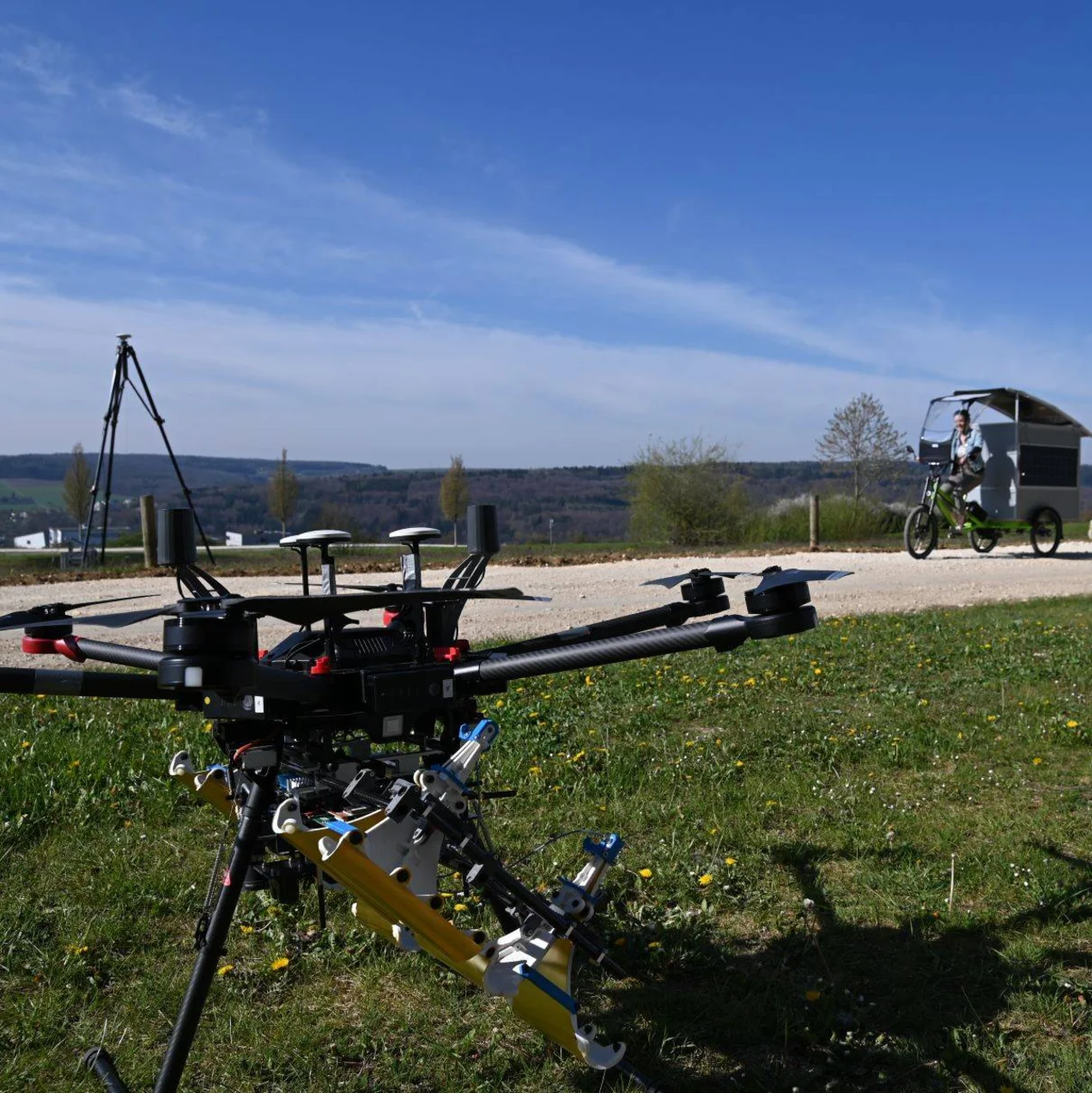
Sensor technology is also used in UAV-supported systems for mine detection. Here, radar and metal detector systems as well as intelligent signal processing and sensor data fusion are used to efficiently detect and classify landmines.
Project manager: Prof. Dr. Hubert Mantz
Project duration: 01.08.2024 - 31.07.2025
Funded by: Federal Government - BMBF
Program name: DATIpilot
Project description:
The research project aims to equip bicycles with mobile sensor technology (including acceleration, lidar and radar sensors) in order to record the road condition with spatial resolution and in real time. The aim is to identify, localize and document damage and obstacles in order to increase road safety and enable effective road maintenance. One of the ways we are implementing this is through an innovative citizen science approach that involves interested road users. Another scientific and technical project objective is to gather knowledge about suitable sensor technologies that can record, transmit and evaluate data in real time. This will form the basis for publications and presentations at conferences as well as for further research projects.
Project manager: Prof. Dr.-Ing. Thomas Walter and Prof. Dr. Hubert Mantz
Project duration: 01.09.2022 - 30.08.2024
Funding: Federal Government - BMVI
Program name: mFUND - Data Innovations for Mobility 4.0
Project description:
The aim of this project is to develop an intelligent wildlife detection system. The radar-based detection of wild animals enables increased protection of vulnerable road users. In the project, THU is developing a test box with a solar energy supply in order to classify wild animals based on AI methods using a combination (cross-modal learning) of radar, IR camera and IR array. The collected data will also be used to develop artificial intelligence-based data processing in order to recognize and classify wild animals such as hunting game using movement patterns. In addition to basic signal processing and the development of self-learning algorithms, the radar data must be reduced to significant features in particular. The aim is to achieve an overall object recognition accuracy of at least 95%. The data processing algorithms based on the test data obtained are linked to the prototype to be developed and optimized. A test is carried out in relevant environments such as wildlife bridges and game reserves.
Project manager: Prof. Dr.-Ing. Thomas Walter
Project duration: 01.12.2019 - 30.09.2024
Funded by: Stiftung
Project description:
FindMine Metal (FMM) is the second phase of FindMine, a joint project to detect landmines using drones. In the second phase, THU is developing metal detectors and associated signal processing and applying this system to a UAV being developed by ETH Zurich. The project is funded by the Urs Endress Foundation. Partners are the University of Ulm, ETH Zurich and the Foundation.
Based on the work from FindMine Metal, the metal detector for detecting landmines is to be further developed. In particular, the attachment to a UAV is to be optimized. Furthermore, a classification capability for different types of mines and debris is to be implemented.
FindMine Radar II (FMR2) is concerned with the UAV-supported detection of landmines. In FMR2, a ground-guided radar platform is being developed with which so-called AB scans are carried out (downlooking radar). The influences of vegetation and soil properties are being investigated and adapted signal processing is being developed. Furthermore, sensor data fusion with the metal detector is to be carried out in order to map and classify inhomogeneities in the ground.
In FindMine fk, a fast and efficient SAR algorithm for radar-based mine detection with UAV platforms is to be developed and implemented. The so-called Stolt fk migration allows real-time processing and is therefore significantly faster than back projection.
Project leader: Prof. Dr.-Ing. Thomas Walter, Prof. Michael Schlick
Project duration: 01.02.2022 - 31.12.2022
Funding provider: Federal Government - BMBF
Program name: University competition for the Science Year 2022 - In demand! Science in Dialogue (WiD)
Project description:
The aim of the project is to make cycling safer as a sustainable form of mobility in Ulm and to take interested citizens on a journey through the research cycle. A radar sensor is used, which citizens can attach to their bicycles. This measures both the distance and the speed of vehicles passing (often too closely). In this way, dangerous spots for cyclists in Ulm can be identified and documented with data.
Project leader: Prof. Dr.-Thomas Walter, Prof. Dr. rer. nat. Hubert Mantz
Project duration: 01.01.2019 - 31.12.2020
Funding provider: State - MWK / EFRE
Program name: Centers for Applied Research at Universities (ZAFH)
Project description:
ZAFH MikroSens is a joint project led by Ulm University of Applied Sciences with the partners Heilbronn University of Applied Sciences, Pforzheim University of Applied Sciences and Ulm University, which has been funded by both the State of Baden-Württemberg (MWK) and the EU (EFRE) since the end of 2015.
The network has set itself the goal of transferring radar sensor technology from the automotive sector to industrial applications. For example, sensors have been and are being developed at THU that can safeguard the environment of robots in the field of automation technology or classify the surface quality of roads. With the entry into terahertz sensor technology (frequency range greater than 100 GHz), a significant miniaturization of the sensors and thus also of the systems was achieved.
In addition to automation technology, other fields of application such as agriculture, environmental sensors, media sensors and medical technology were also addressed in MikroSens. An image film was created for the project, which reflects the diversity of applications for radar sensors (YouTube link). One focus of the joint project is the cooperation with medium-sized companies. In the context of MikroSens, collaborations have been initiated with more than 20 companies from Baden-Württemberg.
In addition to terahertz sensor technology, other innovative technologies are being used in the MikroSens joint project. For example, an FPGA-based backend was developed at Pforzheim University, which enables fast range Doppler maps and real-time processing using high-resolution chirp sequence modulation. At Heilbronn University of Applied Sciences, radar signal processing with neural networks (CNN) was implemented to classify the boiling process in order to prevent milk from boiling over. The University of Ulm has developed dielectric waveguides that not only conduct electromagnetic waves, but can also radiate (and receive) them in a directed manner through vaporized antenna elements. With this concept, robot arms can be wrapped around to quickly detect a potentially dangerous approach by humans.
A special highlight was a THU exhibit at the BUGA 2019 in Heilbronn. Radar-based gesture recognition was used to conduct the Württemberg Chamber Orchestra Heilbronn (including the European anthem from Beethoven's 9th Symphony). The video created for this purpose and the music played at the same tempo as the visitors conducted. However, the orchestra paid attention to quality: anyone who conducted irregularly was first given a polite warning. In the event of repetition, the orchestra stood up and left the stage (with appropriate remarks and gestures). The exhibit was tested by more than 10,000 visitors at the BUGA.
Project manager: Prof. Dr.-Ing. Thomas Walter, Prof. Dr. rer. nat. Hubert Mantz
Project duration: 01.07.2018 - 30.07.2020
Funded by: State - MWK / EFRE
Program name: Promotion of technology transfer between universities of applied sciences (HAW) and small and medium-sized enterprises (SMEs) - HAW-KMU TT program
Project description:
Cyclists and deer have something in common: they are frequently involved in traffic accidents. On average, nine cyclists have an accident on German roads every hour. A deer accident occurs every two minutes. A research team at Ulm University of Applied Sciences led by Prof. Hubert Mantz is trying to prevent such accidents.
The aim of the project "Safe and sustainable mobility for rural and urban regions through intelligent road infrastructure" (SALUS) is to develop an intelligent road infrastructure. It is designed to detect wild animals and cyclists using radar sensors and then issue a warning to other road users. A key challenge of the research project is to develop a suitable radar sensor system using innovative and highly integrated millimeter wave technology that enables the clear classification of cyclists and wild animals. New machine learning methods will be used to evaluate the sensor data. THU is conducting research on this project together with Heilbronn University, business partners and the Baden-Württemberg Forest Research Institute.
Project manager: Prof. Dr.-Ing. Thomas Walter
Project duration: 01.01.2017 - 30.04.2020
Funded by: Federal Government - BMBF
Program name: Elevate
Project description:
KoRRunD is a sub-project of the BMBF Elevate cluster. The aim is to further develop radar-based driver assistance systems for automated driving. In particular, cooperative radar sensors are being developed and validated to enable all-round visibility around the vehicle. The task of Ulm University of Applied Sciences is the development and validation of a target simulator for complex targets, with which the classification capability of radar sensors can be evaluated.
Project manager: Prof. Dr. Hubert Mantz
Project duration: 01.07.2017 - 30.06.2019
Funded by: Federal Government - BMBF
Program name: Funding of an ideas competition for the establishment and expansion of innovative R&D networks with partners in countries bordering the Danube
Project description:
The project aims to develop, implement and test various driver assistance systems for bicycles (for passenger and freight transport). For example, the use of radar sensors to detect other road users is conceivable; differentiating between trucks, cars and other bicycles, for example, is crucial here. The radar sensors can also detect road conditions and thus distinguish dry from wet or slippery surfaces. In an ageing society (which will increasingly be riding electric bikes in the future), this can lead to a significant increase in safety in combination with other sensors. Furthermore, innovative drive and energy concepts for cargo bikes are to be designed and implemented in a study in cooperation with universities and companies along the Danube. In accordance with the know-how, experience and synergies of the network partners designated to date, the scientific research and application projects will be assigned to the areas of need of intelligent mobility and sustainable management and energy of the German government's high-tech strategy. The aim of the first phase is to network German scientists and companies with partners from Serbia and Hungary. In the second phase, a joint research proposal will be developed. With InBiDAS, a network of universities and SMEs from countries along the Danube is to be established for the joint development of an EU application or similar measures.
Arendt, Bernd; Schneider, Michael; Walter, Thomas:
Enhancing the Detection Probability of Buried Objects by Phase Analysis of a SFCW-GPR,
in: IEEE International Geoscience and Remote Sensing Symposium, Athens, Greece, 2024, IEEE, 2024, pages 10997-11000.
DOI: 10.1109/IGARSS53475.2024.10642654
ISBN: 979-8-3503-6033-2
ISSN: 2153-7003
Arendt, Bernd; Schneider, Michael; Mayer, Winfried; Walter, Thomas:
Environmental Influences on the Detection of Buried Objects with a Ground-Penetrating Radar,
in: Remote Sens. vol. 16, no.6, MDPI, 2024, pages 28.
DOI: doi.org/10.3390/rs16061011
ISSN: 2072-4292
Schneider, Michael; Arendt, Bernd; Walter, Thomas; Mantz, Hubert:
Increasing the Reliability of GPR Detection of Buried Targets by Combination with Vegetation Indices,
in: IGARSS 2024 - 2024 IEEE International Geoscience and Remote Sensing Symposium, Athens, Greece, IEEE, 2024, pages 7821-7824.
DOI: 10.1109/IGARSS53475.2024.10640618
ISBN: 979-8-3503-6032-5
ISSN: 2153-7003
Arendt, Bernd; Walter, Thomas; Mayer, Winfried:
Interference Effects of Shallow Buried Targets on a GPR,
in: IGARSS 2023 - 2023 IEEE International Geoscience and Remote Sensing Symposium, Pasadena, CA, USA, IEEE, 2023, pages 4.
DOI: doi: 10.1109/IGARSS52108.2023.10282704
Arendt, Bernd; Walter, Thomas; Mayer, Winfried:
Buried Target Detection with a UAV Based GPSAR-System using a Circle-Hough-Transformation,
in: IGARSS 2023 - 2023 IEEE International Geoscience and Remote Sensing Symposium, Pasadena, CA, USA, IEEE, 2023, pages 4.
DOI: doi: 10.1109/IGARSS52108.2023.10283375
Grathwohl, Alexander; Arendt, Bernd; Grebner, Timo; Waldschmidt, Christian:
Detection of Objects Below Uneven Surfaces With a UAV-Based GPSAR,
in: IEEE Transactions on Geoscience and Remote Sensing, IEEE, 2023, pages 15.
DOI: 10.1109/TGRS.2023.3271826
ISSN: 0196-2892
Romero, Ivan; Walter, Thomas; Mariager, Simon:
Depth Analysis for Continuous Wave Metal Detector for UAV Applications,
in: IGARSS 2023 - 2023 IEEE International Geoscience and Remote Sensing Symposium, Pasadena, CA, USA, IEEE, 2023, pages 4.
DOI: 10.1109/IGARSS52108.2023.10282145
ISSN: 2153-7003, ISBN: 979-8-3503-2010-7
Romero, Ivan; Walter, Thomas; Mariager, Simon:
Wavelet Transform Analysis for a Continuous Wave Metal Detector for UAV Applications,
in: IGARSS 2023 - 2023 IEEE International Geoscience and Remote Sensing Symposium, Pasadena, CA, USA, IEEE, 2023, pages 4.
DOI: 10.1109/IGARSS52108.2023.10282736
ISSN: 2153-7003, ISBN: 979-8-3503-2010-7
Arendt, Bernd; Grathwohl, Alexander; Waldschmidt, Christian; Walter, Thomas:
Influence of Vegetation on the Detection of Shallowly Buried Objects with a UAV-Based GPSAR,
in: IGARSS 2022 - 2022 IEEE International Geoscience and Remote Sensing Symposium, IEEE, 2022, pages 100-103.
DOI: 10.1109/IGARSS46834.2022.9883635
ISSN: 2153-7003
Grathwohl, Alexander; Arendt, Bernd; Walter, Thomas; Waldschmidt, Christian:
Influence of Soil Moisture on the Detection of Buried Objects Using an Airborne GPSAR,
in: 2022 IEEE/MTT-S International Microwave Symposium - IMS 2022, IEEE, 2022, pages 433-435.
DOI: 10.1109/IMS37962.2022.9865400
ISSN: 2576-7216
Mutschler, Marc A.; Scharf, Philipp A.; Rippl, Patrick; Gessler, Timo; Walter, Thomas; Waldschmidt, Christian:
River Surface Analysis and Characterization using FMCW Radar,
in: IEEE Journal of Selected Topics in Applied Earth Observations and Remote Sensing Volume 15, IEEE, 2022, pages 11.
DOI: 10.1109/JSTARS.2022.3157469
ISSN: 2151-1535
Rippl, Patrick; Iberle, Johannes; Walter, Thomas:
Classification of Vulnerable Road Users Based on Spectrogram Autocorrelation Features,
in: 18th European Radar Conference (EuRAD), 2021, IEEE, IEEE Xplore, 2022, pages 293-296.
DOI: 10.23919/EuRAD50154.2022.9784539
ISBN: 978-2-87487-065-1
Rippl, Patrick; Iberle, Johannes; Scharf, Philipp A.; Walter, Thomas:
Radar Scenario Generation for Automotive Applications in the E Band,
in: IEEE Journal of Microwaves, Volume 2, Issue 2, IEEE, 2022, Pages 253-261.
DOI: 10.1109/JMW.2022.3153690
ISSN: 2692-8388
Rippl, Patrick; Walter, Thomas:
Near Range Target Generation By Direct Replay of Measurements,
in: 14th German Microwave Conference (GeMiC), IEEE, IEEE Xplore, 2022, pages 72-75.
ISBN: 978-3-9820397-2-5
Rippl, Patrick; Schoeder, Pirmin; Grebner, Timo; Waldschmidt, Christian; Walter, Thomas:
Variable Traffic Scenario Generation for Testing Automotive Radar Sensors,
in: 19th European Radar Conference (EuRAD), 2022, IEEE, IEEE Xplore, 2022, pages 9-12.
DOI: 10.23919/EuRAD54643.2022.9924859
ISBN: 978-2-8748-7071-2
Romero, Ivan; Walter, Thomas; Mariager, Simon:
Performance Analysis and Simulation of a Continious Wave Metal Detector for UAV Applications,
in: IGARSS 2022 - 2022 IEEE International Geoscience and Remote Sensing Symposium, IEEE, 2022, pages 7222-7225.
DOI: 10.1109/IGARSS46834.2022.9883102
ISSN: 2153-7003
Burr, Ralf; Schartel, Markus; Grathwohl, Alexander; Mayer, Winfried; Walter, Thomas; Waldschmidt, Christian:
UAV-BorneFMCW InSAR for Focusing Buried Objects,
in: IEEE GEOSCIENCE AND REMOTE SENSING LETTERS, IEEE, IEEE Journals, 2021, pages 5.
DOI: 10.1109/LGRS.2021.3094165
ISSN: 1545-598X / eISSN: 1558-0571
Arendt, Bernd; Burr, Ralf; Walter, Thomas:
Influence of Gravel On Object Detection with a Uav-Based Ground Penetrating Radar,
in: 2021 IEEE International Geoscience and Remote Sensing Symposium IGARSS, 2021, Institute of Electrical and Electronics Engineers (IEEE), IEEE, 2021, pages 4.
DOI: 10.1109/IGARSS47720.2021.9554461
ISBN: 978-1-6654-0369-6 / ISSN: 2153-7003
Iberle, Johannes; Rippl, Patrick; Walter, Thomas:
ARadar Target Simulator for Generating Synthesised and Measured micro-Doppler-Signatures of Vulnerable Road Users,
in: 2020 17th European Radar Conference (EuRAD), 2021, IEEE, IEEE, 2021, pages 4.
DOI: 10.1109/EuRAD48048.2021.00063
ISBN: 978-2-87487-061-3
Iberle, Johannes; Rippl, Patrick; Walter, Thomas:
ANear-Range Radar Target Simulator for Automotive Radar Generating Targets of Vulnerable Road Users,
in: IEEE Microwave and Wireless Components Letters (Vol.: 30, Issue: 12, Dec. 2020), IEEE (ed.), IEEE, 2020, pages 5.
DOI: 10.1109/LMWC.2020.3030231
ISSN: 1558-1764 (online) / 1531-1309 (print)
Rippl, P.; Iberle, J.; Mutschler, M. A.; Scharf, P. A.; Mantz, H.; Walter, T.:
Analysis of pedestrian gait patterns using radar based Micro-Doppler Signatures for the protection of vulnerable road users,
in: 2020 IEEE MTT-S International Conference on Microwaves for Intelligent Mobility (ICMIM), Linz, 2020, IEEE (ed.), IEEE, 2020, pages 4.
DOI: 10.1109/ICMIM48759.2020.9299029, ISBN: 978-1-7281-6755-8 (eISBN) / 978-1-7281-6756-5 (PoD)
Geiger, M.; Hügler, P.; Galler, T.; Bandel, T.; Ott, P. ; Rech, W.; Walter, T.; Waldschmidt, C.:
A160-GHz radar sniffer probe for honey bee detection,
in: Passive and Active Millimeter-Wave Imaging XXIII, Proc. SPIE Conference, David A. Wikner and Duncan A. Robertson, Eds. SPIE (Eds.), 2020, pages 10.
DOI: 10.1117/12.2556145
Teutsch, Michael; Sedelmaier, Simone; Moosbauer, Sebastian; Eilertsen, Gabriel; Walter, Thomas:
An Evaluation of Objective Image Quality Assessment for Thermal Infrared Video Tone Mapping,
in: 2020 IEEE/CVF Conference on Computer Vision and Pattern Recognition Workshops (CVPRW), Seattle, WA, USA, 2020, IEEE (Eds.), IEEE, 2020, pages 9.
DOI: 10.1109/CVPRW50498.2020.00062, ISBN: 978-1-7281-9360-1 (eISBN) / 978-1-7281-9361-8 (PoD)
Burr, Ralf; Schartel, Markus; Mayer, Winfried, Walter, Thomas, Waldschmidt, Christian:
Abroadband UAV-Based FMCW GPR and the Influence of Vegetation,
in: Proc. of GeMIC 2019, 2019, pages 4
Burr, Ralf; Schartel, Markus; Mayer, Winfried; Walter, Thomas; Waldschmidt, Christian:
UAV-basedpolarmimetric synthetic aperture radar for mine detection,
in: Proc. of IGARSS 2019, Yokohama, 2019, pages 4.
Erhart, Christian; Lutz, Steffen ; Mutschler, Marc; Scharf, Philipp; Walter, Thomas; Mantz, Hubert; Weigel, Robert:
Compact polarimetry for automotive applications,
in: International Journal of Microwave and Wireless Technologies, 2019, Cambridge University Press, 2019, pages 1-7.
DOI: 10.1017/S1759078718001617
Güth-Thiel, Sabine; Kraus-Kuleszka, Ines; Mantz, Hubert; Hoth-Hannig, Wiebke; Hähl, Hendrik; Dudek, Johanna; Jacobs, Karin; Hannig, Matthias:
Comprehensivemeasurementsofsalivarypelliclethicknessformedatdifferentintraoral sites on Si wafers and bovineenamel,
in: Colloids and Surfaces B: Biointerfaces, 174, 2019 (online 2018), Number of pages: 6, p. 246-251.
DOI: 10.1016/j.colsurfb.2018.11.020
https://www.sciencedirect.com/science/article/pii/S0927776518307951
Heinzel, Andreas; Schartel, Markus ; Burr, Ralf, Bähnemann Rik; Schreiber, Eric; Peichl, Markus; Waldschmidt, Christian:
Acomparison of ground-based and airborne SAR systems for the detection of landmines, UXO, and IEDs,
in: Proceedings Volume 11003, Radar Sensor Technology XXIII; 1100304 (SPIE), SPIE Defense + Commercial Sensing, 2019, Baltimore, Maryland, United States (ed.), 2019, pages 9.
DOI: 10.1117/12.2518587
Iberle, Johannes; Mutschler, Marc, Scharf, Philipp; Walter, Thomas:
ARadar Target Simulator Concept for Close-Range Targets with Micro-Doppler Signatures,
in: Proc. of GeMIC 2019, 2019, pages 4.
Iberle, Johannes; Mutschler, Marc; Scharf, Philipp; Walter, Thomas:
ARadar Target Simulator for Generating Micro-Doppler-Signatures of Vulnerable Road Users,
in: Proc. of EuMW 2019, Paris, 2019, pages 4.
Mutschler, Marc; Scharf, Philipp; Mantz, Hubert; Walter, Thomas; Waldschmidt, Christian:
Feature Extraction for Classification of Water Surfaces using a 24 GHz CW Radar,
in: Proc. of EuMW 2019, Paris, 2019, pages 4.
Scharf, Philipp; Mutschler, Marc; Iberle, Johannes; Mantz, Hubert; Walter, Thomas; Waldschmidt, Christian:
Spectroscopic Estimation of Surface Roughness Depth for mm-Wave Radar Sensors,
in: Proc. of EuMW 2019, Paris, 2019, pages 4.
Schartel, Markus; Burr, Ralf; Mayer, Winfried; Waldschmidt, Christian:
Airborne Tripwire Detection Using aSynthetic Aperture Radar,
in: IEEE GEOSCIENCE AND REMOTE SENSING LETTERS, IEEE (ed.), 2019, pages 5.
DOI: 10.1109/LGRS.2019.2917917, Online ISSN: 1558-0571
Scharf, Philipp A.; Iberle, Johannes; Mantz, Hubert; Walter, Thomas; Waldschmidt, Christian:
Multiband Microwave Sensing for Surface Roughness Classification,
in: Proc. of IMS 2018, Philadelphia, 2018, Number of pages: 4.
Mutschler, Marc A.; Scharf, Philipp A.; Fonfara, Pascal; Mantz, Hubert; Walter, Thomas; Waldschmidt, Christian:
Radar Based Rain Drop Classification for Industrial Applications,
in: Proc. of ICMIM 2018, Munich, 2018, Number of pages: 4.