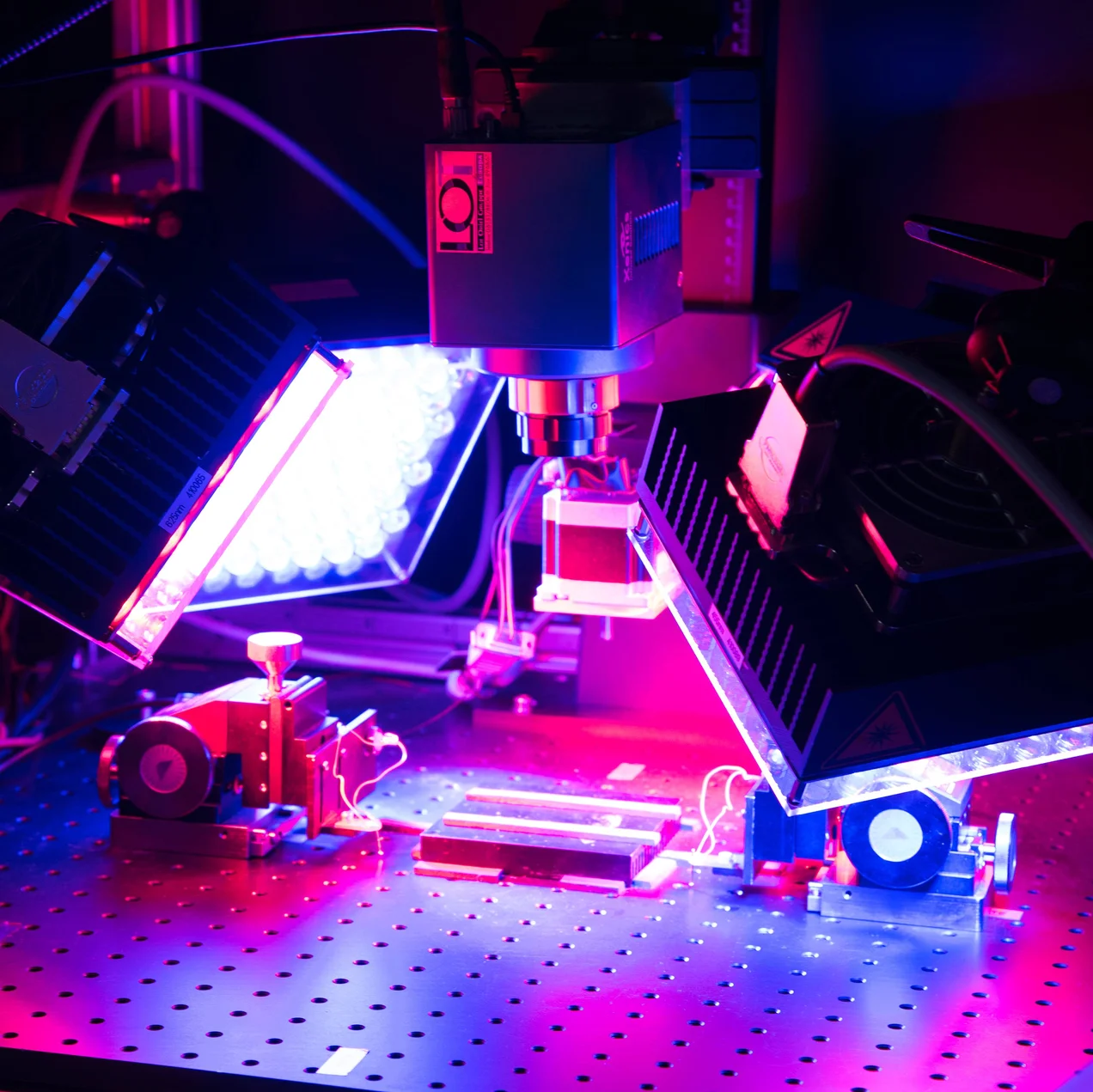

Photovoltaics – the direct conversion of solar radiation into electrical energy – is a key component of the future energy supply worldwide. Applications range from garden lights and parking meters to solar home systems in Africa, solar panels on rooftops and gigawatt-scale solar power stations. Solar researchers at Ulm University of Technology are focused on the quality assurance of solar cells, solar modules and photovoltaic systems.
Research topics include the characterization of solar cells and solar modules, ageing tests on cells, modules and systems, the further development of technical operation management and the grid integration of solar inverters and battery systems. Extensive models for computer-aided simulation and analysis of the behavior of solar cells through to grid integration are also available for this purpose. Extensive laboratory equipment with Class AAA flasher, electroluminescence and infrared cameras and climate chambers is available for the research work. Technical operation management systems and mobile measuring equipment for field measurements to analyze faults in solar systems are also available. The integration of solar power into the distribution grid is researched in the THU's Smart Grids Laboratory.
Project manager: Prof. Dr. Hubert Mantz
Project duration: 01.05.2024 - 30.04.2026
Funded by: Federal Government - BMWK
Programme name: Energie2020
Project description:
The aim of indu-bottomCIGS is to characterize and optimize thin-film tandem solar cells (perovskite CIGS). With such tandem cells, the focus is on efficiencies above 30 %.
In its sub-project, THU will research and optimize the long-term stability of these solar cells and focus on the topics of metastability, high-temperature stability and PID. To date, these degradation mechanisms have been insufficiently investigated in tandem solar cells. Due to modified processes and material compositions for tandem solar cells, these mechanisms must be investigated in great detail in order to ensure long-term stability.
Project manager: Prof. Dr.-Ing. Thomas Walter
Project duration: 01.08.2018 - 31.07.2022
Funded by: Federal Government - BMWi
Programme name: Energy 2020
Project description:
In optiCIGSII (successor project optiCIGS), CIGS thin-film solar cells are characterized and optimized. In addition to the breakthrough behavior of these diodes, the influence of PDT (post deposition treatment) on the efficiency and homogeneity of modules is being investigated and modeled in this project. Ulm University of Applied Sciences is responsible for modeling and simulation.
Project manager: Prof. Gerd Heilscher
Project duration: 01.07.2019 - 30.11.2022
Funded by: Federal Government - BMWi
Programme name: Photovoltaic Power System Technology Collaboration Programme
Project description:
The "Photovoltaic Power Systems Technology Collaboration Programme (PVPS)" is a platform within the International Energy Agency (IEA) for improving international research and development cooperation in the field of harnessing photovoltaic energy and its integration into electrical grids. Seven international project groups (known as tasks) are currently working within the PVPS on various key topics.
Task 14 "Solar PV in the 100% RES Power System" deals with issues relating to the integration of large amounts of photovoltaics into the electrical energy supply. Task 14 was founded in 2010 and currently comprises 17 participating countries, represented by national experts. The aim of Task 14 is to promote the international exchange of research and industry in the field of grid integration of photovoltaics, to identify proven methods for the grid integration of photovoltaics and thus to focus the respective national research and development more efficiently on key issues.
The "Photovoltaic Power Systems Technology Collaboration Programme (PVPS)" is a platform within the International Energy Agency (IEA) for improving international research and development cooperation in the field of harnessing photovoltaic energy and integrating it into electrical grids. Seven international project groups (known as tasks) are currently working within the PVPS on various key topics.
Task 14 "Solar PV in the 100% RES Power System" deals with issues relating to the integration of large amounts of photovoltaics into the electrical energy supply. Task 14 was founded in 2010 and currently comprises 17 participating countries, represented by national experts. The aim of Task 14 is to promote the international exchange of research and industry in the field of grid integration of photovoltaics, to identify proven methods for the grid integration of photovoltaics and thus to focus the respective national research and development more efficiently on key issues.
Project manager: Prof. Gerd Heilscher, Fraunhofer Center for Silicon Photovoltaics CSP
Project duration: 01.04.2019 - 31.03.2021
Funded by: Federal Government - BMWi
Program name: WIPANO
Project description:
The accumulation of dust and other impurities on the surfaces of photovoltaic modules or solar thermal mirrors can lead to significant yield losses. Accordingly, the glass surfaces are usually cleaned, even on a daily basis in particularly affected areas. Regular cleaning results in high mechanical loads on the glass surfaces, which nowadays are usually provided with anti-reflective coatings. Damage to these coatings through cleaning leads to significant, irreversible yield losses, which pose major financial risks for system operators, investors and system manufacturers.
The aim of the project is to develop a standard with which the surfaces of solar energy systems can be tested for their resistance to real cleaning loads in Europe and desert regions. In addition, the method should also be able to evaluate the damage potential of user-specific cleaning parameters and materials. Such a test method and correspondingly designed test device do not yet exist.
To support the standard, existing cleaning resistance tests of other application examples and open-field cleaning tests in Europe and desert regions are carried out on glass coatings typical of the market. Based on the results of the laboratory and outdoor tests, the requirements for realistic cleaning tests will be defined and a practicable test procedure and suitable test equipment will be developed. These will be optimized as part of the project and verified by comparing degradation rates and microscopic damage patterns with the open-field tests. As part of the project, a DIN SPEC will be created in English and used as the basis for the creation of an international ISO/IEC standard.
Project manager: Prof. Dr.-Ing. Thomas Walter
Project duration: 01.07.2016 - 30.06.2019
Funded by: Federal Government - BMWi
Programme name: Energy 2020
Project description:
In proCIGS, the reliability of CIGS thin-film solar cells is being investigated and optimized. The focus is on PID (potential induced degradation). Endurance runs are carried out, parameter drifts are analyzed and models are created/simulated.
Project manager: Prof. Dr.-Ing. Thomas Walter
Project duration: 01.09.2014 - 28.02.2018
Project description:
In optiCIGS, CIGS thin-film solar cells are optimized with a focus on luminescence characterization and simulation. Ulm University of Applied Sciences is responsible for transient photoluminescence.
Project manager: Prof. Dr. Malte Groß
Project duration: 01.01.2017 - 31.12.2018
Funded by: Federal Government - BMWi
Program name: ZIM
Project description:
The aim of the project is to develop an innovative solar home system (SHS) with intelligent load management. An SHS is a solar stand-alone system for supplying a household or building that is not connected to a power grid. It consists of a photovoltaic module, a storage battery, a central control unit and consumers such as lamps or household appliances.
Grid technologies, end devices and load management are developed for this purpose. Depending on the energy supply, load management switches off devices with high power requirements that are not absolutely necessary or reduces their output. In addition to load control hardware and an energy management concept, a communication system must be developed between the SHS control unit and the consumers.
Project manager: Prof. Gerd Heilscher, M.Sc.
Project duration: 01.12.2013 - 30.11.2017
Project description:
The NATHAN-PV project aims to develop a planning process for the grid expansion of distribution grids with large proportions of decentralized PV systems. For this purpose, analysis data from a roof potential analysis and the irradiation information from the ENDORSE research project of the 7th European Research Framework Program are used as a basis. This data can be used to calculate the shading caused by neighboring buildings, trees or roof structures on the buildings in the area under investigation. These shading values, together with the characteristics of the installed PV systems provided by the local Ulm/Neu-Ulm public utility company (SWU) and the local weather data from the university's own weather station and the German Weather Service, are input variables for calculating the electrical power output. With the help of the grid structure and recorded weather data or weather statistics data, the voltage and load flow parameters as well as the effect of feed-in management can be determined in the grid simulation. The project results support forward-looking grid planning and efficient operation of distribution grids with a high proportion of solar power systems.
Project manager: Prof. Dr.-Ing. Thomas Walter
Project duration: 01.11.2012 - 31.03.2016
Project description:
In RECISII, the reliability of CIGS thin-film solar cells is being investigated and optimized. The focus is on PID (potential induced degradation). Endurance runs are carried out, parameter drifts are analyzed and models are created / simulated
Project manager: Prof. Gerd Heilscher, M.Sc.
Project duration: 01.07.2015 - 30.09.2016
Project description:
The PlusEnergy Project House Ulm for sustainable energy use combines technologies available today, including photovoltaics, battery storage, pellet and heat pump heating and ventilation with heat and moisture recovery. The aim is to sustainably increase self-consumption and thus reduce energy costs, while at the same time reducing the impact on the power grid and thus also the need for expansion.
Vidal Lorbada, Ricardo; Walter, Thomas; Fuertes Marrón, David; Muecke, Dennis; Lavrenko, Tetiana; Salomon, Oliver; Schaeffler, Raymund:
Phototransistor Behavior in CIGS Solar Cells and the Effect of the Back Contact Barrier,
in: Energies 2020, 13(18), (ed.), MDPI, 2020, pages 18.
DOI: doi.org/10.3390/en13184753, ISSN: 1996-1073 (eISSN)
Mücke, D.; Vidal Lorbada, R.; Walter, T.; Schäffler, R.:
Effects of PDT on the Low Temperature Behavior of CIGS Thin-Film Solar Cells,
in: Proc. EU PVSEC 2020, EU (ed.), 2020, pages 3.
DOI: 10.4229/EUPVSEC20202020-3CO.8.4, ISSN: 3-936338-73-6
Salomon Oliver; Hempel, Wolfram; Kiowski, Oliver; Lotter, Erwin; Witte, Wolfram; Ferati, Artan; Schneikart, Anja; Kaune, Gunar; Schäffler, Raymund; Becker, Maximilian; Schröppel, Birgit; Vidal Lorbada, Ricardo; Mücke, Dennis; Walter, Thomas:
Influence of Molybdenum Back Contact on the PID Effect for Cu(In,Ga)Se2 Solar Cells,
in: Coatings 2019, 9, 794, MDPI, 2019, pages 13.
DOI: 10.3390/coatings9120794
Vidal Lorbada, Ricardo; Lavrenko, Tetiana; Muecke, Dennis; Walter, Thomas:
Comparison of accelerated ageing and metastabilities between CIGS based solar cells and thin-film modules,
in: Proc. of the EU PVSEC 2019, Marseille, 2019, pages 4.
Muecke, Dennis; Vidal Lorbada, Ricardo; Walter, Thomas:
Influence of doping density on the back contact of CU(IN,GA)SE2 solar cells,
in: Proc. of the EUPVSEC 2019, Marseille, 2019, pages 3.
Vidal Lobarda, Ricardo; Walter, Thomas; Marrón, David Fuertes; Lavrenko, Tetiana; Muecke, Dennis:
ADeep Insight into the Electronic Properties of CIGS Modules with Monolithic Interconnects Based on 2D Simulations with TCAD,
in: Coatings 2019, 9(2), 128, MDPI, 2019, pages 10.
doi.org/10.3390/coatings9020128