
From its beginnings as an engineering school to its current status as a modern university of applied sciences: the history of Ulm University of Applied Sciences (THU) is characterised by innovation, a practical focus and continuous development.
| Year | |
|---|---|
| 1960 | The Ulm State School of Engineering (SISU) begins operations at the Sägefeld School in Wiblingen with its first four degree programs: Mechanical Engineering (Design), Mechanical Engineering (Manufacturing), Telecommunications Engineering, and Precision Engineering. |
| 1963 | SISU moves into its new building on Prittwitzstraße. The first graduates leave SISU. |
| 1965 | The program offerings are expanded to include a degree program in Steel and Lightweight Construction. The Institute of Nuclear Engineering is completed. |
| 1970 | SISU introduces new degree programs: Production Engineering and Technical Computer Science. |
| 1972 | SISU becomes Ulm University of Applied Sciences under the first University of Applied Sciences Act of the State of Baden-Württemberg. It is subordinate to the Ministry of Science, has elected bodies for self-administration and student representation, and enjoys freedom in research and teaching. The university’s academic offerings were further expanded between 1977 and 2006, including the following programs: Automotive Engineering (1977), Industrial Electronics (1977), Medical Technology (1988), Automation Engineering (1988—established at the Geislingen branch, which was closed in 1999 as part of a reorganization), Energy Engineering (1990—established at the new Böfingen location, Eberhardt-Finck-Straße campus), Industrial Engineering (1995—the first educational alliance with the newly founded Neu-Ulm University of Applied Sciences, established by state treaty), Medical Documentation and Informatics (1997), Digital Media (1999), Business Informatics (2000—in collaboration with the Neu-Ulm University of Applied Sciences), Automotive Electronics (2003), Industrial Engineering and Logistics (2004) |
| 1989 | The Institutes for Innovation and Transfer (IIT) for Automation Systems and Medical Technology (now the Institute for Applied Research, IAF) as well as the Ulm Technical Academy (TAU) as a continuing education institution are founded |
| 1991–1994 | Support units strengthen management and service capabilities: the Office of International Affairs to intensify international relations and the Regional Science Center (RWZ) for science communication and business contacts. The Coordination Office for Scientific Continuing Education is added as another administrative unit. |
| 1998 | Ulm University of Applied Sciences inaugurates its new building on the Oberer Eselsberg (Albert-Einstein-Allee Campus). |
| 2000 | Ulm University of Applied Sciences introduces a new form of dual degree programs in collaboration with the Chamber of Industry and Commerce (IHK) and the vocational school: the cooperative degree programs based on the Ulm Model. |
| 2001 | The members of the newly established University Council are appointed. |
| 2002 | The RWZ becomes part of Corporate Communications and Marketing. The first master’s programs, such as Sustainable Energy Competence, are introduced. |
| 2003 | Ulm University of Applied Sciences adopts a mission statement. FHU Alumni-Netz e.V. is founded. |
| 2004 | IAF Automation Systems and IAF Medical Technology are merged into a single Institute for Applied Research. The responsibilities of the former RWZ are transferred to the newly established Office of the Vice President for Research and Transfer. New master’s programs, such as Medical Technology, expand the portfolio of the Ulm University of Applied Sciences. |
| 2006 | Under the new State Higher Education Act, the Ulm University of Applied Sciences becomes a so-called University of Applied Sciences. It is renamed “Ulm University of Applied Sciences – Technology, Computer Science, and Media.” Starting in the winter semester, the program offerings are fully transitioned to the tiered Bachelor’s and Master’s degrees. |
| 2007 | All degree programs are accredited by the ASIIN and ACQUIN agencies. |
| 2008 | The new educational partnership with Biberach University of Applied Sciences offers the joint degree program in Energy Systems. A Graduate School is established to market the master’s program and provide support for master’s students. |
| 2010 | The university celebrates its 50th anniversary. |
| 2017 | The university launches a comprehensive strategic planning process involving all university groups. |
| 2018 | The university’s continuing education programs are transferred to a joint institution with the University of Ulm, the School of Advanced Professional Studies (SAPS). The University of Ulm and Ulm University of Applied Sciences establish a joint center for energy research and technology. |
| 2019 | Effective March 1, 2019, the university is renamed Ulm University of Applied Sciences, becoming the first and, to date, only university of applied sciences in Baden-Württemberg. |
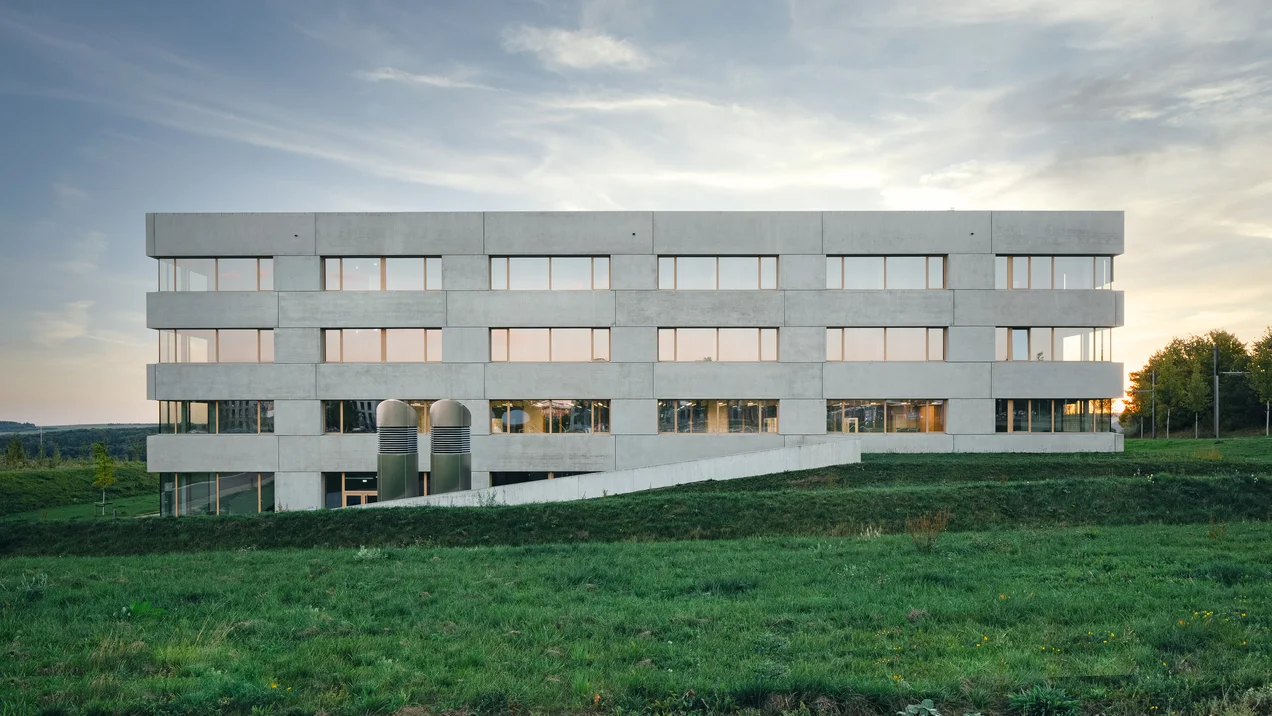
| 2021 | Inauguration of the new building on the Albert-Einstein-Allee campus, constructed according to the “Energy-Efficient House Plus Standard”; consolidation into two campuses. |
| 2022 | Founding of the Doctoral Association of Universities of Applied Sciences in Baden-Württemberg; some THU professors are granted the right to award doctoral degrees |
| 2023 | Launch of the 2024–2028 strategic process—establishment of the vision “We Rethink Solutions” |
| 2023/24 | Redesign of the degree program portfolio—including the new field of study in Health Sciences (B.Sc. in Physical Therapy) |
| 2024 | First doctoral candidates admitted to the THU’s Doctoral Center under the university’s new authority to grant doctoral degrees |
| 2025 | Endowed professorship in “Artificial Intelligence in Production” established in partnership with the Chamber of Industry and Commerce (IHK) and regional donor companies |
| 2025 | New SAP-based campus management system introduced |
| 2025 | TTWWDI (“Tech’s the way we do it”) campaign launched as part of student marketing efforts |
| 2026 | THU2Cloud – the university’s entire IT infrastructure migrates to the cloud |