
We are an interdisciplinary team of researchers and research assistants dedicated to supporting the complex treatment and management of Restless Legs Syndrome (RLS). In the iTAS-PLMS project, we are developing a therapy assistant for RLS over an expected period of three years until 2028, which is intended to improve treatment management, promote more self-directed management of the condition and, ultimately, advance research into RLS.
Due to the high complexity of the condition, treatment requires a comprehensive, holistic dataset that best reflects the patient’s condition. It is difficult for patients to provide a retrospective account of their condition, and such accounts can be distorted by many factors. Therefore, it should be possible to assess the condition directly. Instead of relying on snapshots taken in a sleep lab, as in
, symptoms should also be able to be recorded at home, ideally on consecutive nights and over a longer period (2–3 weeks).
We aim to address these challenges by developing an assistant that enables a well-founded and objective assessment of symptoms. This will allow patients to better assess their condition themselves. The effects of new therapeutic approaches and treatment by healthcare professionals can be more precisely tailored to individual needs.
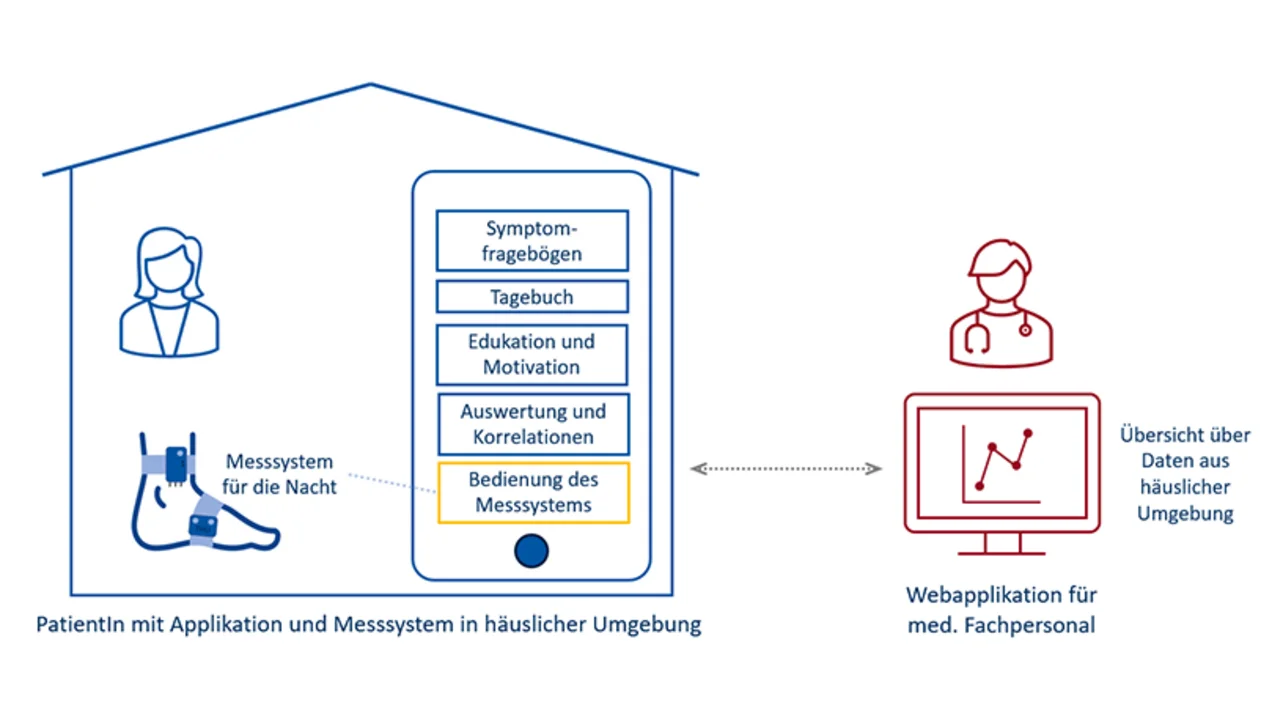
The sensor is worn at night, while the user is sleeping.
Motion sensor: This measures and records the movements typical of RLS in the relevant limb (usually the leg or foot).
Heart rate sensor: This measures the heart rate to identify the sleep phase, if applicable, or to determine whether the person is awake or asleep.
The mobile app is designed to allow users to independently record their own perception of symptoms. It is also intended to capture parameters that we cannot measure directly, such as eating habits, medication use, physical activity, or perceived stress levels.
Using machine learning algorithms, the data from the mobile app can be correlated with the measured leg movements.
Patients can share their data with their healthcare providers. This gives healthcare professionals insight into the data entered in the mobile app as well as the nighttime movements measured by the sensors, presented in a clear and organized format. This allows healthcare professionals to better tailor both medication and other therapeutic measures to the patient.
In addition, healthcare professionals should be able to communicate changes to the therapy to our therapy assistant so that these can be taken into account by the system. Medical professionals should also be able to reject non-pharmacological therapy approaches suggested by the assistant if these are proposed based on factors unknown to the assistant and are therefore not effective.
Patients themselves also gain important insights into their condition and possible connections to their diet, daily routines, or other habits through their data. By analyzing the data independently, patients can better understand the effects of their condition and thus assess necessary doctor visits or positive lifestyle factors on their own.