
In the field of driver assistance systems and automated driving, the Ulm University of Technology has secured and is carrying out various publicly funded research projects. These collaborative projects are characterised by partnerships with leading German technology groups, regional SMEs and research institutions. Several collaborative PhDs have already been successfully completed as part of these research projects. In addition, a research group at Ulm University of Applied Sciences was awarded the City of Ulm Science Prize for its work in the field of radar sensor technology for driver assistance systems.
In 2015, the Center for Applied Research at Universities (ZAFH) MikroSens was established at the THU by the MWK-BW. In collaboration with other university partners and the University of Ulm, radar sensor technology is being developed for various fields of application (including intelligent mobility) and transferred in particular to SMEs, which are involved via an industry advisory board. In the context of this ZAFH, further research projects were acquired, enabling the laboratory infrastructure at the THU in the field of sensor technology for driver assistance systems to be significantly developed and expanded (terahertz sensor technology).
Surround-view and camera-monitor systems are being investigated for camera-based driver assistance systems. Camera monitor systems make it possible to replace the legally prescribed conventional vehicle mirrors with digital camera systems in accordance with ISO 16505 and UN R.46. THU's activities include architecture design, measurement technology and the circuit design required for signal processing. The transfer of knowledge also includes participation in the work of international standardization committees in this field.
The "Handbook of Camera Monitor Systems", in collaboration with authors from leading international technology groups and research institutions, is an example of the work carried out at THU.
Project manager: Prof. Dr. Hubert Mantz
Project duration: 01.08.2024 - 31.07.2025
Funded by: Federal Government - BMBF
Program name: DATIpilot
Project description:
The research project aims to equip bicycles with mobile sensor technology (including acceleration, lidar and radar sensors) in order to record the road condition with spatial resolution and in real time. The aim is to identify, localize and document damage and obstacles in order to increase road safety and enable effective road maintenance. One of the ways we are implementing this is through an innovative citizen science approach that involves interested road users. Another scientific and technical project objective is to gather knowledge about suitable sensor technologies that can record, transmit and evaluate data in real time. This will form the basis for publications and presentations at conferences as well as for further research projects.
Project manager: Prof. Dr.-Ing. Thomas Walter, Prof. Michael Schlick
Project duration: 01.02.2022 - 31.12.2022
Funded by: Federal Government - BMBF
Program name: University competition for the Science Year 2022 - In demand! Science in Dialogue (WiD)
Project description:
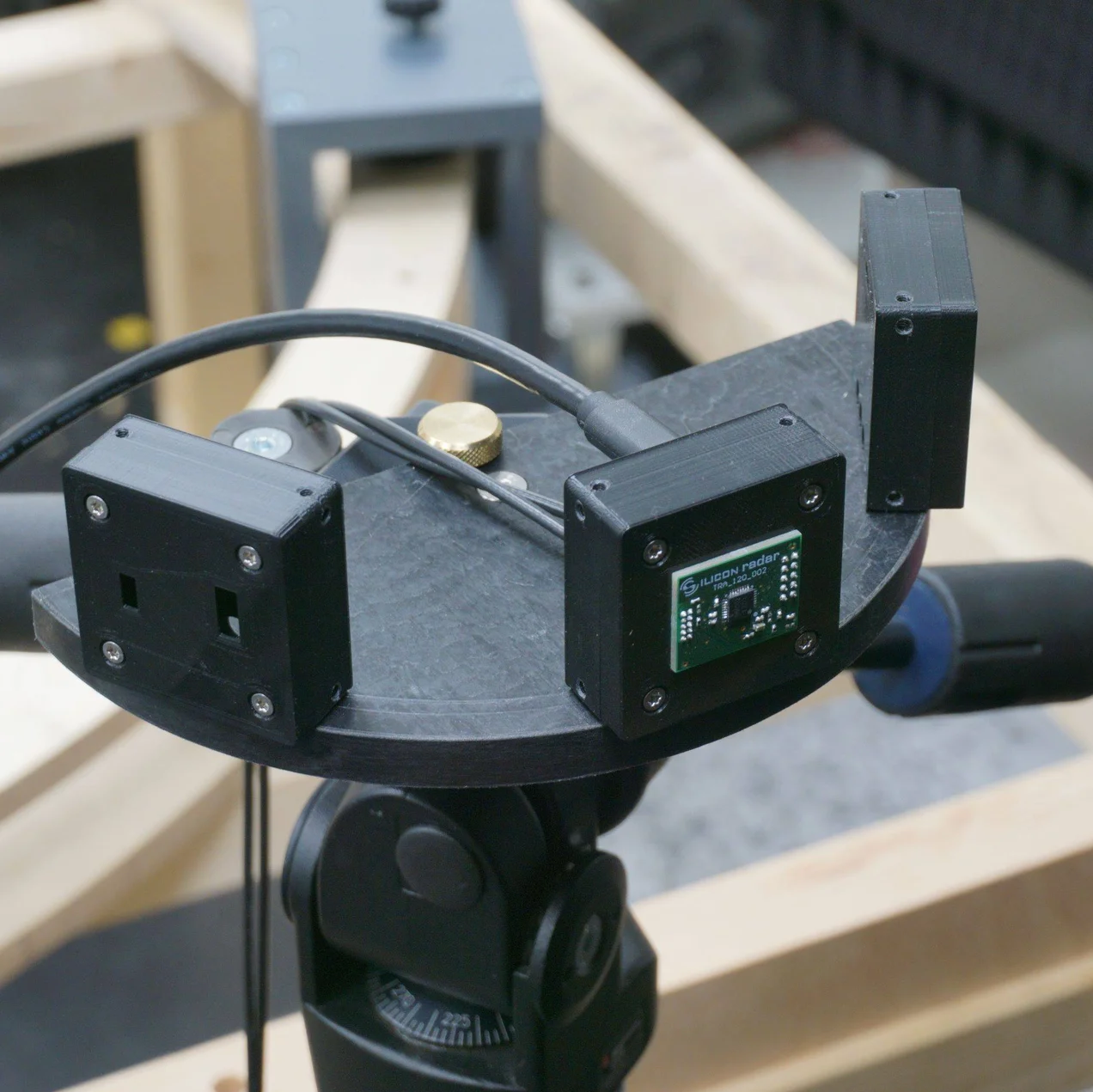
The aim of the project is to make cycling safer as a sustainable form of mobility in Ulm and to take interested citizens on a journey through the research cycle. A radar sensor is used, which citizens can attach to their bicycles. This measures both the distance and the speed of vehicles passing (often too closely). In this way, dangerous spots for cyclists in Ulm can be identified and documented with data.
Project manager: Prof. Dr.-Ing. Thomas Walter
Project duration: 01.01.2017-30.04.2020
Funded by: Federal Government - BMBF
Program name: Elevate
Project description:
KoRRunD is a sub-project of the BMBF Elevate cluster. The aim is to further develop radar-based driver assistance systems for automated driving. In particular, cooperative radar sensors are being developed and validated to enable all-round visibility around the vehicle. The task of Ulm University of Applied Sciences is to develop and validate a target simulator for complex targets with which the classification capability of radar sensor technology can be evaluated.
Project manager: Prof. Dr. Hubert Mantz
Project duration: 01.07.2017 - 30.06.2019
Funded by: Federal Government - BMBF
Program name: Funding of an ideas competition to establish and expand innovative R&D networks with partners in countries bordering the Danube
Project description:
The project aims to develop, implement and test various driver assistance systems for bicycles (for passenger and freight transport). For example, the use of radar sensors to detect other road users is conceivable; distinguishing between trucks, cars and other bicycles, for example, is crucial here. The radar sensors can also detect road conditions and thus distinguish dry from wet or slippery surfaces. In an ageing society (which will increasingly be riding electric bikes in the future), this can lead to a significant increase in safety in combination with other sensors. Furthermore, innovative drive and energy concepts for cargo bikes are to be designed and implemented in a study in cooperation with universities and companies along the Danube. In accordance with the know-how, experience and synergies of the network partners designated to date, the scientific research and application projects will be assigned to the areas of need of intelligent mobility and sustainable business and energy of the German government's high-tech strategy. The aim of the first phase is to network German scientists and companies with partners from Serbia and Hungary. In the second phase, a joint research proposal will be developed. With InBiDAS, a network of universities and SMEs from countries along the Danube is to be established for the joint development of an EU application or similar measures.
Project leader: Prof. Dr.-Thomas Walter, Prof. Dr. rer. nat. Hubert Mantz
Project duration: 01.01.2019 - 31.12.2020
Funding provider: State - MWK / EFRE
Program name: Centers for Applied Research at Universities (ZAFH)
Project description:
ZAFH MikroSens is a joint project led by Ulm University of Applied Sciences with the partners Heilbronn University of Applied Sciences, Pforzheim University of Applied Sciences and Ulm University, which has been funded by both the State of Baden-Württemberg (MWK) and the EU (EFRE) since the end of 2015.
The network has set itself the goal of transferring radar sensor technology from the automotive sector to industrial applications. For example, sensors have been and are being developed at THU that can safeguard the environment of robots in the field of automation technology or classify the surface quality of roads. With the entry into terahertz sensor technology (frequency range greater than 100 GHz), a significant miniaturization of the sensors and thus also of the systems was achieved.
In addition to automation technology, other fields of application such as agriculture, environmental sensors, media sensors and medical technology were also addressed in MikroSens. An image film was created for the project, which reflects the diversity of applications for radar sensors (YouTube link). One focus of the joint project is the cooperation with medium-sized companies. In the context of MikroSens, collaborations have been initiated with more than 20 companies from Baden-Württemberg.
In addition to terahertz sensor technology, other innovative technologies are being used in the MikroSens joint project. For example, an FPGA-based backend was developed at Pforzheim University, which enables fast range Doppler maps and real-time processing using high-resolution chirp sequence modulation. At Heilbronn University of Applied Sciences, radar signal processing with neural networks (CNN) was implemented to classify the boiling process in order to prevent milk from boiling over. The University of Ulm has developed dielectric waveguides that not only conduct electromagnetic waves, but can also radiate (and receive) them in a directed manner through vaporized antenna elements. With this concept, robot arms can be wrapped around to quickly detect a potentially dangerous approach by humans.
A special highlight was a THU exhibit at the BUGA 2019 in Heilbronn. Radar-based gesture recognition was used to conduct the Württemberg Chamber Orchestra Heilbronn (including the European anthem from Beethoven's 9th Symphony). The video created for this purpose and the music played at the same tempo as the visitors conducted. However, the orchestra paid attention to quality: anyone who conducted irregularly was first given a polite warning. In the event of repetition, the orchestra stood up and left the stage (with appropriate remarks and gestures). The exhibit was tested by more than 10,000 visitors at the BUGA.
Project manager: Prof. Dr.-Ing. Thomas Walter
Project duration: 01.07.2010 - 30.06.2014
Project description:
In RADAMES, radar concepts and the associated signal processing for driver assistance systems are being developed. The focus here is on MIMO concepts.
Mehrke, Jannik; Terzis, Anestis; Bringmann, Oliver:
The Effect of Image Coding on CMS Image Quality Parameters Using Embedded Video Coding of an MPSoC FPGA,
in: Tagungsband der MPC-Gruppe Ausgabe: 64/65, MPC-Gruppe, 2024, Seiten 7 (37-43).
ISSN: 1868-9221
Mehrke, Jannik; Volk, Georg; Stumpp, Yannik; Bringmann, Oliver; Terzis, Anestis:
Impacts of Image Compression on the Detection Quality of a Novel Real-Time Image Processing Platform,
in: IEEE 26th International Conference on Intelligent Transportation Systems (ITSC), IEEE, 2024, pages 8.
DOI: 10.1109/ITSC57777.2023.10421873
ISBN: 979-8-3503-9947-9
ISSN: 2153-0017
Terzis, Anestis (ed.); Schubert, Endric; Güthoff, Mathias:
Programmable processing for the autonomous / connected vehicle : From classical FPGA to adaptable computing Algorithms. Architecture. Realization.Test.,
in: 4th Workshop Programmable Processing for the Autonomus / Connected Vehicle, 24.09.2020, Ulm, Technische Hochschule Ulm. OPARU, 2022, pages 118.
ISBN: 978-3-9820843-2-9
Hoffmann, Philipp; Terzis, Anestis; Bauer, Günter:
Camera Monitor Systems as aReplacement for Outside Rearview Mirrors,
in: ATZ - Automobiltechnische Zeitschrift 123, 2021, Springer Fachmedien Wiesbaden GmbH, Springer, 2021, pages 42-47.
DOI: 10.1007/s35148-021-0732-0
ISSN: 2192-8800
Hoffmann, Philipp; Terzis, Anestis; Bauer, Günter:
Camera Monitor Systems as a Replacement for Outside Rearview Mirrors,
in: ATZ worldwide 123, 2021, Springer Fachmedien Wiesbaden GmbH, Springer, 2021, pages 42-47.
DOI: 10.1007/s38311-021-0698-2
ISSN: 2192-9076
Lavrenko, Tetiana; Ahmed, Ayman; Prokopenko, Vladimir; Walter, Thomas; Mantz, Hubert:
Real-time detection and classification for a 360°-camera using a YOLO algorithm,
in: Tagungsband Virtueller ASIM Workshop 2021 Simulation Technischer Systeme / Grundlagen und Methoden in Modellbildung und Simulation & Edukation und Simulation, Prof. Dr.-Ing. Umut Durak, ARGESIM Publisher, Vienna, 2021, 2021, pages 6.
DOI: 10.11128/arep.45
ISBN: 978-3-901608-69-8
Maier, Marcel; Buntz, Stefan; Schmidt, Lothar; Terzis, Anestis:
CAN FD Signal Manipulation Circuit based on FPGA,
in: Proceedings Issue 60 Workshop of the Multiproject Chip Group BW, 2019, pages 51-56.
ISSN: 1868-9221
Schmidt, Lothar:
Proceedings of the Workshop of the Multiproject Chip Group Baden-Württemberg,
in: Issue: 60, Workshop: Constance July 2018, Lothar Schmid, Ulm University of Applied Sciences (ed.), 2019, pages 1-56.
ISSN: 1868-9221
Terzis, Anestis:
Digital Camera Monitor Systems and Future Innovations in the Connected Car Scenario,
in: Tagungsband zum Ersten Innovationskongress Ulm | Neu-Ulm, von Schwerin, Marianne (ed.), 2019, pages 36-42.
ISBN: 978-3-9820843-0-5
Terzis, Anestis:
Programmable processing for the autonomous/connected vehicle - from classical FPGA to ACAP algorithms. Algorithms. Architecture. Realization. Test.,
in: Terzis, Anestis (ed.), 2019, pages 107.
ISBN: 978-3-9820843-1-2