

The Master’s programme in Systems Engineering and Management, specialising in Industrial Engineering, specifically prepares you for challenging roles in an increasingly complex technical world. You will learn to take a holistic approach to products and processes, identify customer requirements at an early stage, and efficiently plan, manage and optimise development and production systems. The Master’s programme combines engineering and business knowledge.
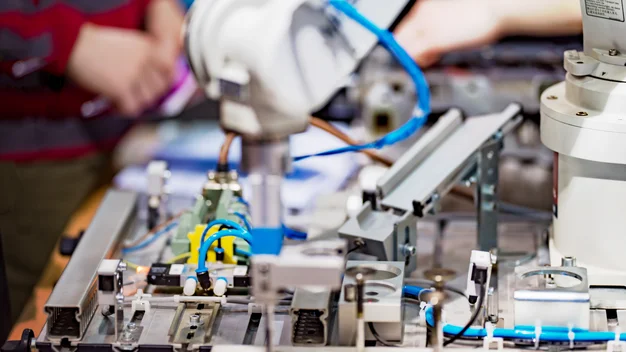
The focus of the Industrial Management Masters is on the simulation and design of production and logistics systems, supplemented by sound business knowledge in controlling, cost accounting and management.
As products and processes in the field of technology are becoming increasingly complex, systems engineering is dedicated to the task of making them controllable and feasible. Thinking in systems is important here. The Master's degree course in Systems Engineering is designed to train you for these challenges and is offered in three subject-specific variants with different specializations.
The Industrial Management Master's degree lasts three semesters and is the result of a cooperation between several faculties at Ulm University of Applied Sciences with the aim of offering attractive further qualifications to graduates of engineering bachelor's degree courses who are aiming for a management position.
In the "Industrial Engineering" specialization, you will learn in-depth engineering skills in the planning, control and simulation of production and logistics systems. In addition, you will acquire business skills, particularly in the areas of controlling, cost accounting, management and leadership. The "Industrial Engineering" specialization (abbreviated SYP as it is offered by the Faculty of Production Engineering and Production Management) includes the following content.
The degree program includes courses that are divided into the three subject groups "Mathematical and Scientific Fundamentals", "Systems Engineering" and "Management". The compulsory part of the course contains five modules that must be completed by all students. In addition to these, four further elective modules are selected from an elective catalog, which belong to the three subject groups. There are no specifications for the combination of electives, so you can choose your focus in one subject group or across several.
In addition to the courses, the degree course also includes a project that takes place during the first two semesters. The degree program concludes with a Master's thesis.
For the Master's degree program in Systems Engineering and Management with a focus on Industrial Engineering, you must have a university degree or a comparable degree with at least 210 ECTS credits. Alternatively, you can also apply with a university degree with 180 ECTS points and acquire the missing ECTS points during the Master's program through modules from the THU Bachelor's program. In addition, extensive knowledge in the fields of production technology, production organization and mechanical engineering amounting to at least 60 ECTS points is required. In addition, you will have basic knowledge in the fields of business administration, management and law amounting to at least 20 ECTS credits.
After successfully completing the Industrial Engineering Master's degree, you will be awarded the academic degree of Master of Engineering. The Master's degree program in Systems Engineering and Management - Focus on Industrial Engineering opens up a wide range of fields of activity with management functions in important industries. As a graduate, you can work in production technology, electrical engineering and information technology, mechanical engineering or the automotive industry, among others. In addition to directly preparing you for demanding specialist and management tasks, the Master's degree also qualifies you for the higher civil service and opens up the possibility of a doctorate. The relevant sectors are already characterized by a high level of innovation. This creates attractive long-term employment and development opportunities, particularly in the areas of development and project planning.