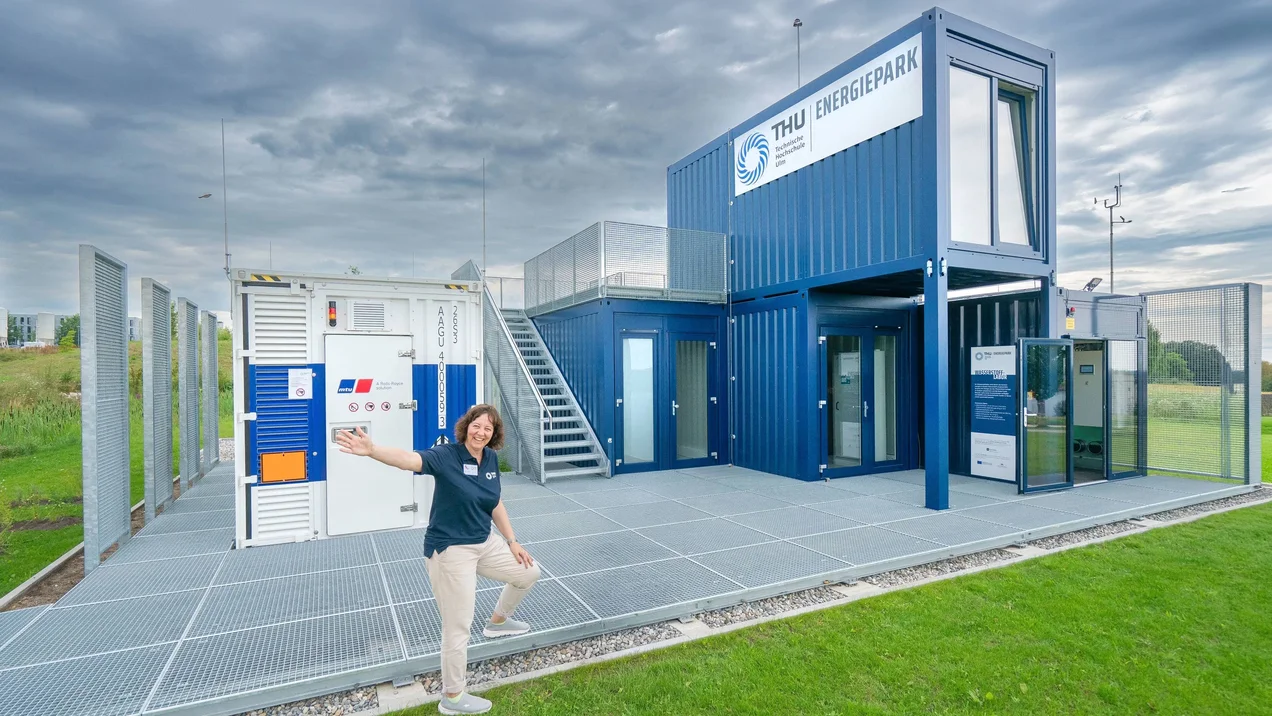

Using renewable energy flexibly to ensure sustainable electricity generation – that is the aim of the research being carried out at the Energy Park at Ulm University of Technology. The THU Energy Park covers the entire spectrum of distributed energy systems, from generation via photovoltaics, through storage using battery storage or in the form of hydrogen, to distribution to direct consumers such as electric cars or local electricity grids.
Energy that is generated and stored in a simple and resource-efficient manner, and can therefore be accessed regardless of weather conditions or grid utilisation: this is the key to the success of the energy transition. The THU Energy Park aims to demonstrate how this can be achieved through the interplay of various methods for generating, storing and distributing renewable energy.
The lithium-ion-based electrochemical energy storage system stores renewable energy from the THU's photovoltaic system. The battery helps regulate the power supply in the electric vehicle charging station: When more electricity is generated than is used, the battery stores the surplus; when more is consumed, it supplies energy. The battery also helps to balance out voltage fluctuations in the distribution grid and can supply the campus with power in an emergency, for example during disruptions caused by severe weather. The storage system has a capacity of 388 kWh.
With 24 charging points, the E-Charging Park allows for the charging of fully electric or hybrid vehicles. The energy for this comes primarily from the solar panels on the university’s roof or the carports. If solar power is not available, the E-Charging Park can also be supplied with stored solar power from the battery storage system or the hydrogen-powered gas turbine at the THU Energy Park. Each charging point has a maximum capacity of 22 kW AC.
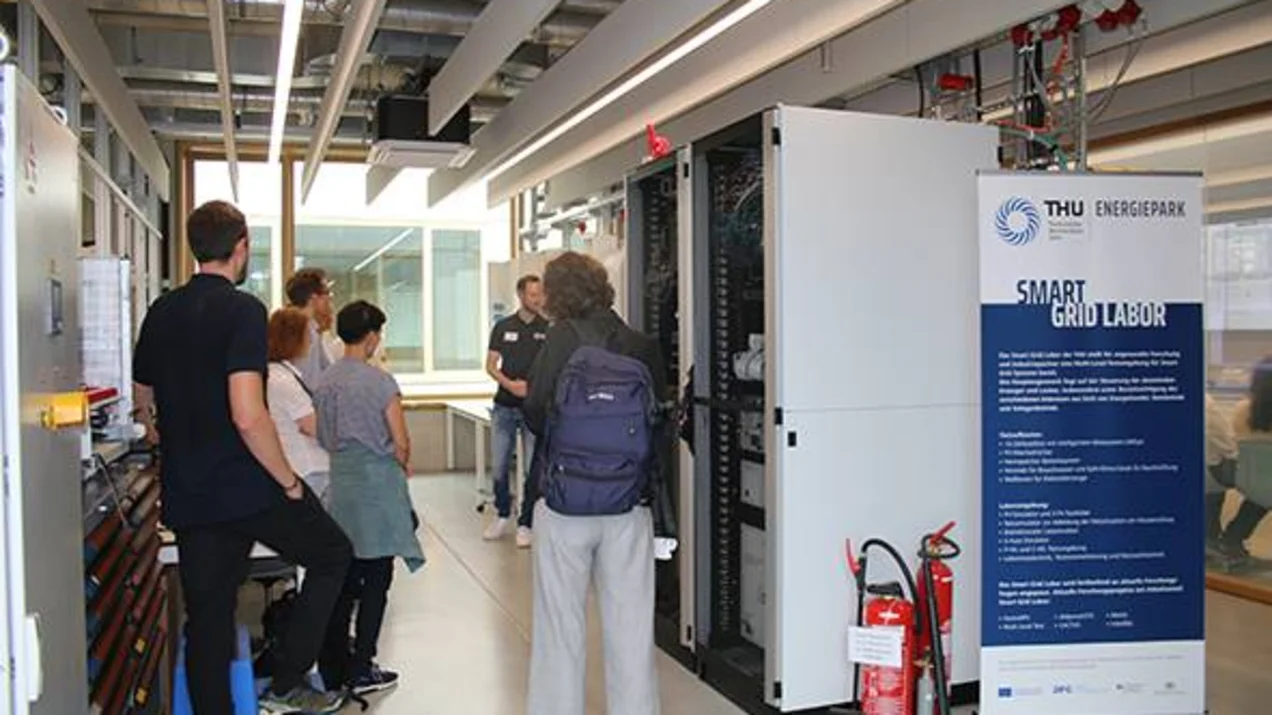
The Smart Grid Laboratory in the new THU building provides a multi-level testing environment for smart grid systems for applied research and industry partners. The primary focus is on controlling decentralized generators and loads, particularly taking into account the various interests from the perspectives of energy trading, grid operation, and plant operation. To this end, the lab is equipped with various types of meters, inverters, heating and cooling units, charging wall boxes, and simulators for different grid environments.
The first gas turbine in Germany to operate on 100% hydrogen during normal operation has an electrical output of 100 kW and a thermal output of 200 kW. The hydrogen is produced on-site using an electrolyzer powered by photovoltaic electricity and stored temporarily. When electricity is needed, the turbine can drive a generator by burning hydrogen.
In the hydrogen laboratory, electricity generated from solar energy is converted into green hydrogen. This allows the energy from the photovoltaic system to be stored in gaseous form and, when needed (for example, when solar energy is not available), converted back into electricity using a fuel cell. The lab is equipped with, among other things, an electrolyzer, a PEM fuel cell, a hydrogen compressor, and a hydrogen storage tank.
The weather station located south of the research containers measures temperature, relative humidity, precipitation, and sunshine duration. A special anemometer mast can even determine wind speed at higher altitudes by taking parallel measurements. The researchers are using this data to investigate how weather phenomena affect the use of renewable energy.
The following projects are involved in the development and operation of the THU Energy Park:
H2-Wandel
The H2-Wandel project is driving the development of a “Green Hydrogen” model region in the Mittlere-Alb-Donau region. To this end, various demonstration projects for hydrogen production, storage, and transport are being launched. THU is involved in two key areas: first, the H2-togo flagship project, which focuses on the use of green hydrogen in mobility; and second, the H2-Grid flagship project, which investigates the grid-friendly operation of decentralized electrolysis plants. As part of the H2-Grid project, a 20 kW electrolysis plant with an 8 kW fuel cell and a storage system with a capacity of 16 kg of hydrogen was installed at the IEE. Research is now being conducted on this system to investigate the application of the technology, the interaction of the various components, and issues related to the system’s efficiency.
In collaboration with other partners, the goal is to develop optimized operational management through cross-sector, forecast-based demand management for regional hydrogen logistics. At THU, the work will also focus on integrating the electrolysis plant into the existing “Efficiency House Plus.” The project is funded by the State of Baden-Württemberg and the EU through the European Regional Development Fund (ERDF) program.
H2Wandel Project Website
“Development of large-scale options for the use of green hydrogen based on the grid booster concept to increase grid stability” (HydrogREenBoost)
THU’s partners in the HydrogREenBoost project consortium are the Karlsruhe Institute of Technology, TransNet BW, and the Center for Solar Energy. And Hydrogen Research Baden-Württemberg. The project is funded by the State of Baden-Württemberg through the “Baden-Württemberg Hydrogen Future Program.”
E-Flex Campus THU
The E-Charging Park and battery storage facility were constructed as part of the E-Flex CAMPUS THU project, funded by the INPUT2 initiative of the State of Baden-Württemberg’s Environmental Research program.
Various projects with EU, federal, and state funding at the Smart Grid Lab
The Smart Grid Lab is continuously adapted to current research questions. Current research projects involving the Smart Grid Lab include: CACTUS, eMpowerSYS, InterBDL, MeGA, Multi Level Test, and SerendiPV. The listed research projects are funded by the EU, the federal government (DFG, BMWK), and the state of Baden-Württemberg.
H2-Flex - Flexible Interoperable Hydrogen Logistics
The project is researching a practical, decentralized concept for the storage, distribution, and use of decentralized green hydrogen for sector coupling. The starting point is the need for decentralized hydrogen production and utilization across all sectors, including in rural regions not accessible via central supply routes. Interoperability is crucial—that is, the integration of different production, storage, and consumption concepts with varying technical parameters. The project’s innovation lies in researching practical methods through which this interoperability can be implemented among the participating stakeholders. The project is aligned with the Hydrogen Roadmap of the State of Baden-Württemberg, the National Hydrogen Strategy, and the European Green Deal. It strengthens the research expertise of the participating universities, intensifies knowledge transfer to regional and supraregional stakeholders in the business sector, and integrates the research findings into teaching.
Duration: October 1, 2023 – September 30, 2027; Project partners: Reutlingen University, Esslingen University of Applied Sciences, Ulm University of Applied Sciences
Initial findings from Ulm University of Applied Sciences have been published in two peer-reviewed articles:
This project is funded as part of the Program for Applied Sustainability Research at Universities of Applied Sciences in Baden-Württemberg (PAN HAW BW) with funds from the European Regional Development Fund (ERDF) and the State of Baden-Württemberg.