New research project on the intelligent management of solar peak loads
​The new research project FLEXSolar-BW (Flexible Export Limits for Solar Peaks in Baden-Württemberg) was launched at the THU in December 2025. The project will run until July 2027 and is funded by the Ministry for the Environment, Climate and Energy of the State of Baden-Württemberg. The aim is to test, for the first time under conditions in Baden-Württemberg, a method already successfully used in South Australia to control solar peaks and thus make better use of solar power. The focus is on so-called ‘flexible export limits’. This involves the intelligent control of the feed-in of solar power from domestic rooftop systems into the electricity grid. Instead of reducing the output of solar systems across the board or temporarily disconnecting them from the grid altogether, the feed-in is flexibly adjusted to the current situation in the electricity grid.
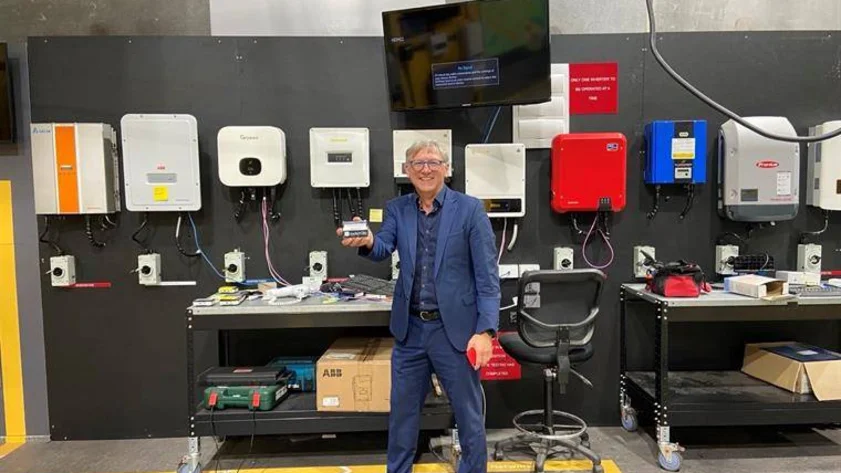
Prof. Heilscher at the Network Innovation Center in Adelaide

From Australia to Baden-Württemberg


An alternative to zero feed-in and fixed limits


The Solar Peak Act has been in force in Germany for a year, imposing a fixed feed-in limit of 60 per cent for new solar power systems, provided that active control is not possible. Consequently, new photovoltaic systems must be controllable or will only be able to feed electricity into the grid to a limited extent. Furthermore, some grid operators in certain grid areas are currently only permitted, for a limited period, to allow zero feed-in from new photovoltaic systems, as too many generation sources are already connected to the electricity supply grid and grid expansion is still ongoing. ‘Flexible export limits’ offer a practical alternative here: the actual feed-in is continuously measured and can be specifically controlled. This allows existing grids to be utilised more effectively without the need for immediate expansion.
This solution is an exemplary implementation of the flexible grid connection agreements provided for in the Renewable Energy Sources Act (Section 8a EEG 2023) and is regarded internationally, particularly in Australia, as a pioneer in modern feed-in management for domestic rooftop systems.
 

What the project is researching


As part of the FLEXSolar-BW project, a technical platform based on international standards is being developed at the THU. It will be integrated into German control technology, for example via smart meter gateways and specialised CLS control boxes. Interfaces to the control systems of distribution system operators are also being created.

The new solutions are being tested both in the laboratory and in real-world operations, in collaboration with households and various inverter manufacturers. The research is examining the technical, economic and legal benefits arising from ‘flexible export limits’. The results are intended to be incorporated into national regulations, standards and legislative developments at a later stage, thereby helping to reduce costs for consumers and grid operators and, in the long term, reducing the need for expensive grid expansion investments.  

Key partners in the FLEXSolar-BW project are distribution system operators, who will benefit from the flexible feed-in limits. The team has already secured Stadtwerke Ulm/Neu-Ulm Netze GmbH, as well as the companies advalju, VIVAVIS, PSI and SunSpec Allianz, as project partners. Other distribution system operators in Baden-Württemberg are invited to contact the University of Applied Sciences if they are interested in participating in the project.

“With FLEXSolar-BW, we are demonstrating that solar peaks do not generally need to be curtailed. Instead of rigid limits, we are focusing on smart solutions that have proven their worth in everyday life – as in Australia. This benefits both residents with solar installations and the electricity grids as a whole,” says project leader Professor Gerd Heilscher, summarising the advantages of the new research project.

Baden-Württemberg’s Minister for Energy, Thekla Walker, emphasises: “As a centre of research, Baden-Württemberg is actively seeking innovative solutions to ensure the efficient utilisation of our energy infrastructure. The ‘FLEXSolar-BW’ research project at Ulm University of Applied Sciences shows us that solar power from rooftops does not need to be subject to blanket limits. Feed-in can be flexibly adapted to the current situation in the electricity grid. This will enable us to press ahead with the expansion of PV and prepare ourselves for moving away from fossil fuel imports.” 

Strong research environment at Ulm University of Applied Sciences


FLEXSolar-BW is led by the Smart Grid Research Group at the Institute of Energy Technology and Energy Economics (IEE) at Ulm University of Technology. This is where the university concentrates its research into sustainable energy systems. Around 15 professors and more than 40 research staff work together here in an interdisciplinary manner.

The Smart Grid Laboratory and the THU Energy Park play a special role. This unique combination of laboratory and practical environments makes it possible not only to develop new solutions in theory, but also to test them directly in real-world operation – for example, in the interaction between solar installations, battery storage systems, electric vehicles or heat pumps.

Through close international links, the THU brings tried-and-tested solutions from Australia to Baden-Württemberg, thereby strengthening the state’s position as a centre of innovation in the field of sustainable energy systems.

Von Australien nach Baden-Württemberg


Alternative zu Nulleinspeisung und festen Begrenzungen


Seit einem Jahr gilt in Deutschland das Solarspitzengesetz mit einer festen Begrenzung der Einspeisung auf 60 % bei neuen Solarstromanlagen, solange keine aktive Steuerung möglich ist. Somit müssen neue Photovoltaikanlagen steuerbar sein oder können ihren Strom nur noch eingeschränkt einspeisen. Darüber hinaus können einige Netzbetreiber in einzelnen Netzbereichen aktuell zeitlich befristet nur Nulleinspeisung von neuen Photovoltaikanlagen zulassen, da bereits zu viele Erzeugungslagen an das Elektrizitätsversorgungsnetz angeschlossen sind und der Netzausbau noch andauert. „Flexible Export Limits“ bieten hier eine praxisnahe Alternative: Die tatsächliche Einspeisung wird kontinuierlich gemessen und kann gezielt gesteuert werden. So können bestehende Netze besser genutzt werden, ohne sie sofort ausbauen zu müssen.
Diese Lösung ist eine beispielhafte Umsetzung der im Erneuerbare-Energien-Gesetz vorgesehenen flexiblen Netzanschlussvereinbarungen (§ 8a EEG 2023) und gilt international, insbesondere in Australien, als Vorreiter für ein modernes Einspeisemanagement für Hausdachanlagen.
 

Was im Projekt erforscht wird


Im Projekt FLEXSolar-BW wird an der THU eine technische Plattform aufgebaut, die auf internationalen Standards basiert. Sie wird in die deutsche Steuerungstechnik eingebunden, etwa über Smart Meter Gateways und spezielle CLS-Steuerboxen. Zudem werden Schnittstellen zu den Leitsystemen von Verteilnetzbetreibern geschaffen.

Die neuen Lösungen werden sowohl im Labor als auch im realen Betrieb, gemeinsam mit Haushalten und verschiedenen Herstellern von Wechselrichtern, getestet. Dabei wird untersucht, welche technischen, wirtschaftlichen und rechtlichen Vorteile sich durch „Flexible Export Limits“ ergeben. Die Ergebnisse sollen später in nationale Regeln, Normen und gesetzliche Weiterentwicklungen einfließen und somit zur Kostensenkung für Verbraucher und Netzbetreiber beitragen und langfristig den Bedarf an teuren Netzausbauinvestitionen reduzieren.  

Wesentliche Partner für das Projekt FLEXSolar-BW sind Verteilnetzbetreiber als Nutzer der flexiblen Begrenzung der Einspeisung. So konnte das Team bereits die Stadtwerke Ulm/Neu-Ulm Netze GmbH sowie die Unternehmen advalju, VIVAVIS, PSI und SunSpec Allianz als Projektpartner gewinnen. Weitere Verteilnetzbetreiber in Baden-Württemberg sind eingeladen, bei Interesse an einer Beteiligung am Projekt Kontakt mit der Technischen Hochschule aufzunehmen.

„Mit FLEXSolar-BW zeigen wir, dass Solarspitzen nicht generell abgeschnitten werden müssen. Statt starrer Begrenzungen setzen wir auf intelligente Lösungen, die sich im Alltag bewährt haben – wie in Australien. Davon profitieren sowohl Bürgerinnen und Bürger mit Solaranlagen als auch die Stromnetze insgesamt“, fasst Projektleiter Professor Gerd Heilscher die Vorteile des neuen Forschungsvorhabens zusammen.

Baden-Württembergs Energieministerin Thekla Walker betont: „Als Forschungsstandort Baden-Württemberg suchen wir aktiv nach innovativen Lösungen für eine effiziente Auslastung unserer Energieinfrastruktur. An dem Forschungsprojekt „FLEXSolar-BW“ der TH Ulm sehen wir, dass Solarstrom vom Hausdach nicht pauschal begrenzt werden muss. Die Einspeisung kann flexibel an die aktuelle Situation im Stromnetz angepasst werden. Damit können wir weiter auf Tempo drücken beim PV-Ausbau und uns fit machen für den Abschied von fossilen Energieimporten.“ 

Starke Forschungsumgebung an der THU


FLEXSolar-BW wird von der Smart Grid Forschungsgruppe am Institut für Energietechnik und Energiewirtschaft (IEE) der Technischen Hochschule Ulm geleitet. Dort bündelt die THU ihre Forschung zu nachhaltigen Energiesystemen. Rund 15 Professorinnen und Professoren sowie mehr als 40 wissenschaftliche Mitarbeitende arbeiten hier interdisziplinär zusammen.

Eine besondere Rolle spielen das Smart Grid Labor und der THU-Energiepark. Diese einzigartige Kombination aus Labor- und Praxisumgebung ermöglicht es, neue Lösungen nicht nur theoretisch zu entwickeln, sondern auch direkt im realen Betrieb zu testen – etwa im Zusammenspiel von Solaranlagen, Batteriespeichern, Elektrofahrzeugen oder Wärmepumpen.

Durch enge internationale Kontakte bringt die THU bewährte Lösungen aus Australien nach Baden-Württemberg und stärkt damit den Innovationsstandort des Landes im Bereich nachhaltiger Energiesysteme.