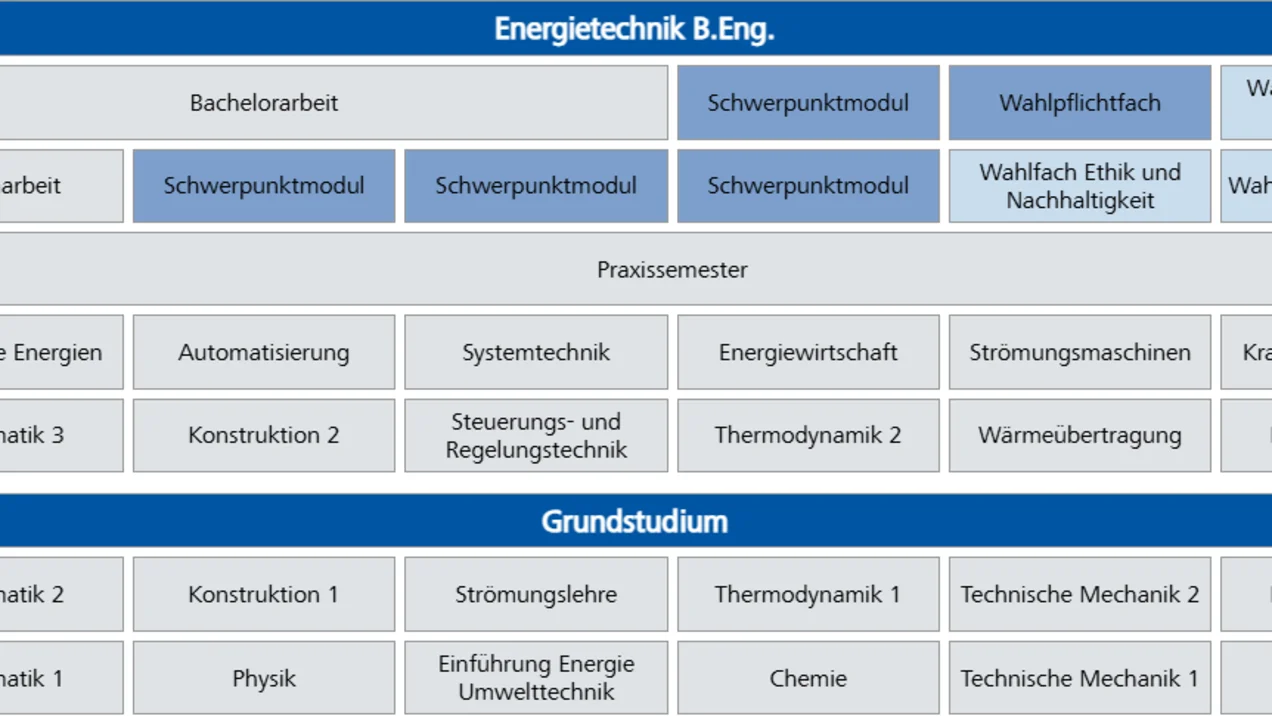

Mathematics is the foundation of all engineering disciplines, including energy engineering, food technology, and environmental engineering. Its applications are woven throughout the entire degree program.
In this course, you’ll start with algebra, calculus, and systems of linear equations before moving on to more complex topics such as differential equations, Fourier analysis, and statistics. This knowledge is essential for modeling technical processes, calculating fluid flow, or analyzing thermodynamic processes.
This module provides a thorough introduction to the fundamental principles of physics that are central to the study of energy engineering. It focuses on the areas of mechanics, oscillations, and electromagnetism. You will gain an in-depth understanding of the laws of classical physics, including the motion of objects, the forces acting on them, and the interactions between objects. This will help you understand how physical laws apply to renewable energy systems—from the motion of rotor blades in wind turbines to the conversion of sunlight into electricity. The module builds upon later courses such as Electrical Engineering, Fluid Mechanics, and Thermodynamics.
The course combines theoretical foundations with practical applications and mathematical models to prepare you for complex problems in the field of energy engineering and to help make energy production more sustainable and efficient.
How can a sustainable energy supply be designed? In this module, you will learn how to develop concepts for an efficient, economical, and environmentally friendly energy supply. You will analyze the life cycles of systems and evaluate sustainable concepts for energy use, for example, in buildings, transportation, or industry. This module is closely linked to the modules on Renewable Energy, Building Energy Technology, Investment Analysis and System Design, as well as the module on Energy Concepts for Buildings and Neighborhoods.
An important component of this module is the three-day seminar “Team-Oriented Learning and Working” (TLA), which takes place during the field trip week. In this seminar, you’ll get to know the other first-semester students better. Working in teams, you’ll explore key concepts in the areas of “communication,” “teamwork,” and “personality,” and together you’ll present a topic. In addition to gaining knowledge of soft skills, you’ll also develop your presentation and communication skills.
Chemical processes play an important role in energy technology—from energy storage in batteries to wastewater treatment. In this module, you will learn the fundamentals of general and inorganic chemistry. You’ll learn how chemical reactions occur, what substances are made of, and how these properties can be utilized in technical applications. Special emphasis is placed on the environmental sustainability of chemical processes, for example in the development of sustainable materials or the analysis of pollutants. This module prepares you for advanced topics such as materials science, hydrogen technology, batteries and accumulators, as well as fuels and their behavior.
Engineering Mechanics teaches you the fundamentals of the design and stability of engineering systems. You’ll learn how forces act on structures and how these structures must be designed to function safely and efficiently. In statics, for example, you’ll analyze the stability of wind turbines, while in dynamics, you’ll examine the motion of machines. These modules are closely linked to CAD and materials science, as well as fluids and flow. You’ll later apply this knowledge when planning energy systems such as hydroelectric power plants and wind farms, or when designing solar power systems.
This module provides fundamental knowledge of computer science specifically geared toward applications in energy engineering. Students learn how to use computer-aided tools and techniques to solve problems in energy engineering.
Contents:
Applications in Energy Engineering: Practical examples and case studies that illustrate the use of computer science solutions to address real-world challenges in energy engineering.
The application of computer science is particularly important in advanced modules such as smart grids, building automation, and the simulation of energy systems. This module also lays the foundation for subsequent courses in automation technology and energy data management.
Mathematics is the foundation of all engineering disciplines, including energy engineering, food technology, and environmental engineering. Its applications are woven throughout the entire degree program. You’ll start with algebra, calculus, and systems of linear equations before moving on to more complex topics such as differential equations, Fourier analysis, and statistics. This knowledge is essential for modeling technical processes, calculating fluid flow, or analyzing thermodynamic processes.
In this module, you will learn how to create technical drawings and models using CAD (computer-aided design) software. You will develop your own designs for components or food technology and learn how various materials are used in food production. There is a particular focus on selecting sustainable materials and assessing their suitability for applications such as solar systems, turbines, or heat exchangers. You will analyze how materials react under stress and what properties they need for use in food production systems. This module is closely integrated with the areas of technical mechanics and fluids and flow. Your knowledge of CAD and materials science will be applied in later projects, such as when planning food production facilities.
Fluid flow is everywhere: in wind turbines, hydroelectric power plants, and ventilation systems. In fluid mechanics, you’ll learn how liquids and gases flow through pipes or turbines and what forces are at work. This module shows you how wind flows can be optimally utilized to maximize the output of wind turbines. You’ll also learn how to design efficient piping systems in buildings and power plants. Theoretical knowledge is supplemented by hands-on simulations in which you model the flow of air or water.
This module provides the foundation for understanding energy and chemical processes in technical systems. You will learn how energy is stored and converted in chemical reactions, and you will examine the thermodynamic principles that are of crucial importance in energy engineering and environmental engineering. A key focus is on the laws of thermodynamics: You’ll learn how energy is transferred as heat and work within systems and how these processes can be optimized for efficiency. Topics such as enthalpy, entropy, and free energy will help you analyze chemical and physical processes.
In physical chemistry, you’ll delve into the molecular fundamentals and examine phase equilibria, chemical reactions, and the interactions between substances. You’ll learn how to calculate and balance the various forms of energy, how to define efficiency, and what conclusions can be drawn from these calculations. You’ll learn about and calculate quantities such as heat, cold, work, and power. This will enable you to develop and design technical systems for energy conversion: from heating systems, heat pumps, and refrigeration systems to internal combustion engines and even large power plants—all of which are based on the laws of thermodynamics.
Engineering Mechanics teaches the fundamentals of the design and stability of engineering systems. You’ll learn how forces act on structures and how these structures must be designed to function safely and efficiently. In statics, for example, you’ll analyze the stability of wind turbines, while in dynamics, you’ll examine the motion of machines. These modules are closely linked to CAD and materials science, as well as fluids and flow. You will later apply this knowledge when planning energy systems such as hydroelectric power plants or designing solar power systems.
The Electrical Engineering 1 module covers the fundamentals of electrical systems that are essential to energy engineering. You’ll learn how electrical voltage, current, and resistance are related and how they’re used in real-world systems such as power grids, machines, and energy storage systems. A central focus is on fundamental electrical laws, such as Ohm’s Law, Kirchhoff’s laws, and circuit analysis. You’ll learn how alternating current (AC) and direct current (DC) work and how they’re used in energy engineering. Through practical exercises, calculations, and lab work, you’ll understand how components such as transformers, capacitors, and inductors function in electrical systems. This module lays the foundation for advanced topics such as power electronics, automation technology, and electric drives. The knowledge gained in Electrical Engineering 1 is essential for later planning and analyzing complex energy systems such as wind turbines, smart grids, and battery storage systems.
The "Mathematics 3" module is an essential part of the Energy and Environmental Engineering program in the third semester. It offers the opportunity to take mathematical skills to a new level by focusing on the application of probability theory, statistics, numerical methods, linear optimization, and graph theory. These skills are crucial for data-driven decision-making and the computer-aided solution of complex technical problems. Through hands-on exercises and the use of software, students develop the ability to understand and apply mathematical algorithms, which optimally prepares them for the challenges in energy engineering and environmental engineering.
This module covers the fundamentals of control and regulation of technical systems—two indispensable disciplines for modern energy and environmental engineering. You will learn how to measure process variables and use them to monitor, control, and optimize processes in energy and environmental systems to ensure efficient and stable operation.
In control engineering, the focus is on developing control systems that operate according to defined rules. You will explore programmable logic controllers (PLCs), logic controllers, and their application in energy and environmental systems such as building automation, production and water treatment processes, and the control of smart grids.
Control engineering expands on this approach and deals with dynamic processes. You will learn how systems continuously respond to changes in order to maintain setpoints—for example, in temperature control in buildings, speed control of motors, or frequency and voltage control in power grids. Topics such as control loop analysis and system stability are central components. You will learn to select appropriate controllers and how to calculate their tuning parameters. This module is closely integrated with automation technology. You will apply the concepts you have learned in later projects and lab sessions, such as when optimizing heating systems, wind turbines, or power distribution systems.
In the Heat Transfer course, you will learn how thermal energy flows within systems and how these processes can be optimized. You will examine how heat is transported in buildings, power plants, and heat pumps. There is a particular focus on the sustainable use of heat, e.g., through waste heat recovery or the integration of solar thermal energy into building systems. This module is closely linked to thermodynamics and building energy systems.
In this advanced module, you will deepen your understanding of the physicochemical and thermodynamic principles covered in the first module. The focus is on more complex applications in energy engineering, such as the design and optimization of thermal power plants, heat pumps, and other energy-generating systems. Physical chemistry describes the thermophysical behavior of substances. This module focuses on mixtures of substances and chemical reactions. You will learn what vapor pressure is and how to calculate phase equilibria—which is particularly important in refrigeration and air conditioning technology as well as in heat recovery. You will examine heat generation in combustion processes and learn how to calculate energy conversions in batteries and fuel cells. This module is closely integrated with heat transfer, building energy engineering, and the energy engineering laboratory. It prepares you to solve complex technical challenges in a sustainable and efficient manner.
In the "Investment Analysis and Plant Design" module, you will learn how to design and optimize plants and evaluate the profitability of investments. The module focuses equally on economic and technical aspects.
In the area of investment analysis, you’ll explore fundamental methods such as the net present value method, the payback period calculation, and life-cycle cost analysis. These tools will help you assess the profitability of renewable energy systems, energy-efficient building systems, environmental technology systems, and food technology systems.
Plant design complements this knowledge by adding the technical dimension. You will learn how to size and optimize plants. Topics such as selecting suitable technologies, integrating renewable energy, and taking environmental and grid requirements into account are key aspects of this module.
The module is highly practice-oriented and closely linked to other modules such as Technology and Sustainability, Renewable Energy, Building Energy Technology, Energy Concepts for Buildings and Neighborhoods, as well as Business Administration and Business Law. You will apply your knowledge in practical, program-specific case studies in which you design, optimize, and evaluate the economic viability of systems in the fields of energy supply, environmental engineering, or food technology.
In Electrical Engineering 2, you’ll build on the fundamentals covered in Electrical Engineering 1 and deepen your knowledge of electrical systems and their applications in power engineering. You’ll explore more complex topics such as the analysis of alternating current circuits, the operation of three-phase systems, and power transmission in electrical grids. There is a particular focus on the use and control of electrical energy in energy systems. You will learn how transformers and generators work, how energy is transmitted in power grids, and how protective measures ensure the safety of electrical systems. In addition, you’ll explore the control of machines and the role of power electronics. Through practical exercises, lab work, and simulations, you’ll learn how to model and optimize electrical systems. This module is closely integrated with automation technology, electric drives, and power electronics. Your knowledge will later be indispensable for the design and control of wind turbines, solar power systems, or smart grids.
Renewable energy is at the heart of the energy transition. In this module, you’ll learn how solar, wind, and hydroelectric power plants work and how they generate electricity in an environmentally friendly way. You’ll learn about the challenges involved in integrating these sources into existing power grids and how storage systems help stabilize the energy supply. A key focus is on analyzing the efficiency and sustainability of the various technologies. You’ll also learn how renewable energy can be used in buildings and transportation systems. This module builds on foundational topics such as physics, thermodynamics, fluids and flow, heat transfer, and electrical engineering.
Automation technology is crucial for controlling modern energy and environmental systems. You will learn how sensors, control, and regulation systems are used to optimize processes such as the control of heating systems, solar power systems, wind power plants, water treatment plants, and environmental systems. A key focus is on the analysis of systems and their automation. This module builds on the fundamentals of electrical engineering, control systems, and computer science.
Sustainable, energy-efficient buildings are a key component of the energy transition. This module covers the fundamentals of building services engineering. The course content includes energy efficiency, thermal building physics, efficient heating and cooling systems, modern ventilation and air conditioning technology, smart building automation and digitalization, and the integration of renewable energy sources, including energy storage. You will learn to prepare energy balances for buildings, calculate and interpret key performance indicators, and take legal requirements into account. In summary, the module provides the fundamentals needed to develop innovative approaches for a sustainable, economical, and safe energy supply for buildings.
The module is highly practice-oriented. The topics mentioned are taught using concrete case studies. In the lecture, you will become familiar with relevant software tools. The module is also closely linked to other modules such as Heat Transfer, Renewable Energies, and the required elective Energy Concepts for Buildings and Neighborhoods.
In the energy technology lab, you can apply your theoretical knowledge in a practical setting. You’ll conduct experiments, for example, on the efficiency of solar cells, battery storage systems, electrolyzers, and hydrogen-powered gas turbines. The lab offers you the opportunity to gain hands-on experience with projects from other modules, such as Renewable Energy, Power Electronics, or Building Energy Technology. Here, you’ll gain valuable experience for your internship semester and your bachelor’s thesis.
The elective courses are designed to help students specialize as energy engineers. They must be selected from the catalog of modules listed below. This list is continuously expanded and updated to include current topics!
The "Electric Drives and Power Electronics" module covers the fundamentals of electric drives and power electronics. You will learn how motors and inverters work and how electrical energy can be efficiently used and converted. A key focus is on applications in energy and environmental technology, including wind energy, building automation, and applications in environmental systems and mobility. You’ll learn how these systems are designed and which components are suitable for them.
The internship semester offers you the opportunity to apply the knowledge you’ve gained in lectures and seminars in a practical setting. At a company or research institution, you’ll work on real-world energy engineering projects—from the planning and optimization of renewable energy systems to the development of sustainable energy concepts. Depending on your area of assignment, you might, for example:
The elective courses help shape the energy technician’s specialization. You must select courses from the catalog of modules listed below. This list is continuously expanded and updated to include current topics!
The elective courses are designed to help students specialize as energy engineers. They must be selected from the catalog of modules listed below. This list is continuously expanded and updated to include current topics!
The elective courses are designed to help students specialize as energy engineers. They must be selected from the catalog of modules listed below. This list is continuously expanded and updated to include current topics!
The elective courses are designed to help students specialize as energy engineers. They must be selected from the catalog of modules listed below. This list is continuously expanded and updated to include current topics!
You can choose this module from the full course offerings at Ulm University of Technology. The electives are also suitable for the recognition of courses taken during a study abroad period at another university ("Mobility Window").
Courses may be selected across disciplines from
.
The bachelor’s thesis is the academic highlight of your degree program. Here, you can focus on a topic that particularly interests you. In collaboration with a company, a research institution, or the university, you will address a research question drawn directly from real-world practice or current research. Possible topics might include:
You will work independently on your project, analyze data, develop concepts, and present your findings in a final presentation. The bachelor’s thesis is not only a demonstration of your expertise but also an excellent opportunity to showcase your skills and position yourself in the job market.
The elective courses are designed to help students specialize as energy engineers. They must be selected from the catalog of modules listed below. This list is continuously expanded and updated to include current topics!
The elective courses are designed to help students specialize as energy engineers. They must be selected from the catalog of modules listed below. This list is continuously expanded and updated to include current topics!
You can choose this module from the full range of courses offered by the Ulm University of Applied Sciences. The electives are also suitable for the recognition of courses taken during a study abroad program at another university ("Mobility Window").
Courses may be selected across disciplines from
.