


AI, energy and sustainable food production: Ulm University of Applied Sciences and the Central University of Technology launch a joint research project
Through this project, Ulm University of Applied Sciences (THU) and the Central University of Technology (CUT) are strengthening their joint research at the interface between artificial intelligence, energy engineering, food technology and digitalisation. At the same time, an international research and learning environment is being created in which students and researchers are working together on a key question for the future: how can industrial production processes be made more sustainable, energy-efficient and economically successful with the help of smart technologies?
In the joint project ‘AI-Enabled Digital Twin and Energy Optimisation for a Smart Sustainable Microbrewery: A South African-German Collaboration’, researchers from both universities are developing new approaches to intelligent, sustainable and energy-efficient food production. The project is funded as part of the South African-German research cooperation SAG-CORE/ZADE-AI by the Federal Ministry of Research, Technology and Space (BMFTR) and the National Research Foundation (NRF).
The focus is on developing an AI-supported digital twin of a microbrewery. This is intended to link real-time process data from production with information on energy consumption. Using smart sensor technology, continuous process monitoring, data analysis and artificial intelligence methods, operating conditions are modelled, analysed and optimised. The aim is to reduce energy and resource consumption, make processes more efficient and, at the same time, improve the quality and sustainability of production.
For the THU, the project offers a unique opportunity to bring together expertise from different disciplines. Food technology and energy engineering form two central pillars of the research work. Whilst food technology contributes knowledge of brewing processes, product quality, process control and resource-efficient food production, energy engineering provides the expertise for analysing and optimising energy flows, energy consumption and energy efficiency. These areas are complemented by expertise in artificial intelligence, automation, digitalisation and data analysis.
This creates a practice-oriented research environment that is also of particular importance to students at the THU. The project’s research questions can be directly linked to content from degree programmes and teaching, ranging from the modelling and simulation of technical processes, through the evaluation of measurement data, to the development and application of modern AI methods. This gives students the opportunity to work on a real-world industrial application and to experience first-hand the link between food production, energy supply and digital transformation.
International collaboration is also a key component of the project. Plans include researcher exchanges, joint scientific projects, international research visits and the involvement of early-career researchers. Through the transfer of knowledge between Germany and South Africa, the aim is to establish long-term research networks and develop new methods for sustainable industrial applications.
In addition to scientific development, the focus is particularly on translating research findings into practical applications. Together with companies and other users, the aim is to identify ways in which AI-based digital twins can be used in future to improve energy efficiency, resource utilisation and sustainability in the food and drink industry.
Furthermore, the project offers prospects for the development of new business models and a business case for AI-supported energy and process optimisation. In this way, the research collaboration combines scientific innovation with concrete economic and societal applications.
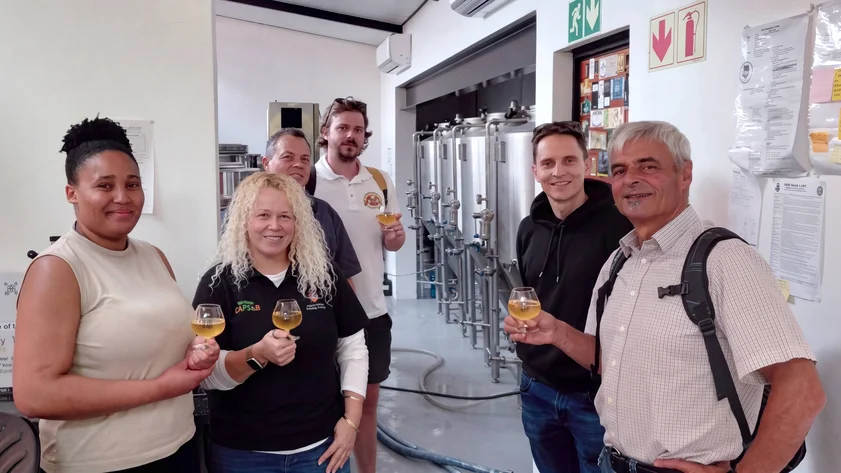
Photo, from left:
Farouscha Brouwers (CUTbrU CUT), Professor Olga de Smidt, Deputy Director of the Centre for Applied Food Sustainability and Biotechnology (CAFSaB CUT), Ruhan Jansen Van Nieuwenhuizen (Centre for Sustainable Smart Cities and Faculty of Engineering, Built Environment and Information Technology CSSC FEBIT CUT), Lukas Hienle (THU), Professor Nicolaas Luwes (CSSC FEBIT CUT) and Professor Walter Commerell (Institute for Energy Technology and Energy Economics).