
THU student develops intelligent prediction system for intensive care medicine
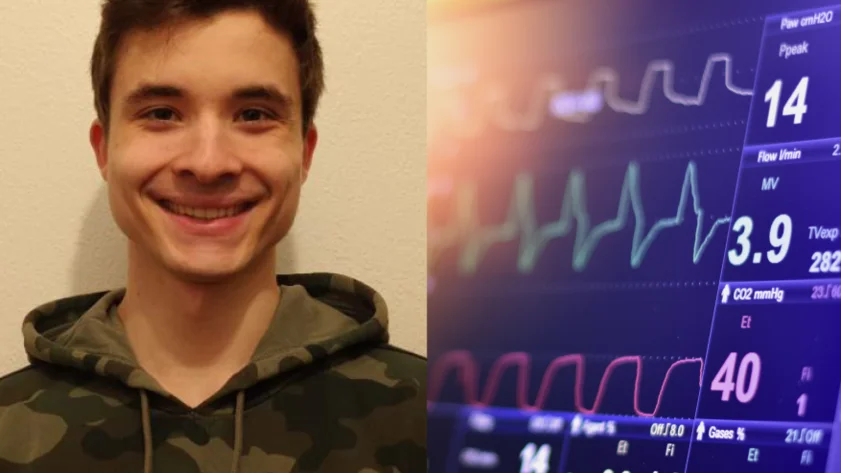
In his bachelor’s thesis, THU student Florian Hauptmann addressed a highly topical challenge: the question of whether patients need to be admitted to the intensive care unit following brain surgery.
Data science and artificial intelligence have the potential to fundamentally improve patient care in medicine. Florian Hauptmann demonstrated this impressively when, to complete his DSM degree at the THU, he carried out his bachelor’s thesis in the Department of Medical Image Processing at the German Cancer Research Centre (DKFZ) in Heidelberg. There, he worked on a highly topical issue in medical care and developed an intelligent prediction system designed to support decisions regarding the admission of patients to the intensive care unit following brain surgery.
The idea behind it: whilst clinical data has primarily been used for such prognoses to date, Hauptmann combined this with imaging techniques for the first time. The results show that the accuracy of the predictions can be significantly improved through this multimodal data fusion.
The practical benefits are clear: through the targeted use of intensive care, unnecessary hospital stays can be avoided, costs reduced and, at the same time, patient care optimised. The work thus makes an important contribution to the further development of efficient and patient-centred medicine.
At the graduation ceremony for THU graduates, Florian Hauptmann was awarded the Böhringer Prize for his outstanding achievement. The university extends its warmest congratulations on this special recognition.
Further information on the project can be found at https://doi.org/10.1007/978-3-658-47422-5_43.
By the way: From this semester onwards, the THU is offering a new degree programme in Medical Informatics – for anyone who would also like to conduct research at the interface between medicine and technology!