
THU Professor Dr Peter Renze to receive the 2026 Ulm Science Prize
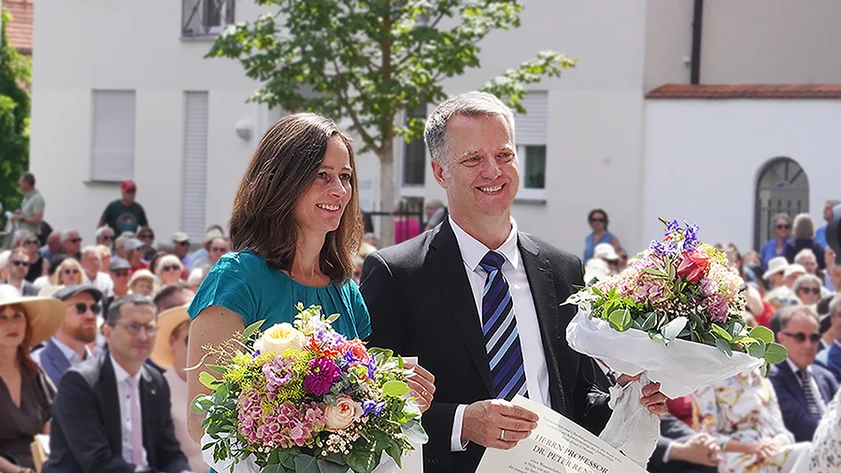
The City of Ulm has once again awarded its prestigious Science Prize this year. The prize, worth a total of 15,000 euros, recognises outstanding scientific achievements by individuals, research groups and working groups whose research has made a lasting contribution to scientific development at Ulm’s universities. Traditionally, the Science Prize is awarded every two years on Schwörmontag as part of the Ulm Schwörfeier celebrations. As in previous years, the prize was shared in 2026. Professor Dr Peter Renze of the Ulm University of Applied Sciences (THU) received one of the two Science Prizes, worth 7,500 euros. He was honoured for his outstanding achievements in the fields of renewable energy systems and energy management.
Professor Dr Renze has had a decisive influence on energy research at the THU over many years. His scientific work focuses on the development of sustainable energy systems and covers, in particular, the fields of renewable energy, energy storage and energy efficiency. A particular focus is on how hydrogen storage technologies can be better integrated into existing energy systems to make them more efficient and cost-effective. In doing so, he is making an important contribution to tackling the major challenges of the energy and climate transition.
As Head of the Institute of Energy Technology and Energy Economics at the THU, Professor Dr Renze is not only responsible for numerous publicly funded research projects, but also supervises a large number of PhD students and promotes close cooperation between academia, industry and public institutions. Furthermore, he was a driving force behind the establishment of the Centre for Energy Research and Technology (ZET) in Ulm, thereby laying an important foundation for interdisciplinary energy research in the region.
A visible result of his work is the THU Energy Park. During his time as head of the institute, a unique research and demonstration platform was established on the Eselsberg campus, which is used to test innovative and sustainable energy systems under real-world conditions. At the same time, the Energy Park brings the energy transition to life for the public, provides valuable impetus for research and development, and strengthens collaboration between academia, the public and the energy sector.
His work is a prime example of application-oriented research that combines scientific excellence with concrete solutions to the pressing climate and energy challenges of our time.
Professor Dr Renze expressed his gratitude: “I am delighted to receive this award and consider it a great honour. However, science is rarely the achievement of a single person. This prize also belongs to the many students, staff members, colleagues and our partners from industry and research with whom I have had the privilege of working over the past few years.”
Professor Birgit Esser from the University of Ulm was also awarded the City of Ulm Science Prize. Dr Esser conducts research into sustainable battery materials and is thus working on solutions to a key issue for the future, as electrochemical energy storage is a key technology for a successful energy transition. The chemist is investigating how such storage systems can be made more efficient, more resource-efficient and less dependent on scarce raw materials. She is also the Ulm-based spokesperson for the POLiS (Post Lithium Storage) Battery Cluster of Excellence, the successful continuation of which bears her distinctive mark to a considerable extent and raises Ulm’s profile as a centre for battery research in Germany and beyond.
As head of the Institute of Organic Chemistry II and New Materials, she uniquely combines expertise in synthetic chemistry with know-how in the field of organic battery electrode materials. With her holistic approach, Esser aims to bridge the gap between basic research into the latter and their practical application. As the founding director of the CELEST Green Energy Lab – which aims to establish a reference laboratory for electrochemical energy storage systems beyond lithium – Esser’s influence extends far beyond her own field, bringing together science, the promotion of early-career researchers and institutional development.